
Affiliate disclosure: This post may contain affiliate links. Please see full disclosure.
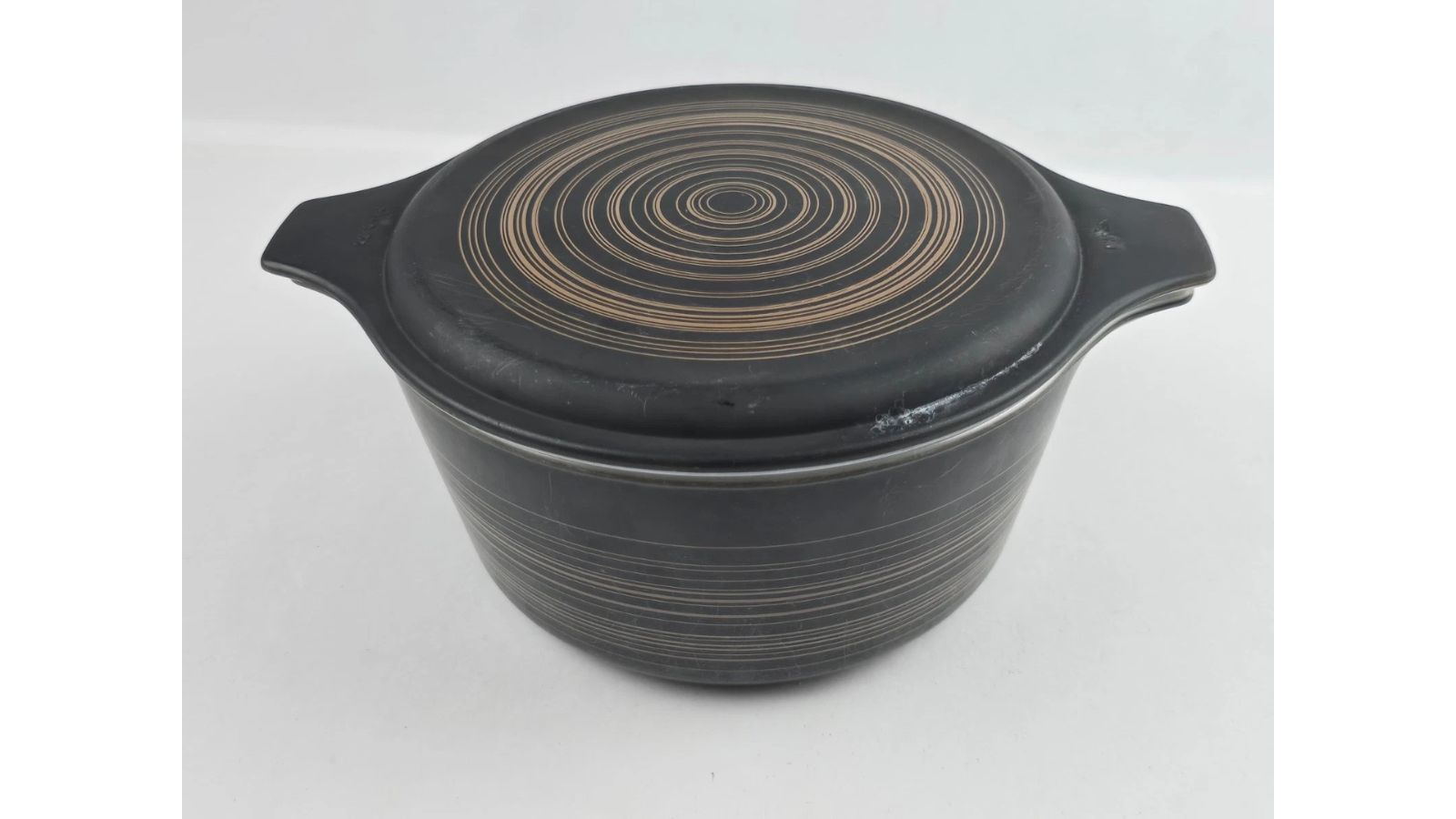
If most vintage Pyrex makes you think of bright flowers, cheerful turquoise, and neat little printed motifs, Terra is going to look slightly odd. In fact, that’s rather the point. Introduced in 1964, Terra was designed to mimic handmade earthenware, with a dark charcoal surface broken up by irregular brown rings. It looks earthy, rough, and almost hand-thrown, which is quite an achievement for a mass-produced glass bowl.
Designer William Curtis developed Terra after researching successful products outside the cookware world and noticing how heavily texture featured in their design. Corning then spent years working out how to reproduce that tactile, handmade look on Pyrex. The finished pattern was distinctive enough to earn Curtis an Industrial Designers Institute award, although making the stuff turned out to be considerably more complicated than designing it.
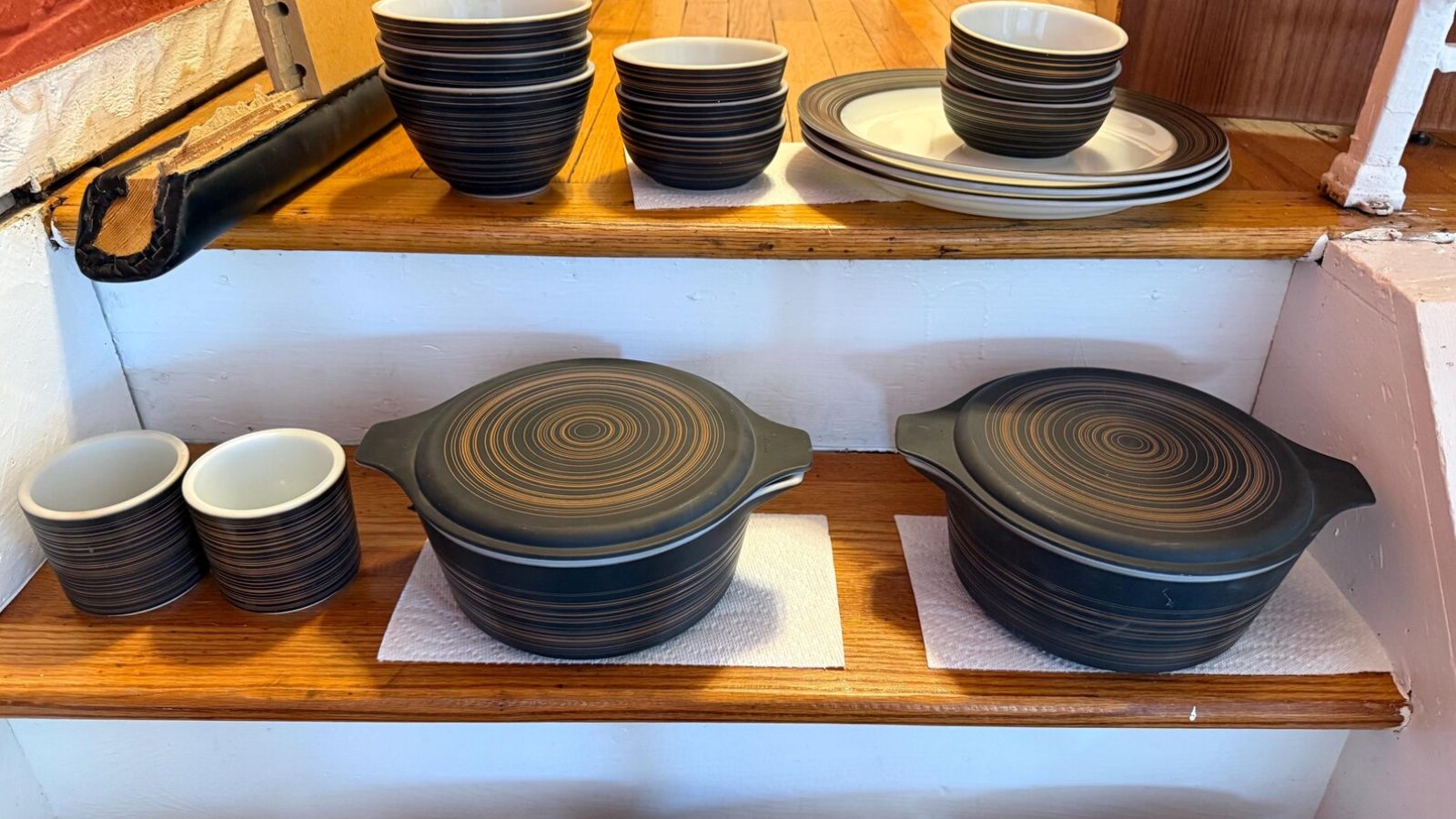
Terra arrived at exactly the right moment aesthetically. Natural materials, pottery, earth tones, and handmade-looking objects were creeping into fashionable homes, and the usual shiny white Pyrex covered with a neat printed flower didn’t quite fit that mood. Terra did. Original advertising leaned hard into its earthenware appearance, presenting it as something that could move comfortably from cooking to serving and look good doing both. It was also the first Pyrex pattern released across both ovenware and tableware, so you could coordinate your mixing bowls and casseroles with plates, small bowls, and mugs. Unfortunately for Terra, looking handmade required an awful lot of very un-handmade engineering.
That striped texture was surprisingly difficult to make
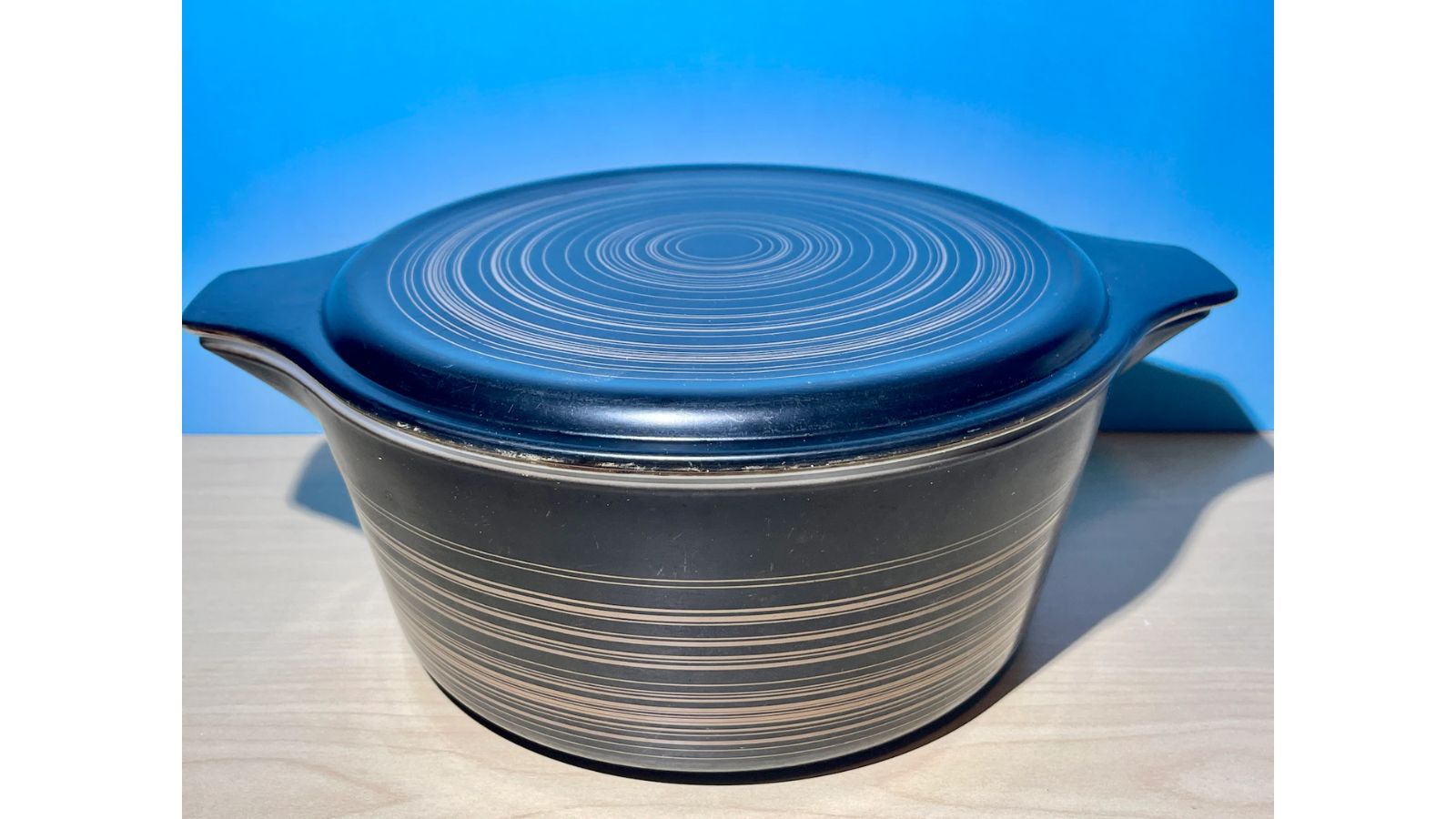
Terra’s uneven rings weren’t simply printed onto the surface like most Pyrex decoration. The manufacturing process was wonderfully overcomplicated. First, a brown base color was applied to the white opal glass and fired on. A charcoal-colored layer then went over the top. The piece was rotated through a specially developed machine that physically removed narrow bands of that darker coating, exposing the brown underneath and creating those irregular horizontal grooves.
The idea was to recreate the appearance of a pottery technique called graffito, and Corning actually trademarked “Graffito” before eventually deciding that Terra was the better name. The finished bowls have a matte, slightly rough surface that looks nothing like the glossy colorware most people associate with vintage Pyrex. If you’re rummaging around a thrift-store shelf, that texture is one of the easiest ways to pick Terra out. Look for charcoal-black or very dark brown glass with uneven rusty brown rings running horizontally around it.
The complicated process also dictated which shapes could carry the pattern. Because the scratching machinery needed to rotate the piece, Terra was largely confined to round forms. The collection included 400-series mixing bowls, round Cinderella casseroles, plates, small bowls, and handleless mugs. There are odd gaps in the lineup, too. The usual 402 mixing bowl and 473 casserole weren’t produced in Terra. A 1½-quart mixing bowl also appeared separately as a promotional piece. For such a short-lived pattern, there’s a surprisingly interesting little group to hunt down.
Terra’s award-winning design helped kill it after only about a year
There is a slight irony to Terra winning a design award, because the very thing that made it clever also made it commercially awkward. That specialist finishing process was expensive. Production costs were high, which pushed up the price consumers saw on store shelves. Corning had managed to make mass-produced Pyrex look like textured artisan pottery, but it wasn’t especially economical to do it. Terra disappeared after roughly a year on the market, with production records dating it to 1964 and 1965.
Its unusual finish brought another problem. The matte surface could scuff and dull through cleaning, handling, and simply being stacked against other dishes. More than 60 years later, that matters. Finding Terra at all is satisfying, but finding a piece where the charcoal finish still looks dark and even and the exposed brown rings remain crisp is particularly nice. It’s worth checking carefully for rubbed patches, scratches, and areas where decades of kitchen use have worn the finish smooth.
The short production period is a large part of why Terra feels so different from the familiar Pyrex patterns that stayed in kitchens for years. There simply wasn’t much time for households to accumulate it. And unlike one-off promotional dishes, Terra was intended to be a proper coordinated collection. You can find surviving Terra mixing bowls, casseroles, plates, mugs, and small bowls in museum collections, which gives collectors enough pieces to chase without making the pattern feel ordinary.
Personally, I think the weirdness is what makes it. Terra doesn’t immediately look like Pyrex. But once you know those dark, scratched-looking rings, it’s difficult to walk past them again.
You might also like…
The 1969 Pyrex Pattern Collectors Dream Of Finding At A Thrift Store
The Pyrex Pattern Made With Real 22-Karat Gold Collectors Dream Of Finding At A Thrift Store
The Blue-And-White Pyrex Pattern Collectors Dream Of Finding At A Thrift Store

