
Affiliate disclosure: This post may contain affiliate links. Please see full disclosure.
There are plenty of old mixing bowls sitting on thrift store shelves that are exactly what they look like: old mixing bowls. But if you spot a turquoise-and-white Pyrex bowl covered in tiny farmers, roosters, corn, and wheat, it’s worth slowing down for a closer look. You’ve probably found Butterprint, commonly called Amish Butterprint, one of the most recognizable vintage Pyrex patterns around.
That distinctive blue is actually turquoise, and Butterprint was made from 1957 through 1968. The design alternates between turquoise decoration on white Pyrex and white decoration on a turquoise background, depicting a wonderfully busy little farm scene with a farmer and his wife, roosters, crops, and tools. It is very 1950s, in the best possible way.
Butterprint also has an important place in Pyrex history. Along with Gooseberry, it was one of the first patterns used on the company’s new Cinderella nesting bowls, recognizable by their handles and pouring spouts. The pattern proved popular enough to appear on casseroles and refrigerator dishes as well. Standard turquoise Butterprint isn’t impossibly rare, so don’t assume every bowl is worth a small fortune. Still, it remains one of the vintage dishware patterns worth watching for at thrift stores, particularly when you find a clean piece or, even better, several matching pieces together.
How to recognize Butterprint Pyrex in a pile of old dishes
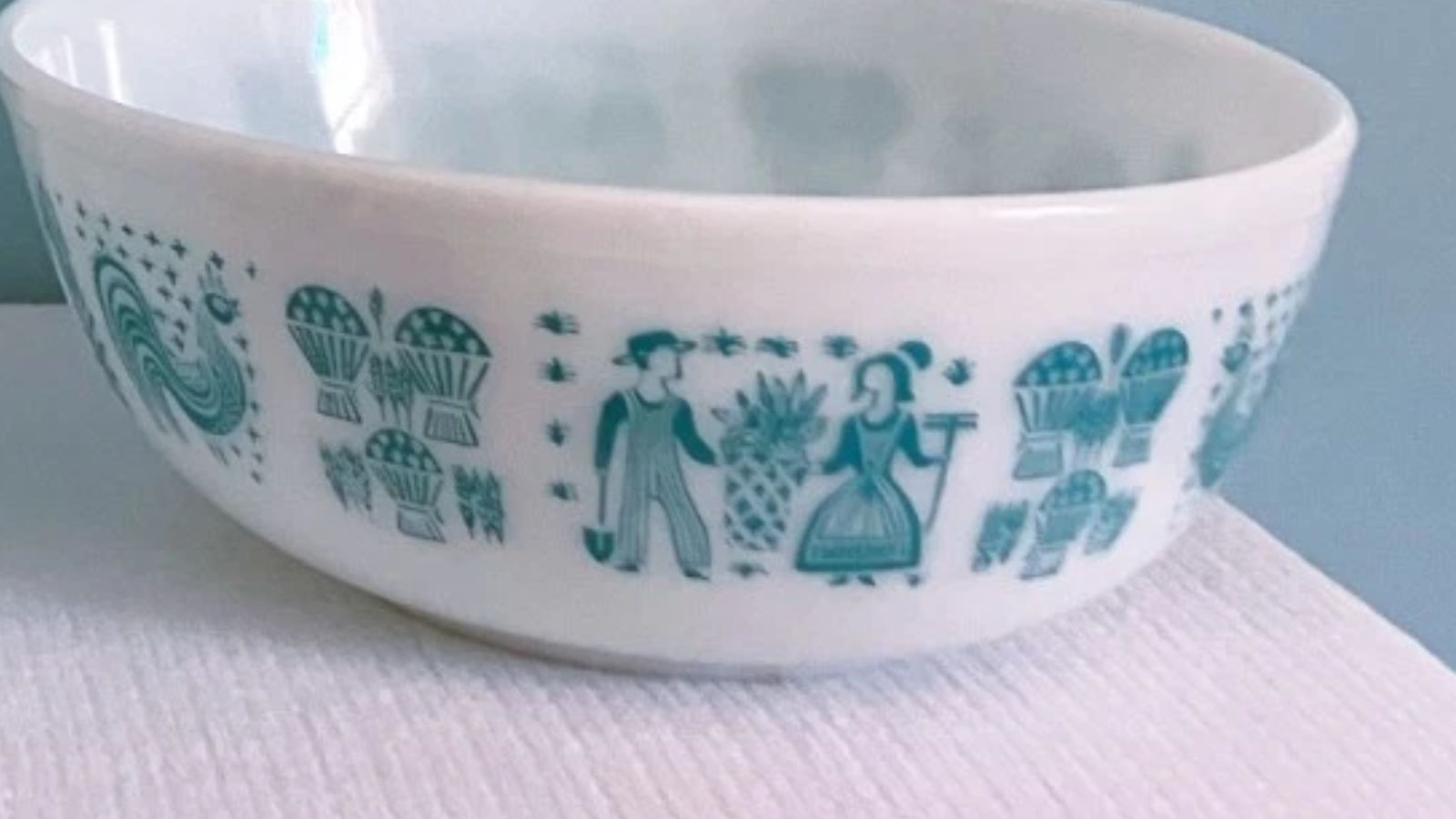
Once you know the pattern, Butterprint is pretty difficult to mistake for anything else. Look for the little farm couple first. They are surrounded by roosters, corn stalks, wheat, baskets, and farming tools, all rendered in that simple folk-art style. A blue-and-white Pyrex piece with snowflakes, flowers, or abstract shapes is something else. Butterprint has people, and that makes identifying it surprisingly easy.
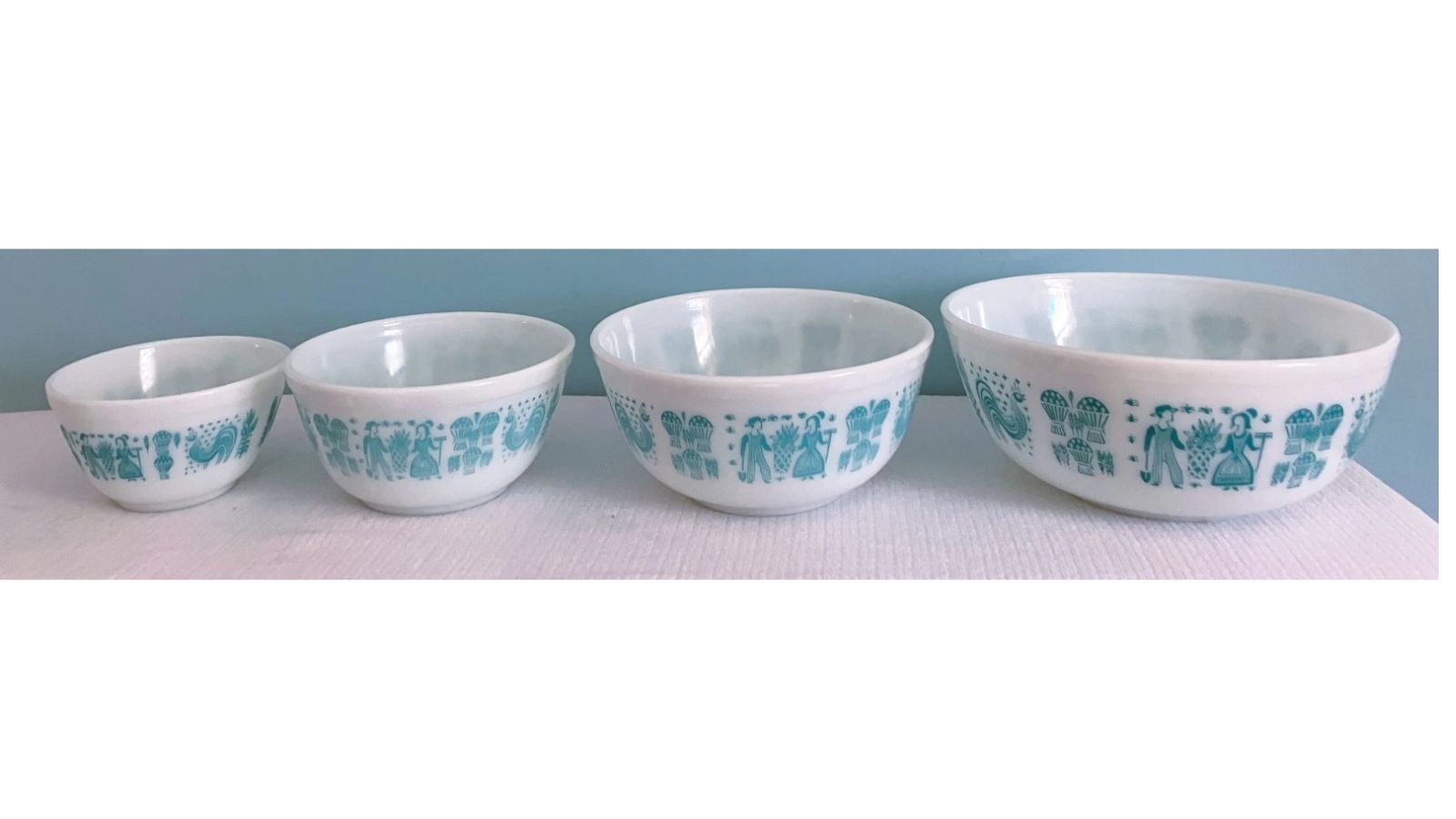
The classic Cinderella mixing bowl set contains four nesting bowls numbered 441, 442, 443, and 444, with the turquoise and white colors alternating through the set. Butterprint was also produced on round Cinderella casseroles and refrigerator storage dishes, so don’t ignore something just because it isn’t a mixing bowl. Turn any promising piece over and check the base for a molded Pyrex mark and, where present, a model number or capacity marking.
Condition is where a nice thrift-store find can become a much better one. Look closely for chips along rims and handles, cracks, scratches through the colored surface, and badly worn graphics. Vintage colored Pyrex can also suffer from dishwasher damage, which leaves the finish looking rough, faded, dull, or hazy. Some wear is perfectly normal on kitchenware that may be pushing 70 years old. A glossy piece with crisp decoration and no chips or cracks, however, is the one I’d be happiest carrying to the register.
Why Butterprint is such a favorite with Pyrex collectors
Butterprint has the sort of design that makes vintage Pyrex collecting fun. It is immediately recognizable, unmistakably midcentury, and just whimsical enough without looking overly cute. The little farming figures, roosters, crops, and tools give it far more personality than a simple floral or geometric pattern. Even people who could not name it on sight often recognize that turquoise-and-white farmhouse look.
It also represents a particularly memorable period in Pyrex design. Butterprint appeared on several forms, including Cinderella mixing bowls, refrigerator dishes, and casseroles, which means collectors can build out a matching group rather than hunt for one specific item. The alternating turquoise-on-white and white-on-turquoise color schemes also make a full group look especially good together. A single bowl is appealing, but a shelf of coordinated Butterprint pieces has that wonderfully cohesive vintage-kitchen look that makes people start collecting in the first place.
For thrift-store hunters, that is really the appeal. Finding Butterprint is not exciting because the piece can be flipped. It is exciting because you have stumbled across a genuine bit of vintage kitchen history in between stacks of ordinary donated dishes. Better still, the pattern is distinctive enough that once you’ ha’ve learned it, spotting one of those tiny Amish-style farm scenes from across an aisle becomes surprisingly easy. A clean, glossy piece with strong turquoise color, crisp decoration, and no serious chips or cracks is the sort of find many Pyrex collectors would be delighted to take home and actually keep.
You might also like…
The Pink Pyrex Pattern Collectors Dream of Finding at a Thrift Store
The CorningWare Pattern Collectors Dream Of Finding At A Thrift Store
15 Tips for Finding Vintage Christmas Decor at Yard Sales and Thrift Stores

