
Affiliate disclosure: This post may contain affiliate links. Please see full disclosure.
There is nothing obviously space-themed about Horizon Blue. No rockets, stars, astronauts, or little moons appear anywhere on it. Instead, you get a crisp turquoise-blue pattern on white Pyrex that looks floral in places and almost geometric in others. Without knowing the story, you’d probably just think it was a particularly nice piece of late-’60s kitchenware. But Horizon Blue arrived in 1969 for a much bigger reason.
Pyrex released the pattern to commemorate the successful Apollo 11 moon landing that July. It was designed by Robert Gibson and remained in production from 1969 until 1972. The space connection was made very clear in the original advertising. An October 1969 magazine ad showed the Horizon Blue collection sitting on the surface of the moon, with Earth hanging in the background. The copy leaned into the theme too, promising that the new blue collection would make your “universe a little bit nicer.” Subtle, it was not.
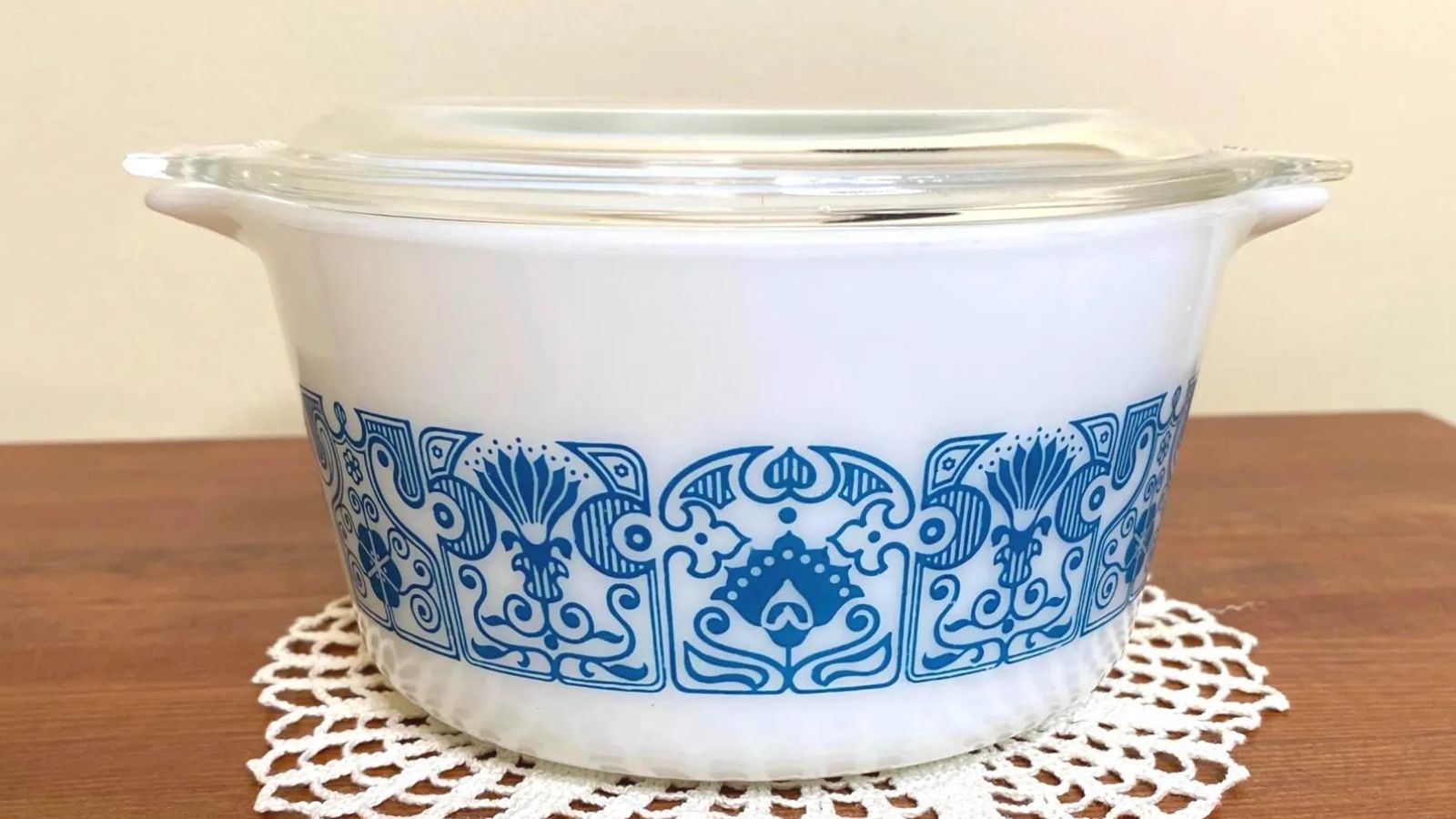
The actual dishes are much more restrained. Horizon Blue combines medium-dark turquoise with white opal glass, sometimes as decoration on a white dish and sometimes as a solid blue piece. Pyrex deliberately varied the blues slightly across the collection to suit the late-1960s fashion for mix-and-match kitchenware. That gives a complete group a coordinated look without making every bowl or casserole identical, which is part of what makes the pattern so pleasing to collect.
Horizon Blue came in far more than one mixing bowl
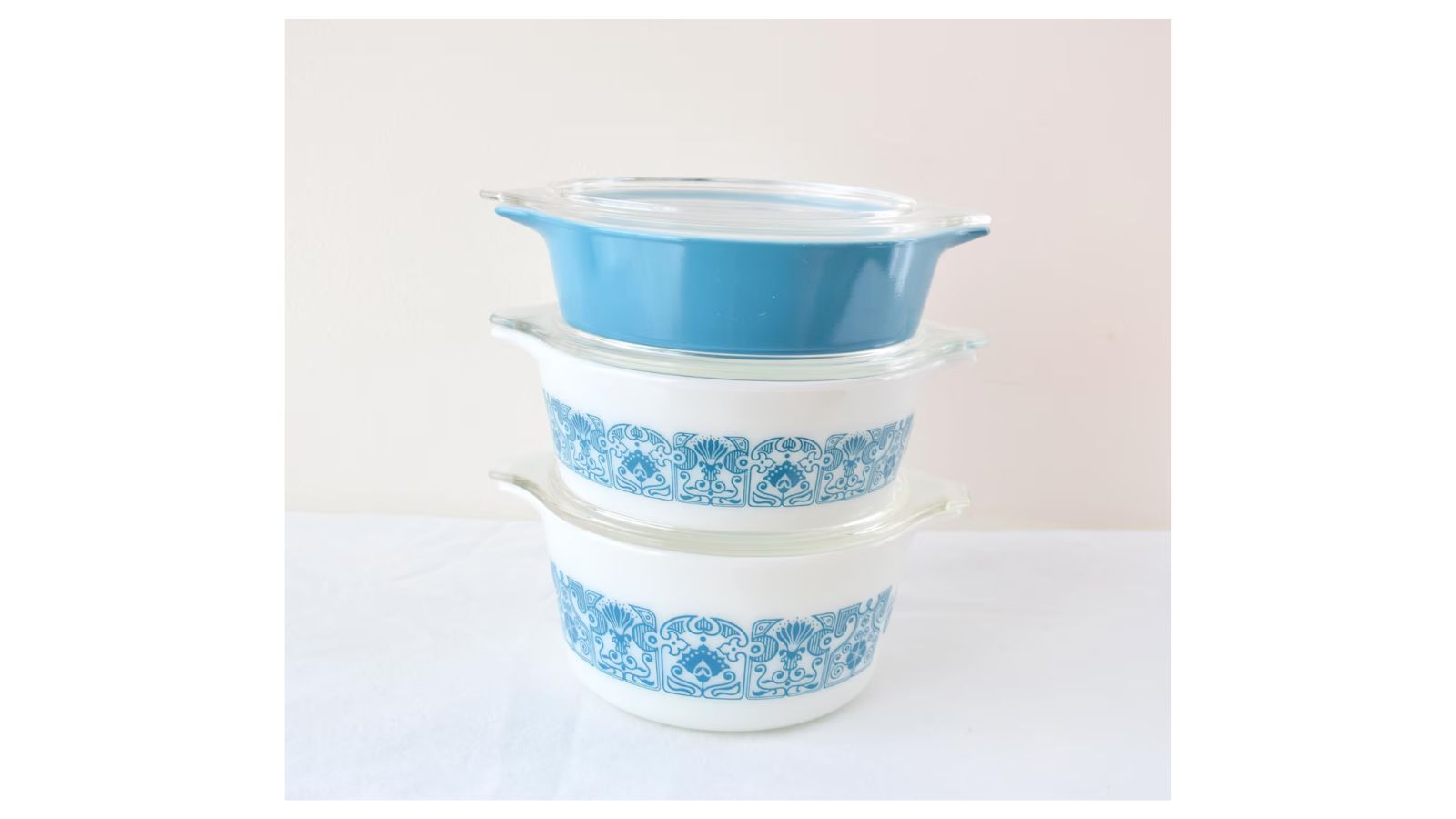
If you’re trying to spot Horizon Blue while thrifting, don’t concentrate solely on patterned bowls. Pyrex made the design across a fairly broad, although initially modest, collection. The original lineup included Cinderella mixing bowls, a three-piece regular mixing bowl set, round casseroles, refrigerator dishes, and oval casseroles. Its success later led to additional bakeware and a little 10-ounce Pixie casserole before the pattern disappeared in 1972.
The mixing bowl sets are particularly easy to recognize once you know their slightly odd arrangement. In the three-piece 300 series, the smallest 401 and largest 403 bowls carry the blue design over white, while the middle 402 is solid blue. There is no matching 404 in this set. The four-piece Cinderella set follows the same mix-and-match idea, alternating patterned white bowls with solid blue ones. So a plain blue vintage Pyrex bowl sitting by itself can actually belong to Horizon Blue even though there’s no pattern on it at all. That makes identification a little more interesting than simply looking for the floral design.
The casseroles vary, too. Some have patterned white bodies, some are solid blue, and the lids can be clear glass or decorated white opal depending on the shape. If you find an unfamiliar blue or blue-and-white piece, check the molded Pyrex mark and model number underneath rather than relying only on the decoration. Horizon Blue is distinctive as a collection, but individual pieces can be surprisingly easy to misidentify when they’ve been separated from their original sets.
The Apollo connection gives Horizon Blue something other patterns don’t have
Horizon Blue isn’t one of those Pyrex patterns where only three examples seem to exist and every sighting becomes collector folklore. It had a proper production run, expanded after its initial release, and enough pieces survive that collectors can realistically hope to come across one. What makes it special is that very specific moment in 1969 attached to it.
That association also gives the pattern a slightly different character from Pyrex’s many flowers, fruits, farm scenes, and purely decorative designs. Horizon Blue is still very much domestic kitchenware, but it was launched against the backdrop of one of the defining technological events of the 20th century. Its original advertising literally put casseroles on the moon. There is something wonderfully strange about that.
It’s also simply a good-looking pattern. The saturated turquoise against white still feels clean and cheerful, and the small flowers, leaves, dots, crescents, and scrolling shapes have enough going on to be interesting without becoming fussy. A group of the alternating blue and patterned pieces looks particularly good together, which explains why complete Horizon Blue bowl sets remain such satisfying finds for vintage Pyrex collectors.
That’s the real pleasure of finding Horizon Blue at a thrift store. You’re not just pulling an attractive old bowl from a stack of kitchenware. You’re finding a small, practical piece of 1969, made at a time when people had just watched humans walk on the moon and apparently decided the kitchen could use a little space-age blue to celebrate.
You might also like…
The CorningWare Pattern Collectors Dream Of Finding At A Thrift Store
The Blue-And-White Pyrex Pattern Collectors Dream Of Finding At A Thrift Store
The Pink Pyrex Pattern Collectors Dream of Finding at a Thrift Store

