
Affiliate disclosure: This post may contain affiliate links. Please see full disclosure.
Most plants get on just fine with sunshine, water, and half-decent soil. Carnivorous plants don’t have that option. In my own vegetable beds I spend half my time trying to build richer soil, so it took me a while to properly appreciate plants that solve poor soil a completely different way. Carnivorous plants are plants that trap and digest insects and other small animals to make up for the nutrients missing from the ground they grow in. Instead of giving up on bad soil, they’ve found another way to feed themselves: they hunt.
They aren’t monsters and they’re not especially interested in us, so I can’t see Day of the Triffids suddenly becoming a real concern on my back porch. These are just ordinary plants that have adapted leaves, stems, and roots into traps. Some move fast enough to snap shut on a fly. Others sit and wait with sticky leaves, pitfall cups, or even tiny underwater suction traps that work faster than you can blink.
Most of their prey is small, from midges, ants, and beetles to tiny crustaceans and microscopic worms in the soil. What gets me every time is the sheer range of methods they use to catch it, from snap traps and flypaper leaves to underground “lobster pots” and plants that farm animal droppings. Strange, inventive, and endlessly fascinating.
What they all have in common is the same basic problem. They live where nutrients are scarce, whether that’s bog, heath, tepui plateau, poor white sand, or a nutrient-starved pond, and they’re making a living in places other plants can’t. Carnivory has evolved independently in plants at least six times, and there are now more than 600 recognized species doing it their own way. That’s what makes them so interesting to me as a grower who spends most of my life trying to feed plants from the soil up.
Here are 20 carnivorous and near-carnivorous plants that show just how far evolution will go when a plant needs to find its own dinner.
1. Venus flytrap

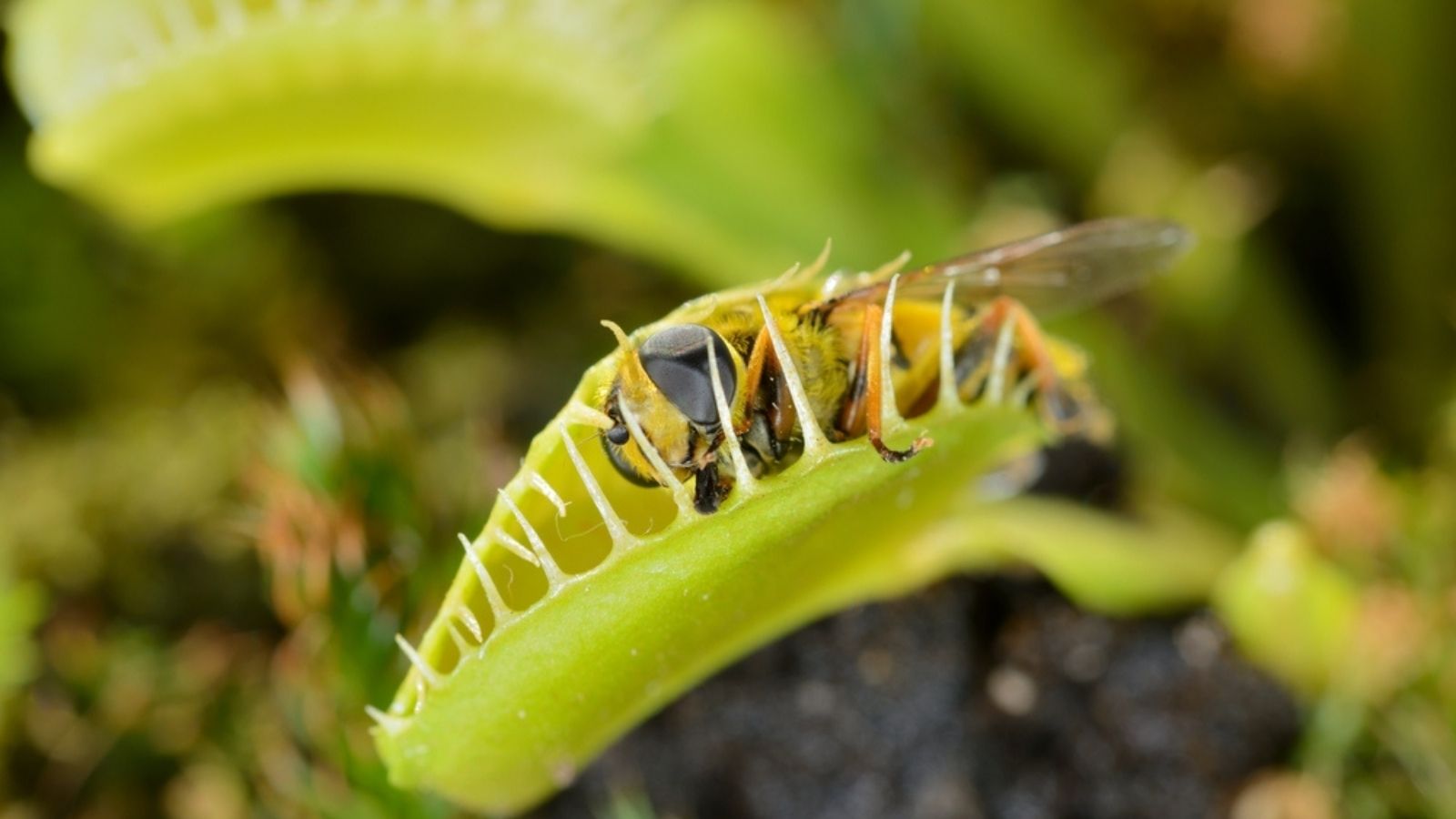
If you only know one carnivorous plant, it’s probably the Venus flytrap. I still think it’s the plant that got most of us hooked on this whole strange corner of the plant world in the first place. Native to nutrient-poor bogs in North and South Carolina, it survives by catching spiders and insects in those famous jaw-like traps.
Each trap is a modified leaf lined with tiny trigger hairs. A fly has to touch those hairs twice within about 20 seconds for the trap to snap, which helps the plant avoid wasting energy on raindrops or falling debris. Once it closes, the trap seals tight, and the plant digests its meal over the next 10 days or so before reopening, ready for the next unlucky visitor.
It’s one of the fastest plant movements we know, and it all runs on changes in water pressure and electricity in the cells, not muscles. In a world where most plants move at glacial speed, a flytrap is basically a cheetah. I’ve kept one on a sunny windowsill for years, and the speed still catches me off guard every time. If you share your home with dogs or cats, here’s some good news: Venus flytraps are non-toxic to dogs, cats, and horses, so a curious nibble won’t poison anyone in the house, even if it might cost you a trap or two.
2. Sundews

Sundews are, in my opinion, the glitter queens of the carnivorous plant world, and I mean that as a compliment. Their leaves are covered in red or green tentacles tipped with sticky droplets that look like morning dew. Insects think they’ve found nectar, land to investigate, and end up glued in place.
Once something sticks, nearby tentacles slowly bend inward, smothering the insect in more glue and digestive enzymes. Some species can curl the whole leaf around the prey like a slow-motion fist. It’s genuinely one of my favorite things to watch happen in real time if you ever get the chance. The plant then absorbs the nutrients it can’t get from its poor, acidic soil.
Sundews are incredibly diverse, from tiny rosettes the size of a coin to the towering king sundew with leaves as long as your hand. They grow on every continent except Antarctica, which tells you how successful this sticky strategy really is.
3. North American pitcher plants
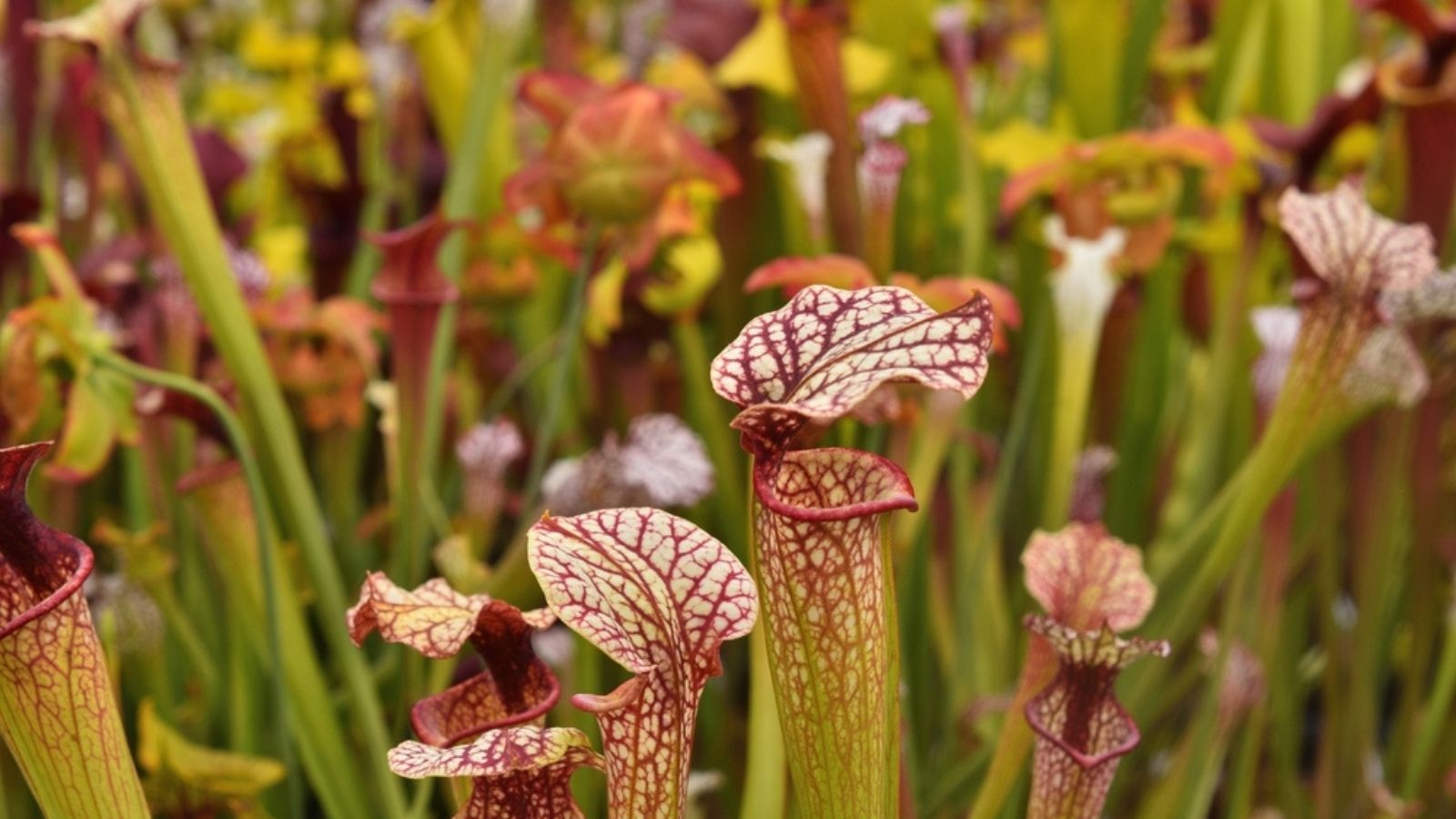
North American pitcher plants, in the genus Sarracenia, look like bundles of fluted trumpets rising out of the bog, and I think they’re one of the easiest carnivorous plants for a US gardener to actually grow outdoors in a bog planter. Each “trumpet” is a hollow leaf that acts as a pitfall trap. The rim and upper inside surface produce nectar that lures insects in. Once they step on the slippery edge, they tumble into the tube and struggle in a pool of digestive liquid at the bottom.
Many species have translucent patches called “windows” near the top of the pitcher. Confused insects fly toward the light, crash into the walls, and fall further down instead of finding the exit. Downward-pointing hairs inside the pitcher make climbing back out nearly impossible.
They’re both beautiful and ruthless, and they do a vital job recycling nutrients in bog ecosystems that would otherwise be painfully poor.
4. Tropical pitcher plants
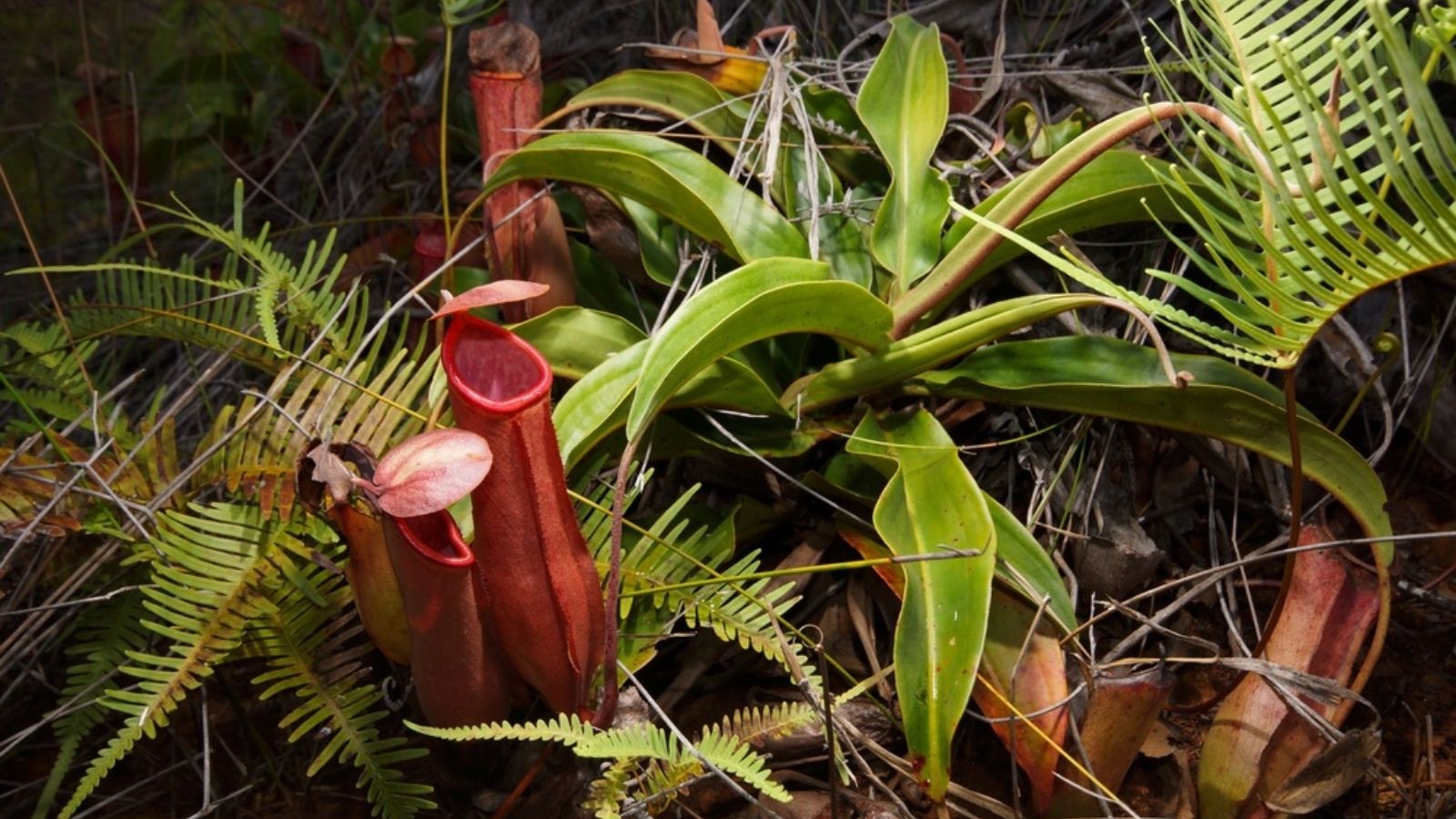
Tropical pitcher plants, Nepenthes, are the exotic cousins of Sarracenia. They grow as vines in the forests of Southeast Asia and dangle colorful pitchers from the ends of their leaves like little cups on hooks. Each pitcher fills with rainwater and digestive fluid, then waits for crawling insects, or even small vertebrates, to slip in.
The inside of many species is lined with ultra-slippery surfaces or a viscoelastic fluid that clings to struggling prey. Some have evolved incredible specializations: wide “mouths” for catching termites, ground-level pitchers for trapping ants, or high-hanging cups designed to attract mammals instead of insects.
Nepenthes are also one of the more forgiving carnivorous plants to grow as a houseplant if you can give them warmth and humidity, which is part of why I think they’re worth trying even if you’ve never grown anything carnivorous before. You’ll meet some of the really weird ones later in this list, including pitchers that work more like toilets than deathtraps.
5. Cobra lily

The cobra lily, Darlingtonia californica, looks like a rearing snake with a forked tongue, which is where it gets its name. It’s native to cold mountain streams and seeps in Oregon and California, where it forms a clump of hooded, twisted pitchers.
Insects crawl up the “tongue” and into the hood, drawn by nectar and light shining through translucent spots at the top. Once inside, they get confused by those fake “windows” and keep trying to escape in the wrong direction until they exhaust themselves and fall into the deeper parts of the pitcher. Unlike many other pitcher plants, the cobra lily doesn’t rely on rainwater alone. It can regulate the fluid level in its pitchers, and it uses bacteria to help break down its prey rather than digesting insects with its own enzymes.
It’s a good reminder that not every carnivorous plant relies on brute force. Confusion, it turns out, is also a very effective weapon. It’s another one you don’t need to worry about if you’ve got pets underfoot. The cobra lily is also non-toxic to dogs, cats, and horses.
6. Butterworts

Butterworts, in the genus Pinguicula, look harmless at first glance. They make rosettes of flat, soft, yellow-green leaves that feel a bit greasy if you touch them. That “grease” is actually a layer of sticky glands that trap tiny insects like fungus gnats and midges.
When something lands and gets stuck, the leaf slowly curls around it, and other glands release digestive enzymes to break the insect down. The roots of many butterworts don’t do much more than anchor the plant, so the nutrients from those gnats really matter.
I keep a couple of butterworts on my seed-starting shelf every spring for exactly this reason. Fungus gnats love damp seed-starting mix, and a butterwort will quietly pick off far more of them than any sticky trap I’ve bought. In the wild, they’re masters of scraping a living out of sunny, wet, nutrient-poor places.
7. Bladderworts

Bladderworts, Utricularia, are easy to overlook. Many species are fully aquatic and just look like little green threads floating in ponds and ditches. I’ve walked straight past them plenty of times before I knew what I was looking at. Look closer, though, and you’ll see tiny, translucent bladders along the stems. Each bladder is a resettable suction trap.
The plant pumps water out of the bladder, creating a vacuum, and sets a tiny trapdoor armed with trigger hairs. When a microscopic creature brushes against those hairs, the door flips open and the prey is sucked in along with the water, then the door snaps shut again. All of this happens in a few thousandths of a second, making bladderworts some of the fastest organisms on Earth.
These plants don’t just snack on insects. They take on tiny crustaceans, worms, and protozoa too, quietly cleaning up the water column.
8. Waterwheel plant

The waterwheel plant, Aldrovanda vesiculosa, is like a Venus flytrap that decided to live underwater. It’s rootless and free-floating, with whorls of traps arranged around a thin central stem, forming a little green wheel.
Each trap is only a few millimeters long but works very much like a flytrap leaf. When a small aquatic invertebrate touches the trigger hairs, the two halves of the trap snap shut in about 10 to 20 milliseconds, roughly ten times faster than a Venus flytrap. The prey is then digested inside the closed trap.
Sadly, the waterwheel plant is endangered and has disappeared from many of its old sites. It’s extremely sensitive to water quality and nutrient pollution, which tells me just how fragile some of these odd little ecosystems really are.
9. Rainbow plants

Byblis, often called rainbow plants, are slim, upright carnivores from Australia and New Guinea. Their long, thread-like leaves are covered in clear, sticky droplets that catch the light and shimmer in different colors, which is where the “rainbow” nickname comes from.
The sticky hairs on the leaves act a bit like those on sundews and dewy pines, trapping small insects that wander past. For a long time, nobody was sure if Byblis truly counted as carnivorous. Botanists call a plant protocarnivorous when it traps prey and seems to benefit from it, but hasn’t been clearly proven to produce its own digestive enzymes or absorb nutrients directly. Byblis sat in that gray area for years, but studies have since shown that at least some species do produce their own digestive enzymes and can break down prey themselves, earning full carnivore status.
Even if you never grow one, rainbow plants are a lovely example of evolution solving the same problem several times over. Sticky flypaper traps have evolved independently in multiple lineages, all trying to make a living on poor soils.
10. Dewy pine

Drosophyllum lusitanicum, usually called dewy pine or Portuguese sundew, breaks nearly every stereotype about carnivorous plants. Instead of soggy bogs, it prefers hot, dry, scrubby hillsides in Portugal, Spain, and northern Morocco.
Its long, thin leaves are covered in glistening droplets that smell sweet and attract insects. Once they land, they get stuck in the sticky mucilage and slowly smother as more droplets ooze out. Unlike sundews, the leaves don’t move much. They just rely on glue and enzymes.
It’s a brilliant reminder that carnivory isn’t limited to wetlands. If the soil is poor enough and competition is tough, plants will get creative almost anywhere, including my own dry, sandy back corner if I ever get around to trying one there.
11. Corkscrew plants

Corkscrew plants, Genlisea, are small and delicate above ground, with modest leaves and pretty yellow flowers. Underground, they’re doing something utterly wild. Instead of normal roots, they grow long, forked, tube-like leaves that twist and coil through waterlogged soil like tiny corkscrews.
Microscopic organisms enter the tubes through slits and find themselves in a one-way maze lined with hairs that only allow movement deeper inside. Eventually they get stuck in chambers where digestive glands break them down. There’s no snapping or squeezing here, just a passive, lobster-pot-style trap operating in the dark.
Most of the action happens below the surface, where none of us are looking, which is probably why it took botanists so long to work out what was going on.
12. Australian pitcher plant
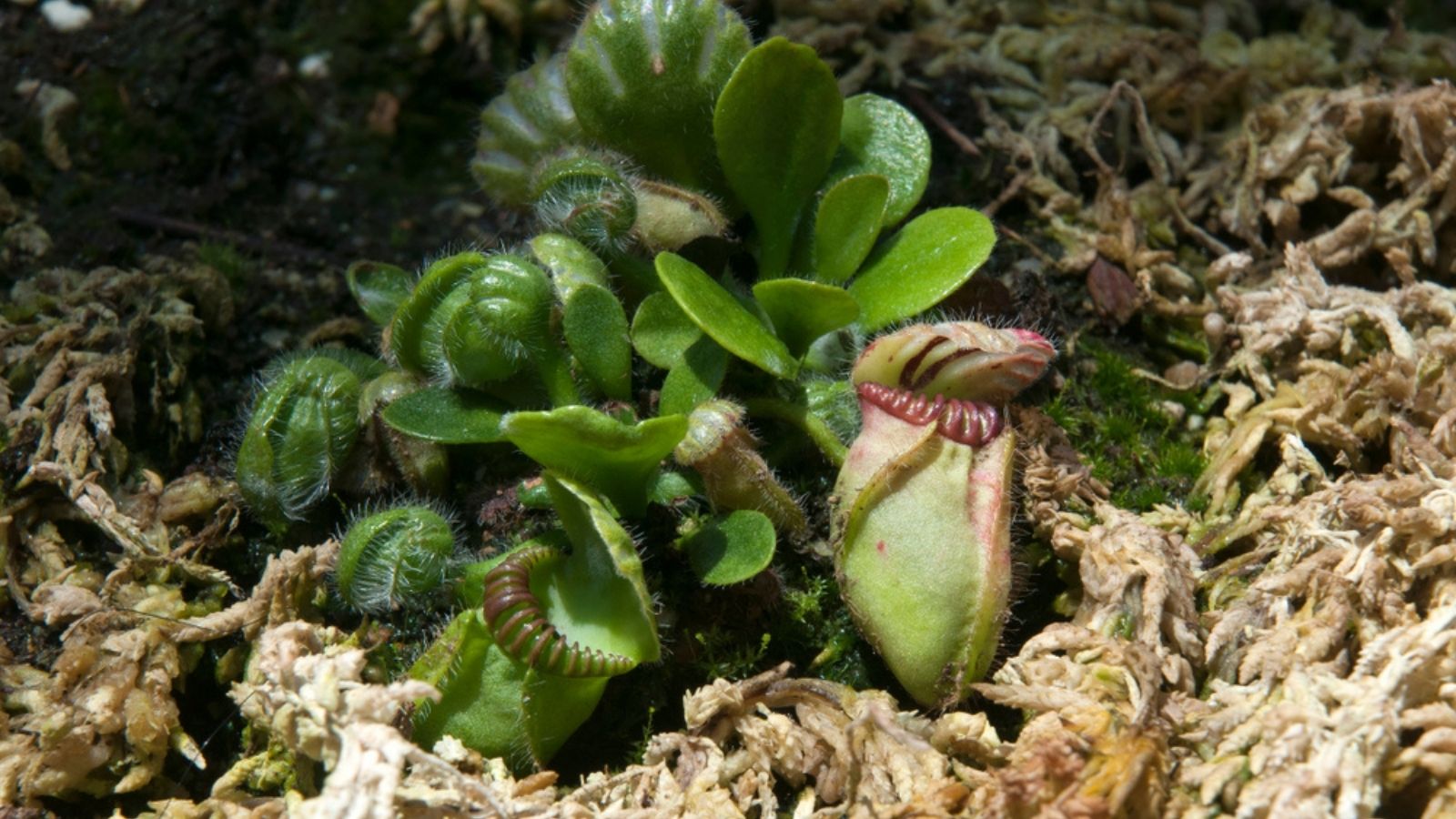
Cephalotus follicularis, the Australian pitcher plant, looks a bit like someone scattered the ground with tiny, toothed boots. This small, low-growing species makes two different kinds of leaves: ordinary flat leaves and squat, lidded pitchers that act as pitfall traps.
The rim and lid of each pitcher secrete nectar, luring ants and other crawling insects. Inside, the walls become slippery and lined with downward-pointing hairs, and at the bottom is a pool of enzyme-rich fluid. Once an insect slips in, it’s unlikely to make it back up that steep, slick interior.
This plant grows in coastal swamps in southwestern Australia, and like many carnivores it’s threatened by habitat loss and over-collection. It’s available from a handful of reputable specialist nurseries if you ever want to grow one, and that’s exactly where it should come from rather than a wild-collected plant.
13. Carnivorous bromeliads
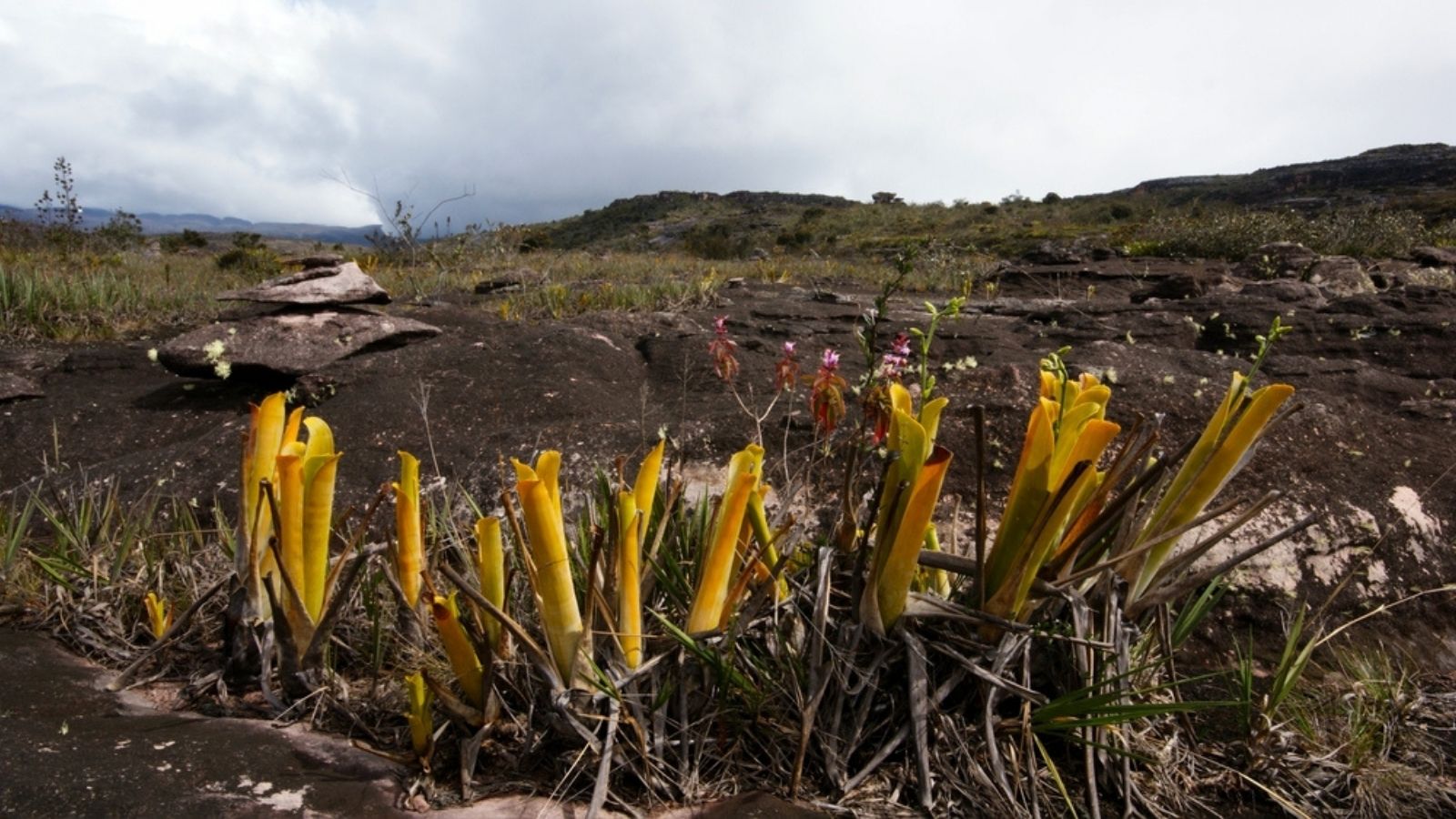
Most bromeliads are harmless epiphytes that just collect water in the rosettes formed by their leaves. A few, like Brocchinia reducta, seem to have gone further and turned those tanks into pitfall traps.
Brocchinia reducta forms a tall, narrow funnel of leaves that holds a column of water. The leaf surfaces are coated with a fine, waxy powder that makes them very slippery and can reflect ultraviolet light, which attracts insects. As they climb toward the light, they lose their footing and slide into the water, where they drown and break down. Specialized hairs inside the tank can absorb nutrients from that soup, and there’s evidence of digestive enzymes in the water too.
Botanists still debate exactly how carnivorous some of these bromeliads really are, which puts them squarely in protocarnivorous territory, but they almost certainly benefit from a steady trickle of insect nutrients either way.
14. Triantha occidentalis
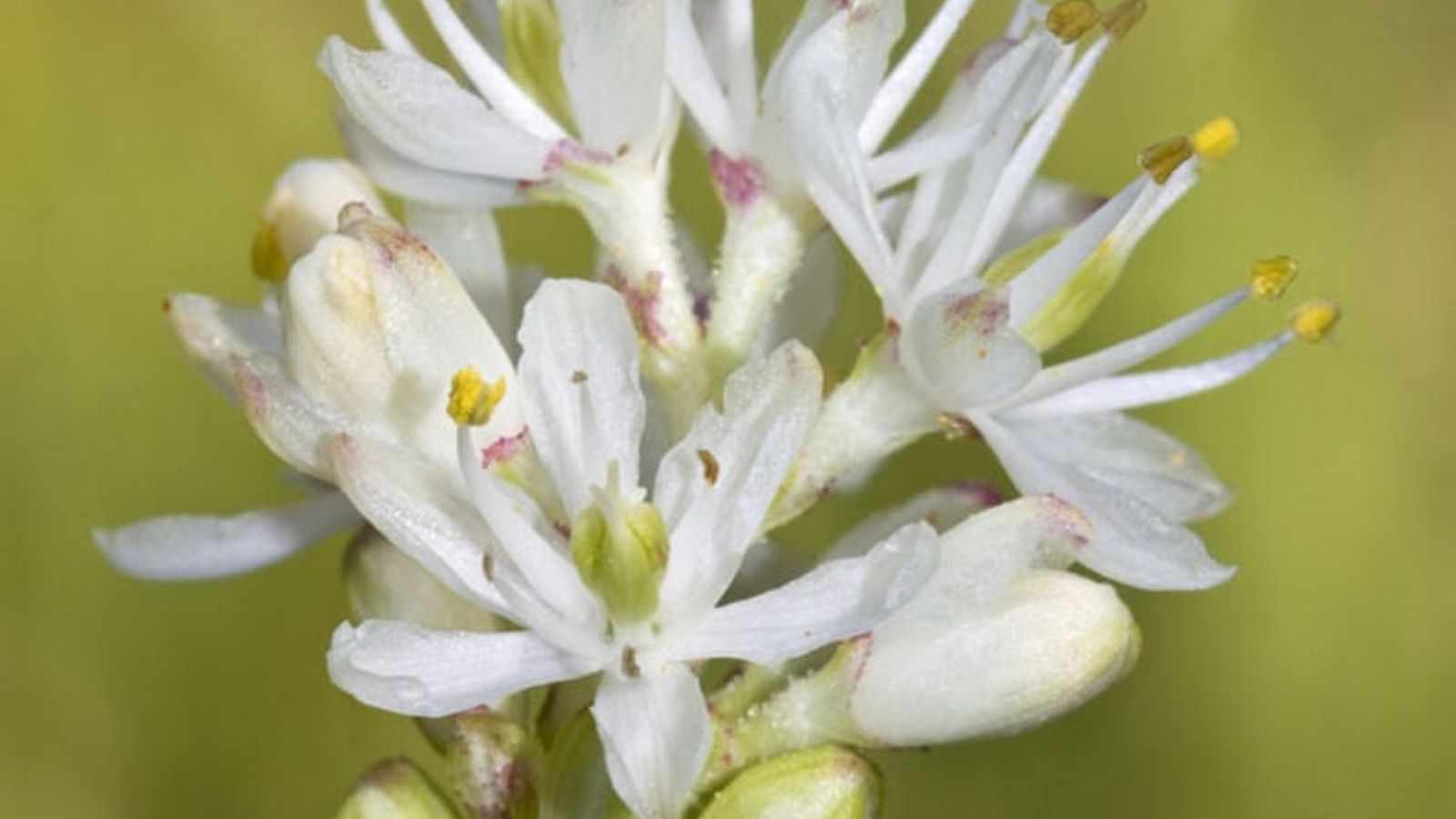
Triantha occidentalis looks like a perfectly ordinary bog wildflower at first glance. It grows in the Pacific Northwest and Alaska, with grass-like leaves and a tall inflorescence covered in small white blooms. For years, nobody suspected it of anything unusual, and I have to admit, neither would I.
Then researchers discovered that the flower stalk and nearby bracts are covered in sticky hairs that trap small insects, and the plant produces enzymes capable of digesting them. Radioactive tracer experiments showed that nitrogen from those trapped insects ends up in the plant’s own tissues, confirming that this is a genuine carnivorous strategy.
What makes it especially strange is that it “hunts” right up near the flowers, exactly where pollinators are working, yet somehow manages to avoid catching many of its own pollinating visitors.
15. Triphyophyllum peltatum

Triphyophyllum peltatum is a rare liana from West African rainforests that spends most of its life looking like a perfectly ordinary climbing plant. Under certain conditions, usually when phosphorus in the soil is scarce, it switches into a carnivorous phase and produces leaves covered in sticky glands.
During that phase, the plant traps small insects on these adhesive leaves and digests them with enzymes, topping up its nutrient budget. When conditions improve, it stops making carnivorous leaves and goes back to behaving like a normal vine. It’s currently the only known plant that flips carnivory on and off like this, triggered purely by nutrient deficiency.
If you wanted a poster child for doing whatever it takes to survive, this would be it.
16. Roridula

Roridula looks a lot like a giant sundew shrub, with tall, branching stems covered in long, sticky hairs that snare insects. The twist is that Roridula doesn’t produce its own digestive enzymes, so it can’t break those insects down by itself.
Instead, it lives in partnership with special assassin bugs that can walk over the sticky leaves without getting trapped. These bugs feast on the stuck insects and then leave nutrient-rich droppings on the plant. Roridula absorbs those nutrients straight through its leaves, essentially outsourcing the messy part of carnivory to its bodyguards.
Some botanists call it “carnivorous by proxy,” but from where the plant is standing, it’s getting exactly what it needs.
17. Heliamphora

Heliamphora, often called sun or marsh pitcher plants, grow on isolated sandstone tepuis in South America, especially in Venezuela and Brazil. These table-top mountains are famous for their sheer cliffs and strange, isolated ecosystems, which is part of why I find this genus so hard to stop reading about.
Heliamphora leaves fuse into upright tubes that hold rainwater and digestive fluids. A small spoon-like structure at the top produces nectar that lures insects to the rim. Once they lose their footing and fall in, it’s the same pitfall story as many other pitcher plants: drowning, then digestion, then nutrient absorption through specialized cells.
They’re some of the most otherworldly plants around, perched on remote summits where almost nothing else can cope.
18. Tree-shrew toilet pitchers

Some Nepenthes species have taken a very different approach to nutrition. Instead of focusing on eating insects, they act as toilets for small mammals like tree shrews. Species such as Nepenthes lowii grow large, sturdy pitchers that sit at just the right height and angle for a tree shrew to perch on the rim and lap up nectar from the lid.
While the shrew feeds, it defecates directly into the pitcher. The plant then digests the droppings in its fluid, gaining a reliable supply of nitrogen and other nutrients. It’s still technically carnivorous, but it has moved from outright predation to a poop-for-nectar trade, which is an incredible piece of co-evolution.
It’s hard not to be impressed by a plant that solved poor soil by turning itself into an animal toilet.

