

Affiliate disclosure: This post may contain affiliate links. Please see full disclosure.
If you spot a heavy, hand-cranked Squeezo tomato strainer among the mismatched kitchen gadgets at a thrift store, take a proper look. This American-made, mostly metal machine was built to turn a glut of garden tomatoes into smooth sauce without the tedious business of peeling and deseeding every one.
As someone who grows a substantial amount of my own food and loves old kitchen equipment, I can see the appeal immediately. It’s practical, nicely engineered, and has a proper history behind it. Better still, a complete one can earn its cupboard space rather than becoming another decorative antique.
An Italian immigrant’s clever idea became a kitchen staple

The Squeezo’s story began with a die maker from Abruzzo, Italy, who arrived in the United States in 1907 with a design for a tomato strainer. Unable to persuade a manufacturer to produce it, he set up a factory in his backyard. In 1919, he began making Squeezos using an old belt-driven steam engine, helped by his wife and three children.
By the 1930s, the machine had found a place in Italian-American kitchens, where making tomato sauce could be a family job involving far more tomatoes than anyone fancied peeling by hand. The original family’s enterprise continued for almost 60 years. Then, in 1978, a fire destroyed its factory in McKeesport, Pennsylvania. The family couldn’t rebuild, and the business was sold.
Garden Way of Troy, New York, which had already sold the strainers, took over production. When that company closed in the 1990s, Lemra Products followed. The Squeezo name subsequently passed to other owners, including Best Products. So a Garden Way or Lemra label doesn’t mean you’ve found a cheap imitation. It’s another chapter in the same machine’s history.
The clever part is what comes out of the other end
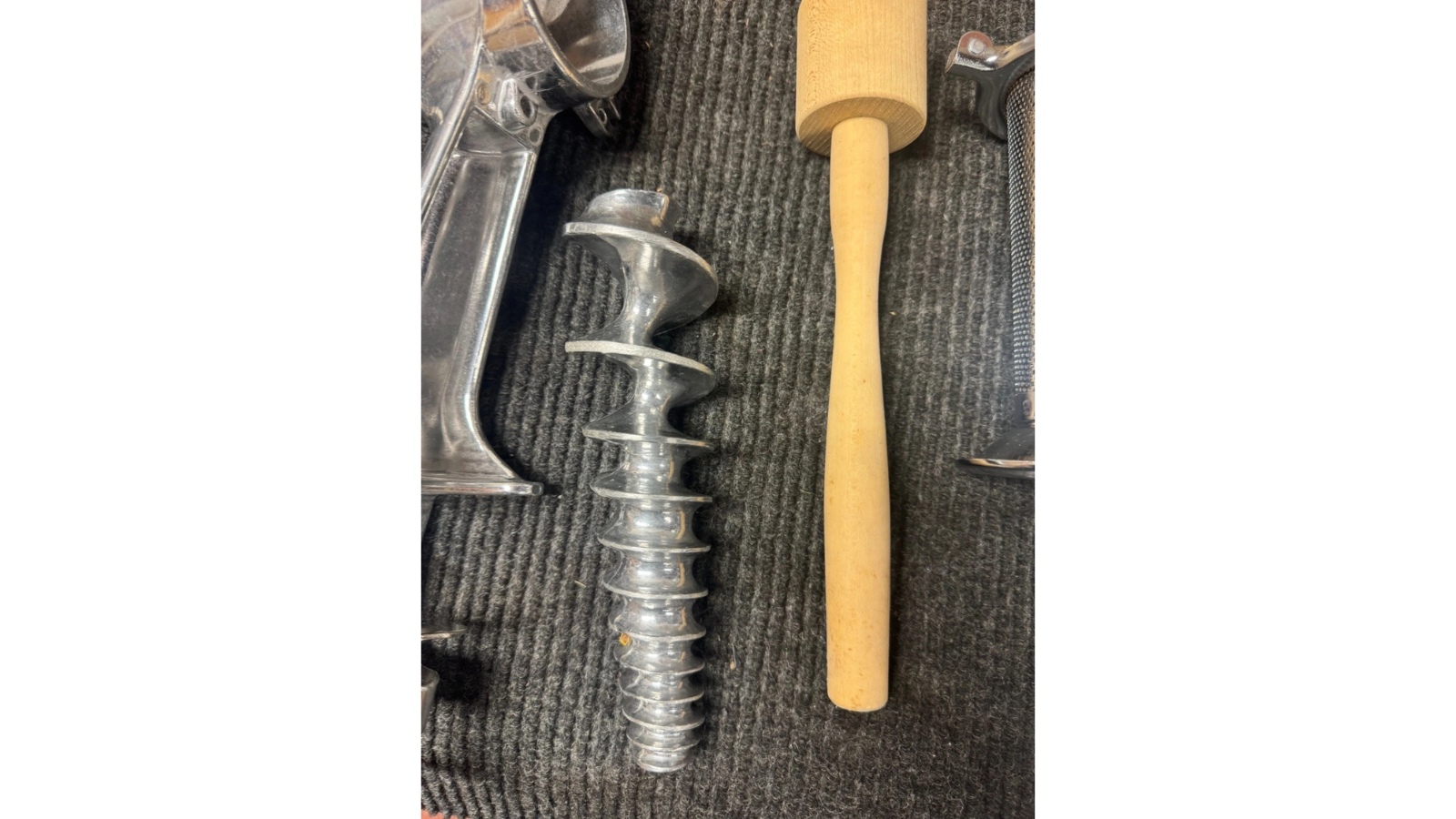
A Squeezo clamps to a table or sturdy countertop. Tip tomatoes into the wide metal hopper and turn the wooden-handled crank. Inside, a spiral screw, called the scroll or auger, pushes the fruit through a perforated metal screen. Smooth pulp and juice flow down one chute into your bowl, while the seeds and skins emerge separately from the end.
That’s ideal for tomato passata, the smooth, strained tomato puree used as the base for sauces and soups. You can use ripe tomatoes without peeling them first, though halving larger ones helps them feed more easily. I particularly like that you’re separating the skins and seeds mechanically, rather than pulverizing everything in a blender and straining it afterward.
The maker’s operating directions call for gentle pressure with the wooden plunger and a hopper no more than half full. If the discarded skins still seem wet, you can run them through again. It’s a sensible tool for a substantial harvest, although cranking and cleaning are part of the bargain.
How to recognize the older models

Look for the upright clamp-on body, large flared aluminum hopper, horizontal cylindrical screen, long hand crank, and sloping drain tray. The original all-metal designation refers to the main working parts. There’s also a rubber gasket and a nylon bushing, so it’s not literally metal from end to end.
Earlier examples may be marked Berarducci Brothers, sometimes with the 400-TS model number. Later machines appear with Garden Way branding, including Squeezo II and Squeezo III; you’ll also encounter Lemra examples. The maker’s name helps identify an era, but doesn’t prove a precise manufacturing year.
Don’t confuse the Squeezo with every other old crank-operated tomato press. Similar Victorio-style strainers exist, and their parts aren’t automatically interchangeable. Check the exact model before ordering replacements.
Check that the important bits are still there

The biggest disappointment would be discovering that you’ve brought home only the impressive body. You’ll want the hopper, clamp and screw, crank and fastening nut, internal scroll, drive shaft and spring assembly, perforated screen, and drain tray. A wooden pusher is useful too. Small pieces include the ferrule, screen wing nuts, gasket, and nylon bushing.
Have a look inside the screen, not just at the polished outside. Check for heavy rust, damaged perforations, cracks, a badly worn auger, and stripped threads on the clamp or fastening nuts. The screen must fit, and the crank should turn smoothly when properly assembled. I wouldn’t use a badly corroded food-contact component just because the machine looks charming on a shelf.
The good news is that replacement screens, gaskets, bushings, shafts, and other parts are still listed. But check compatibility before assuming a newer part fits an older example. A missing rubber gasket is quite different from an absent or damaged main housing.
Three screens make it more than a tomato machine

The standard tomato screen has approximately 1/16-inch holes. A finer 3/64-inch berry screen handles small seeds, while a coarser 1/8-inch pumpkin screen suits thicker, softer produce. Deluxe sets included all three, but don’t expect every secondhand Squeezo to have them. The regular model generally came with the tomato screen.
You can also put softened apples through it for applesauce or use appropriately cooked vegetables for smooth purees. That’s what makes the Squeezo interesting to me as a gardener. Equipment that can deal with several different harvests is more appealing than something used once before spending eleven months gathering dust.
Before using an old one, dismantle it, clean every food-contact surface and screen, remove the gasket so debris can’t hide behind it, and dry the parts thoroughly. Hand-washing is preferable to the dishwasher. If you’re going to can the resulting tomato sauce, use a tested recipe with required acidification and processing. Straining makes puree; it doesn’t preserve it.
I enjoy vintage kitchen finds that still solve a real problem, and the Squeezo absolutely qualifies. It’s a little piece of Italian-American food history, a reminder of hardworking home kitchens, and a genuinely useful partner when the tomato harvest starts getting out of hand.
You might also like…
The CorningWare Pattern Collectors Dream Of Finding At A Thrift Store
The Blue-And-White Pyrex Pattern Collectors Dream Of Finding At A Thrift Store
The Pink Pyrex Pattern Collectors Dream of Finding at a Thrift Store

