
Affiliate disclosure: This post may contain affiliate links. Please see full disclosure.
The 34-inch light-up Santa holding a wrapped present is a proper vintage Christmas find, but the name molded into his back and the condition of his plastic tell you more than a hopeful price tag. Look for the cheerful face, long white beard, red suit and black boots, with a toy sack tucked behind him.
For me, the pleasure of thrifting is finding something I’ll enjoy bringing out every year. As a collector, though, I want to know what I’m buying. He’s big enough to make a wonderfully kitsch porch display without requiring half the garage for storage, but I’d spend more time checking his feet and light fitting than admiring a “rare” label.
Meet the Santa behind the glow

This is Empire’s Santa with Gift, shown as model 1323, standing 34 inches high, in the 1973 Christmas catalog. The pictured version has a small gold-colored present held against his beard and a green sack at his side. Later examples can have different paint colors, so match the sculpted details as well as the decoration.
The design carries a 1971 mold stamp and remained in Empire’s range into the 1990s. That makes him a documented early-1970s design, but it doesn’t make every surviving Santa a piece manufactured in 1971.
That distinction matters when collecting. You’re looking at a hollow plastic figure illuminated from inside, made in a design that could stay popular for years. A well-kept later example can still be a lovely addition to your Christmas decorations. It simply deserves an accurate description.
Read the mark molded into the plastic
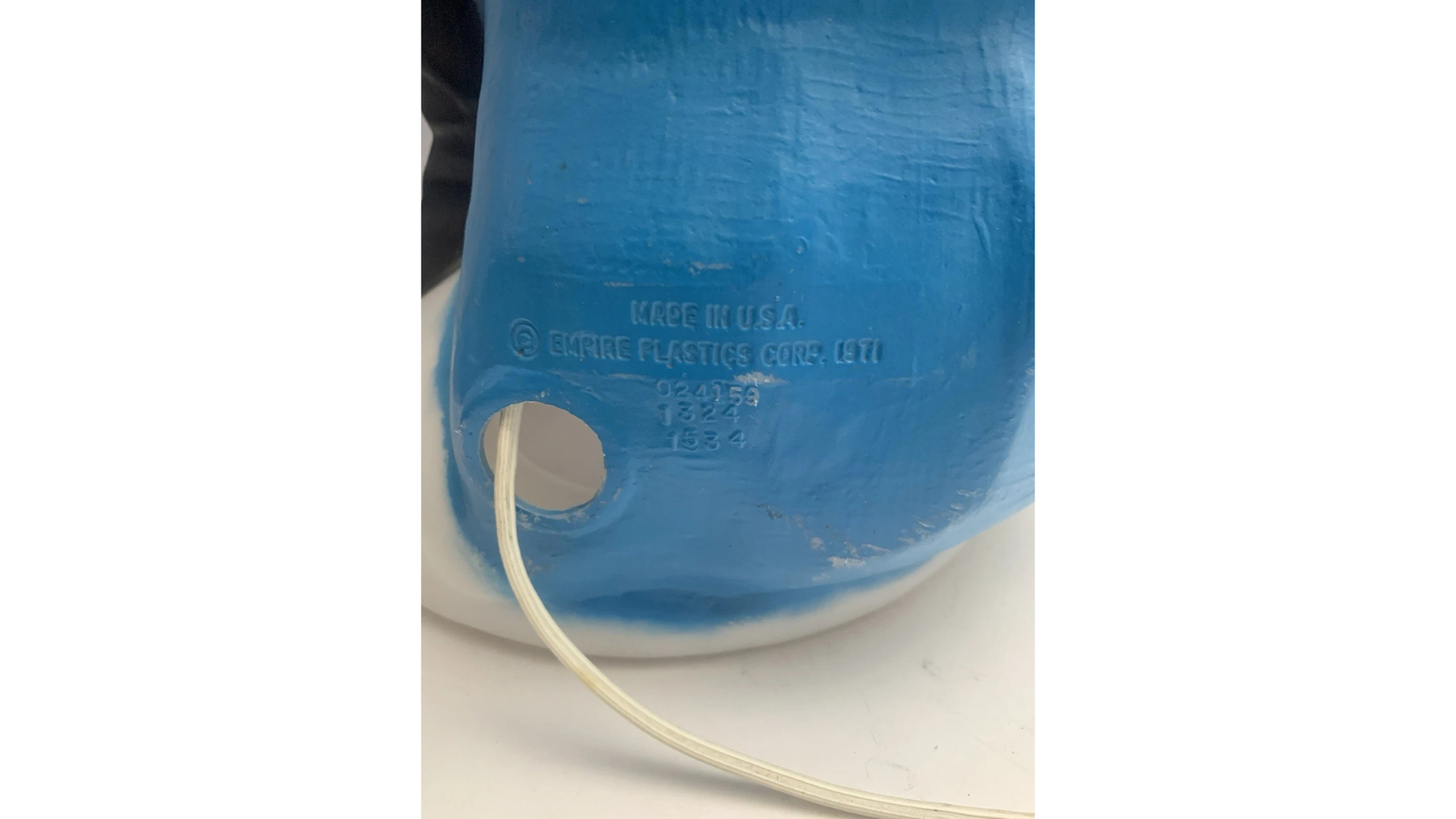
On an example of this Santa sold at auction, a close-up of the lower back shows “Made in USA” and “© Empire Plastics Corp. 1971”. The lettering is part of the plastic itself, rather than a paper price label or somebody’s handwritten identification.
Unplug the figure and support it carefully while looking around the lower back and underside. Shine your phone light across the surface from the side. Raised or recessed lettering can be surprisingly difficult to read straight on, especially against pale, scuffed plastic. Photograph the whole mark, including any numbers.
Empire isn’t the only name you’ll encounter. Poloron, Union Products and General Foam also made Christmas figures. With this particular design, General Foam later produced its own version, which is another reason a familiar face alone won’t settle the maker.
My advice is to compare the mark, height, pose and light opening together. Treat a copyright year as evidence about the design, then use original packaging or documented ownership to help narrow the age of the actual figure. An elderly cord isn’t a birth certificate.
Measure before comparing prices

These Santas range from 13-inch tabletop lamps to 34-inch figures and 46-inch giants. Those are different models, rather than one Santa in interchangeable sizes. The present-holding figure belongs to the middle group.
Measure from the bottom of the base to the highest point. Sellers sometimes round or measure differently: the auction example matching this present-holding design was described as 33 inches, while the period catalog specifies 34. That small discrepancy is worth checking against the photographs, not treating as proof of another model.
I recommend measuring the storage space too. A Santa that fits beautifully beside the front door still needs somewhere to live in February. Don’t assume you’ll be able to nest another figure inside him.
Check the color, cracks and cord separately
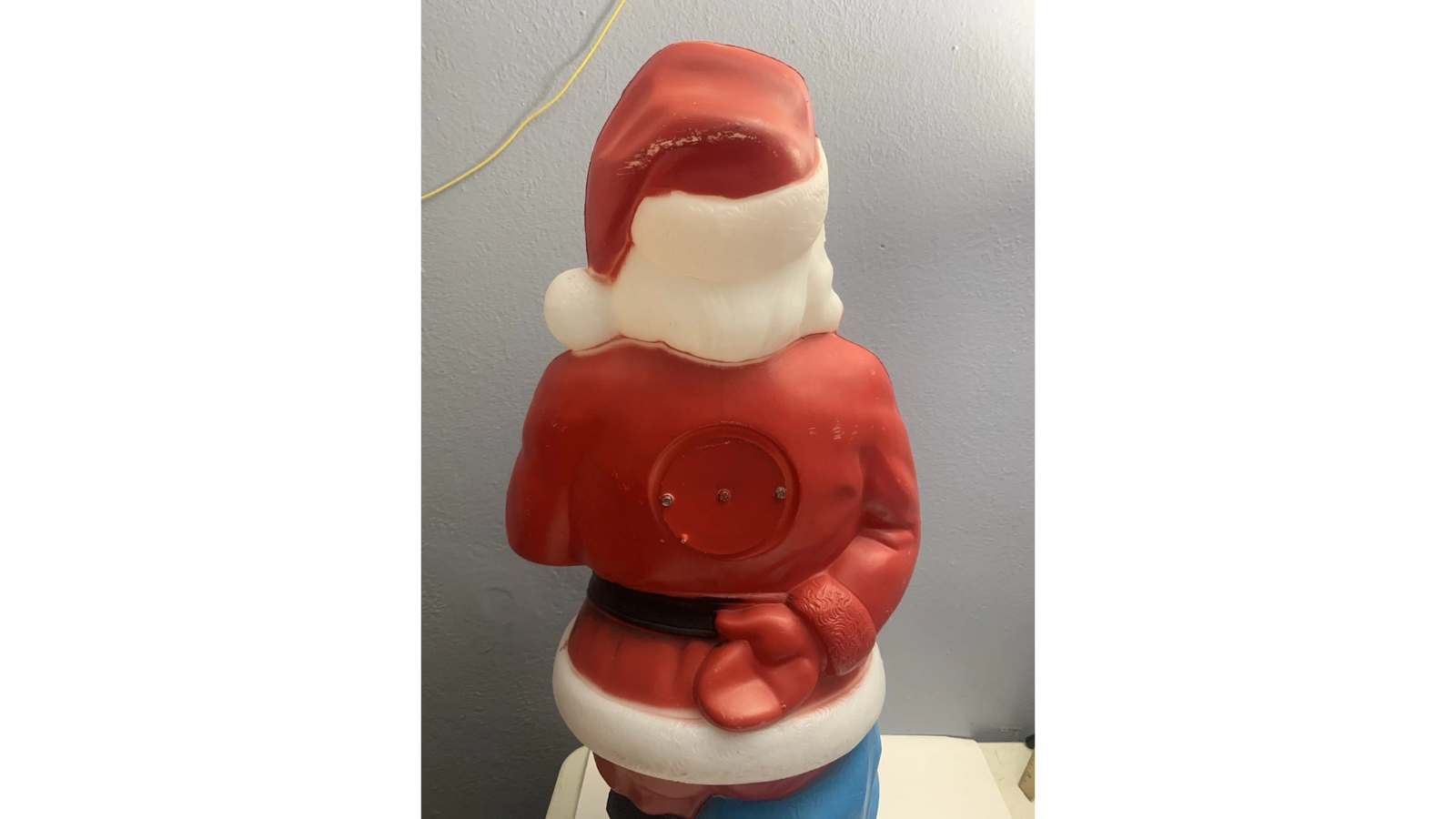
Fading changes both the look and collecting appeal. Compare the front with sheltered areas at the back, and inspect the face, red suit and painted present. A little rubbing wouldn’t stop me buying a figure I liked, but I’d want the price to reflect substantial color loss.
Look for repainting as well. Paint over scratches, brush marks or colors that differ from a documented version deserve a closer look. Bright paint doesn’t automatically mean original paint, and an attractive repaint shouldn’t command the same assumption of originality as a documented untouched example.
Cracks concern me more than a rubbed boot. Check around the base, narrow ankles, seams, cord exit and light-kit opening. Use a flashlight inside the unplugged figure where access allows, without forcing the plastic. Look for splits, holes, glue and tape. Never squeeze an old Santa to test how strong he is.
A replaced cord reduces electrical originality, but I wouldn’t reject a sound figure just for having a suitable replacement light kit. I would reject the idea that original wiring must be preserved in use at any cost. Frayed or visibly damaged cords need replacement. Have questionable fittings assessed by a qualified repairer, and follow the correct kit’s bulb and use instructions.
Use sold examples as a starting point
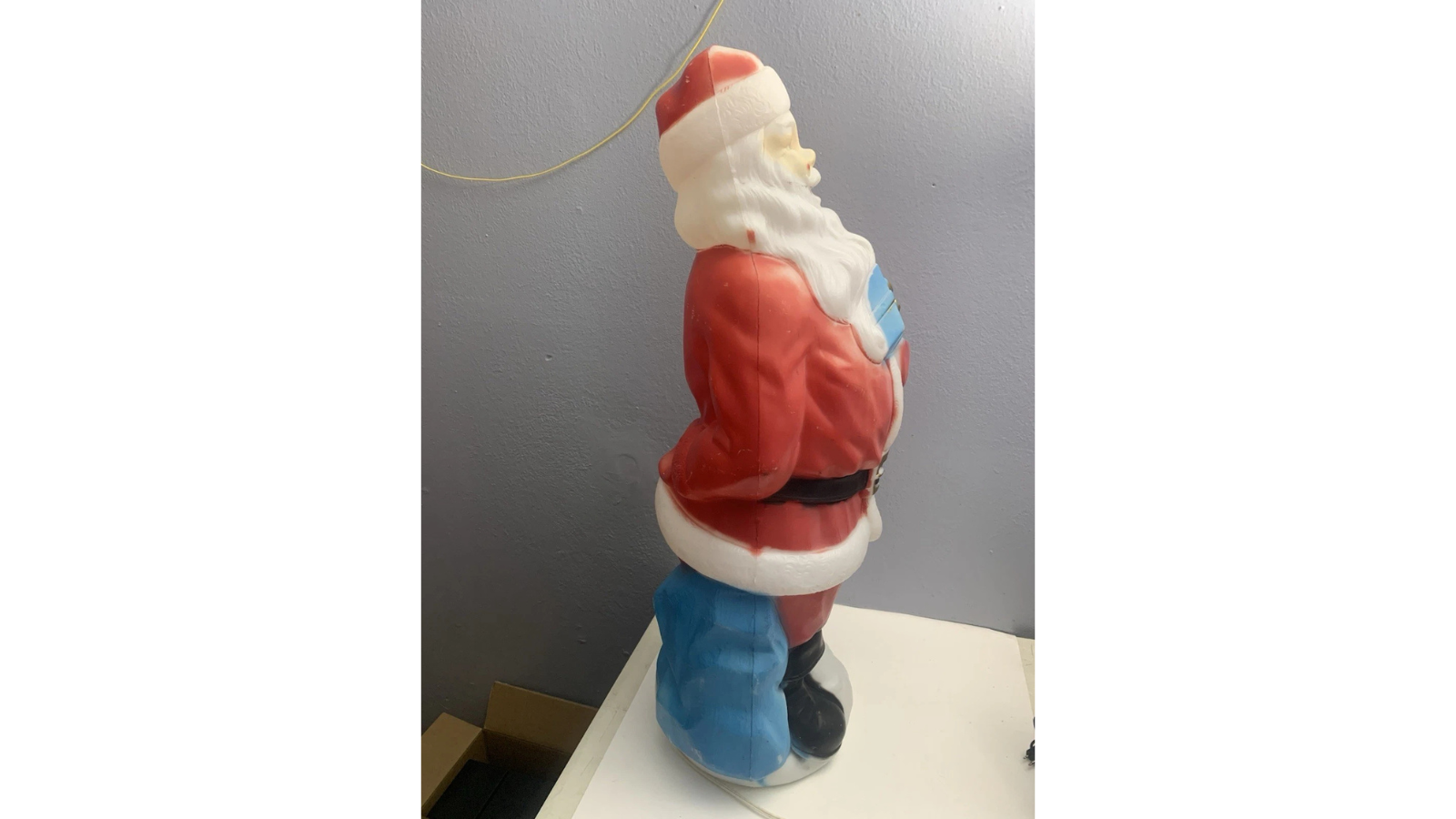
The present-holding Santa advertised as 33 inches realized $42 at an October 2026 Michigan auction. It was local pickup only; the photos show paint wear and a hole near the bottom. The stated 18% buyer’s premium brings $42 to $49.56 before tax. That’s one condition-specific result, not an appraisal for every Santa of this design.
A separate Empire Santa described as 48 inches realized $65 at another October auction, before its fees. Size alone clearly isn’t enough to assign a price.
When you’re thrifting vintage Christmas decorations, compare the same figure, finish and condition, and include fees or transport in your budget. I’d choose a sound, slightly scuffed Santa I could happily display over a cracked example with a grander price tag. Leave room in the budget for making the lights usable, then enjoy him.
You might also like…
The CorningWare Pattern Collectors Dream Of Finding At A Thrift Store
The Blue-And-White Pyrex Pattern Collectors Dream Of Finding At A Thrift Store
The Pink Pyrex Pattern Collectors Dream of Finding at a Thrift Store

