
Affiliate disclosure: This post may contain affiliate links. Please see full disclosure. AI-assisted.
A cast-iron skillet small enough to sit in your palm could be a piece of toy cookware or a pan made expressly for frying an egg. If you find a tiny Griswold or Wagner at a thrift store, turn it over before you decide which you’ve got. On a round Griswold, the combination of 0 and 562 points to a little toy skillet. On a square one, the position of the handle can tell you just as much as the writing underneath.
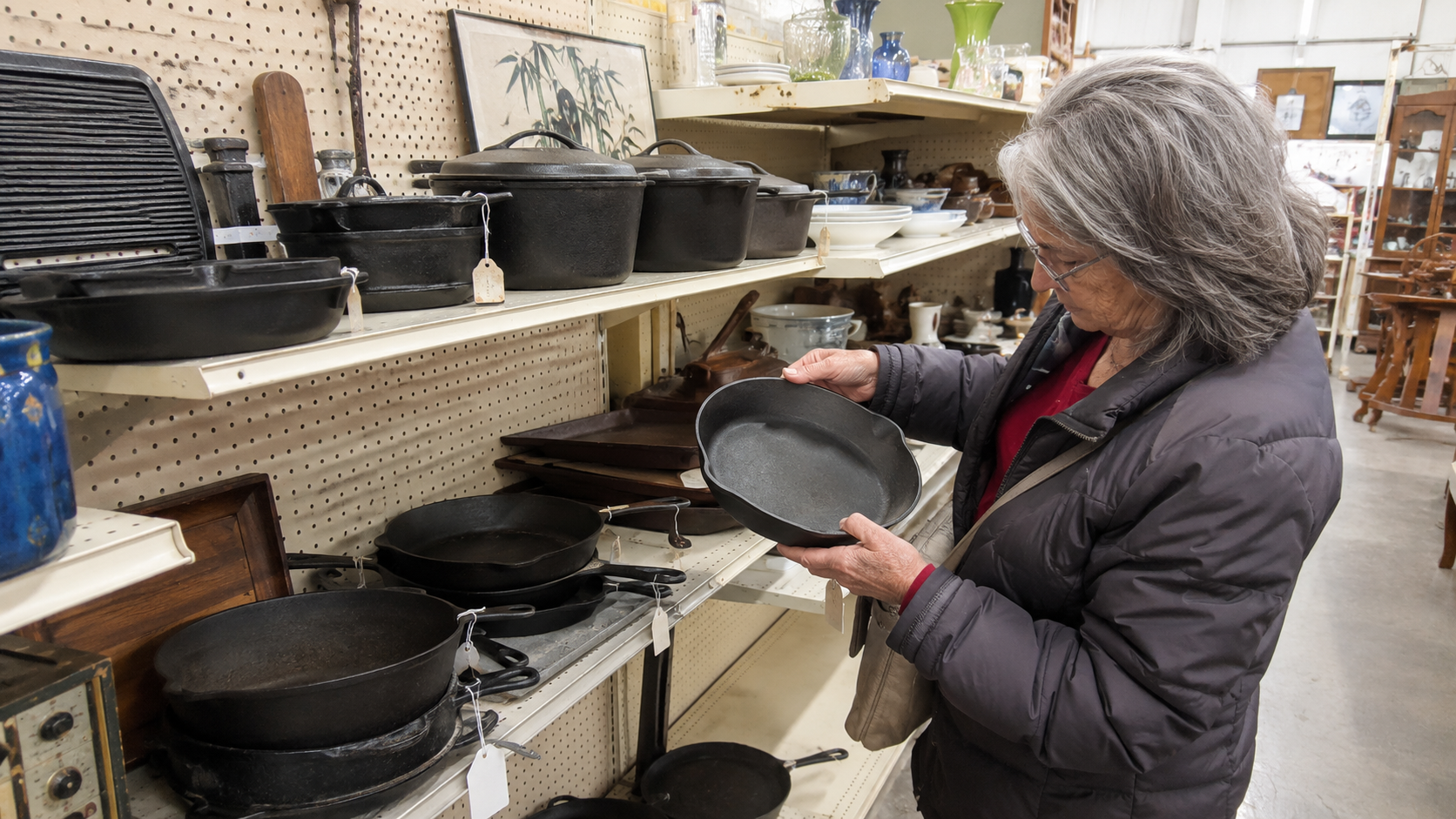
I’m a longtime thrifter, and this is exactly the sort of piece I’d pick up for a closer look. A tiny pan can have the same little pouring lips and neatly finished surface you’d expect on a bigger one. There’s a reason for that. Some of these were made as miniature versions of kitchen cookware, right down to details that would have been easy to leave off a toy.
Wagner sold miniature skillets in its toy cookware line

Wagner’s 1924 toy ware catalog page lists a 4½-inch cast-iron skillet as catalog No. 1365. The aluminum skillet on the same page was No. 850. You could buy the pieces separately or in boxed assortments with miniature kettles, griddles, and waffle irons. So if you spot a little skillet on its own, it may have been sold that way from the start.
In Wagner’s later Catalog No. 55, the 4½-inch No. 1365 was still there, alongside a 3½-inch skillet listed as No. 1367. The catalog even said the toys were large enough to cook with. That’s the bit I love. You could have a proper little pan made for a child’s set, and it could still fry something. I’d want actual provenance before paying extra for a tag that calls one a salesman’s sample. The toy catalog gives plenty of these pans a much simpler explanation.
For a useful comparison, the same 1924 catalog put the bottom of a regular Wagner No. 3 skillet at 5½ inches across. Its catalog number was 1053, sometimes followed by a letter on the casting. That makes it a small pan from the regular range. The 3 is a size designation, and the letter identifies a working pattern. If you measure your find, take a measurement across the rim and another across the bottom, leaving out the handle and pouring lips. An old catalog might be giving you the base diameter while an online listing measures across the top.
Check the Griswold numbers and where the handle joins

The classic round Griswold No. 0 toy skillet carries pattern number 562. Look for the large block cross-in-circle logo and the inset heat ring, a raised ridge set in from the outer edge of the base. The handle changed over the years, and genuine examples can have a groove underneath. The 0 is the size mark. The 562 helps identify the pattern, but you’ll want the shape, logo, and handle to agree with it. If the tiny pan is marked 00 and 570, you’re looking at the markings associated with Griswold’s skillet-shaped ashtray.
Griswold sold sets of miniature cookware in the 1930s and was still making toy skillets in the 1950s. Later pieces were also marketed to adults as one-egg skillets. That’s a change in how tiny pans were sold, and there’s some overlap in what they could do. The square models give you a particularly handy visual clue. On the square toy skillet the handle meets a straight side, while the Square Egg Skillet has its handle at a corner.
Turn a corner-handled example over and look for 129 or 53. Those are pattern numbers associated with the Square Egg Skillet. Some genuine examples even read Squar Egg, missing the final E. The 53 is generally dated to around 1960 in collector references, while the production dates for the 129 are less certain. And Griswold’s name alone can’t put a pan in the Erie foundry. Its Erie production ended in 1957, and later Griswold-branded pieces were made in Sidney, Ohio, under the same ownership as Wagner.
Look past the logo before you buy

Tiny cast iron has been copied, including the Griswold 562. Some reproductions have rough, unpolished interiors or a sideways mold number outside the heat ring. The grooved-handle version is worth comparing closely with photos of a documented original. I’d take one photo straight down at the base and another from the side so I could check the shape of the handle and the depth of the pan at home. The lettering alone only gets you so far, especially if it’s half buried under buildup.
If you want a pan for breakfast, I’d choose a clearly identified cooking skillet with a sound handle and a base that sits steadily on your stove. At the shop, set it on a flat surface and press gently at a few spots around the rim. Use your phone light to check for hairline cracks, especially from the rim down the sidewall, and look around the handle joint for damage or repairs. A little surface rust wouldn’t automatically put me off, but I’d pass on a cracked pan. If I couldn’t establish that it was cookware, I’d keep it for display. And if I mostly wanted a small pan I could use every day, I’d happily take a regular No. 3. It’s still small enough to tuck into a crowded cupboard, and the marks on vintage Griswold skillets give you something to look for the next time you’re turning pans over.
You might also like…
The Old Cast-Iron Skillet Collectors Are Always on the Hunt For
How to Rescue a Rusty Cast-Iron Pan and When It’s Time To Give Up
24 Cast Iron Skillet Recipes for Simple, Hearty Homestead Meals

