
Affiliate disclosure: This post may contain affiliate links. Please see full disclosure.
I cannot pass a pile of old cast iron at a thrift store without turning at least a few pieces over. Most of the time there is nothing particularly exciting underneath, but Griswold is one name that will make me put the skillet down, pick it straight back up, and have a much closer look.
The company grew out of an Erie, Pennsylvania, metalworking business run by Matthew Griswold and the Selden family in the late 1860s, with the business reorganized as Griswold Manufacturing Co. in 1887. It went on to become one of the best-known American cast-iron cookware makers, producing everything from skillets and Dutch ovens to waffle irons. The Erie operation lasted until 1957. A local Erie history collection describes Griswold as having a worldwide reputation for high-quality cast-iron cookware.
That reputation is exactly why the pans have two quite different groups chasing them today. Collectors want the older logos, unusual sizes, and scarcer variations. Cooks want them because a good Griswold skillet is not merely an attractive antique. Many are lighter and more finely finished than the hefty modern cast-iron pans people are used to handling.
For me, that second part matters. I like collectible kitchenware, but I particularly like the sort that can earn its keep rather than spending the rest of its life sitting on a shelf.
The logo can tell you a lot
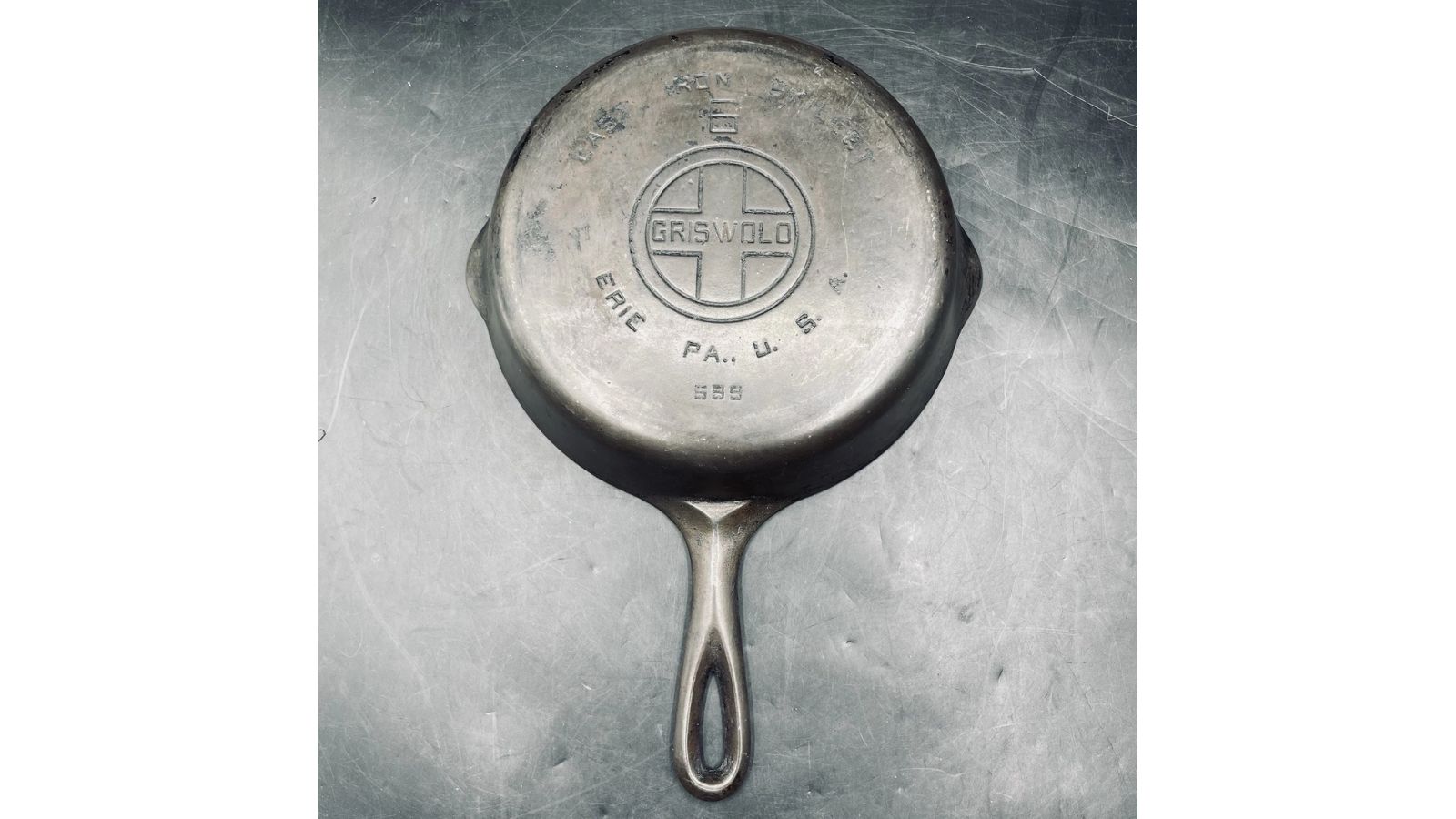
The useful thing about Griswold is that you do not need to be a cast-iron historian before you can start recognizing the important markings. Turn the skillet over and look for the famous cross inside a double circle with GRISWOLD running across the middle. The style of that lettering helps narrow down when the pan was made.
Earlier Griswold cookware can be marked simply “ERIE,” and the company went through several other marks before the familiar cross logo became standard. The “slant” version has Griswold written in italic-style lettering across the cross. Collector records generally date slant-logo skillets from the early 1900s through the 1920s, with some later exceptions.
Around 1920, the lettering became upright and bolder, creating what collectors call the large block logo. These are easy to spot because the trademark takes up a substantial chunk of the underside, and many examples also carry wording such as “CAST IRON SKILLET” and “ERIE, PA, U.S.A.” The smaller block logo appeared around 1939 and remained in use through the end of Griswold’s Erie production in 1957.
I would not buy a battered pan purely because it has the “right” logo, but learning these basic marks makes thrift-store hunting far more interesting. Suddenly that row of apparently identical black skillets is not identical at all.
Why cooks still chase old Griswold skillets
Collectors can argue about logos and pattern numbers for hours, but there is a much simpler reason I would happily bring the right Griswold home: they are lovely pans to actually use.
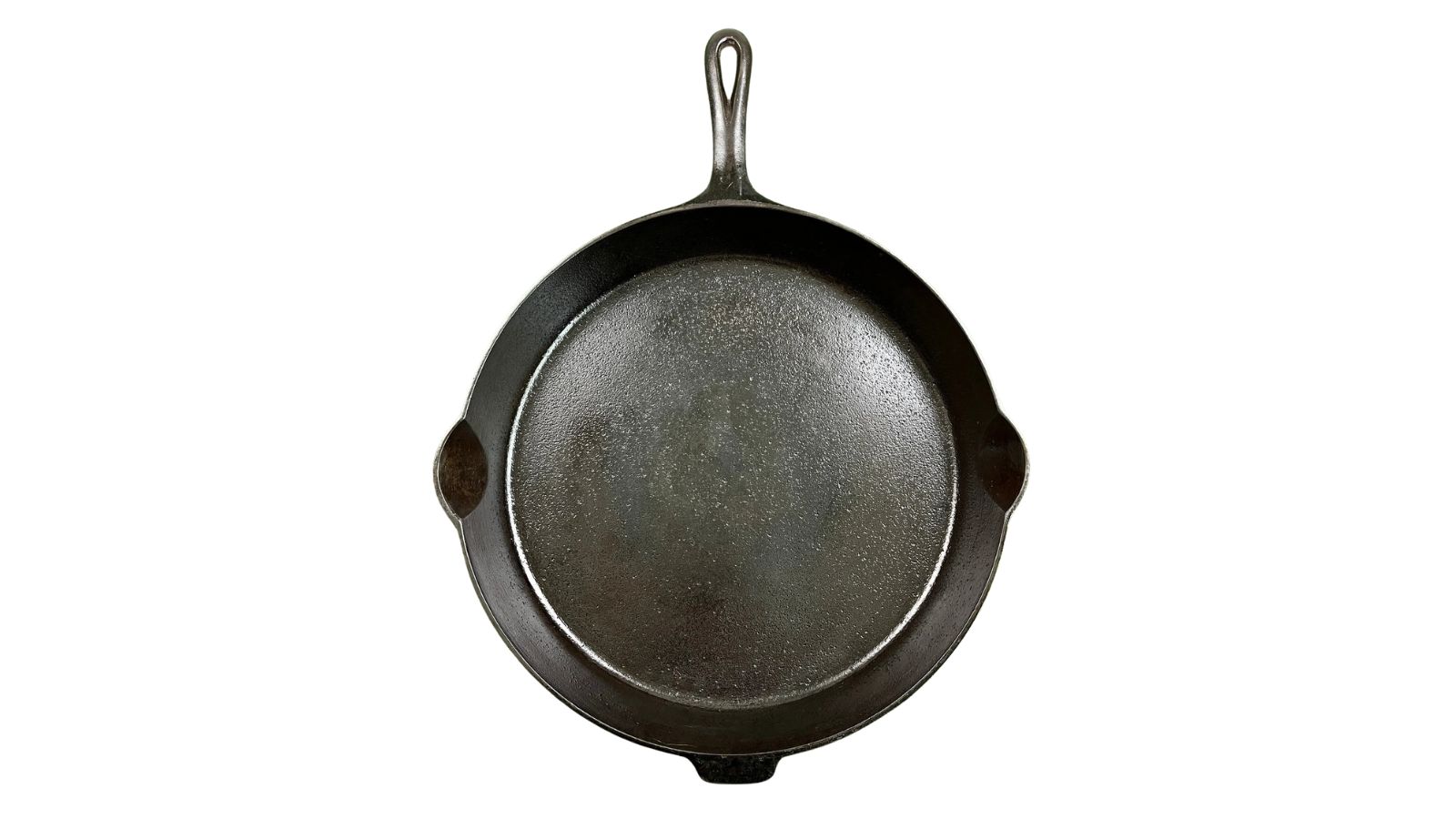
One of the first things you notice when handling good vintage cast iron is the finish. Many older skillets have a much smoother cooking surface than inexpensive modern cast iron, which often retains the pebbled texture left by the sand mold. Older American cookware was commonly given additional finishing work, and Griswold became particularly well known for the quality of its casting and machining. Even later small-block Griswold skillets are generally regarded as comparable in manufacturing quality to the earlier large-logo pans.
They can also feel surprisingly civilized for cast iron. A vintage Griswold may be thinner and lighter than the hulking skillet you are accustomed to lifting with both hands. That does not make it flimsy. It makes it considerably more pleasant when you are moving a hot pan between stovetop and oven or simply trying to wash the thing without doing an impromptu forearm workout.
Of course, age is not automatically a virtue. Old cast iron can warp, crack, pit, or suffer serious heat damage. I always place a skillet on a flat surface and press around the rim and handle. If it rocks badly or spins, I leave it behind unless it is something genuinely exceptional. Cosmetic rust does not frighten me nearly as much as a crack or badly warped base.
Condition, size, and logo all matter
Finding the word Griswold does not automatically mean you have uncovered a retirement fund in the cookware aisle. Some pieces are fairly common. Others are considerably harder to find, and values can change dramatically depending on the size, logo, pattern, and condition.
Collectors generally prefer earlier pieces, particularly those with the older ERIE markings, slant logos, and large block logos. Later small-block pieces are usually considered less valuable than earlier Griswold cookware, even though their overall quality can still be excellent. That actually makes the later pans rather appealing if, like me, you want something good enough to collect but not so precious that frying an egg in it feels like vandalism.
The rarer sizes and variations are another matter. Auction results show just how wide the gap can be between ordinary user-grade Griswold and genuinely scarce examples, with individual Griswold pieces ranging from relatively modest prices to hundreds or even thousands of dollars depending on rarity.
At a thrift store, though, I am not standing there trying to calculate an auction estimate. I am checking for a recognizable mark, a flat base, no cracks, a decent cooking surface, and a price that makes sense. Find all of those together and you have the best sort of collectible kitchenware: something with genuine history that can still make dinner.

