
Affiliate disclosure: This post may contain affiliate links. Please see full disclosure.
Fire-King Sheaves of Wheat is one of the prettiest jadeite patterns you could hope to uncover in a thrift-store stack. Instead of the familiar plain or ribbed green plates, these dishes have little bundles of wheat molded into the glass. The design is subtle until you catch it in the light, and then it’s unmistakable.
I’ve always had a soft spot for vintage kitchenware that was made to be used, not just admired. This is exactly that sort of glass. Its warm, harvest-inspired decoration looks wonderful on a kitchen shelf, but the little details also make it a genuinely interesting pattern to identify.

A short-lived jadeite design with an older-fashioned name
Anchor Hocking produced the jadeite Sheaves of Wheat pattern in the late 1950s, generally dated to 1957 through 1959. Some collector references narrow its production to 1957 and 1958, so those dates aren’t quite as settled as you’ll sometimes see claimed. Either way, this was a brief run compared with better-known Fire-King lines.
Here’s a lovely bit of collecting trivia: “Sheaves of Wheat” is the collectors’ nickname. Historical references call it simply “Wheat.” That’s useful to remember because Anchor Hocking also made a later wheat-themed pattern. The two shouldn’t be mixed up just because a seller uses the same word.
The late-1950s version has wheat actually raised in the glass, rather than applied as a picture or decoration. That distinction matters far more than a listing title, which can be surprisingly creative when a dish is an attractive shade of green.
Look for wheat molded around the edges

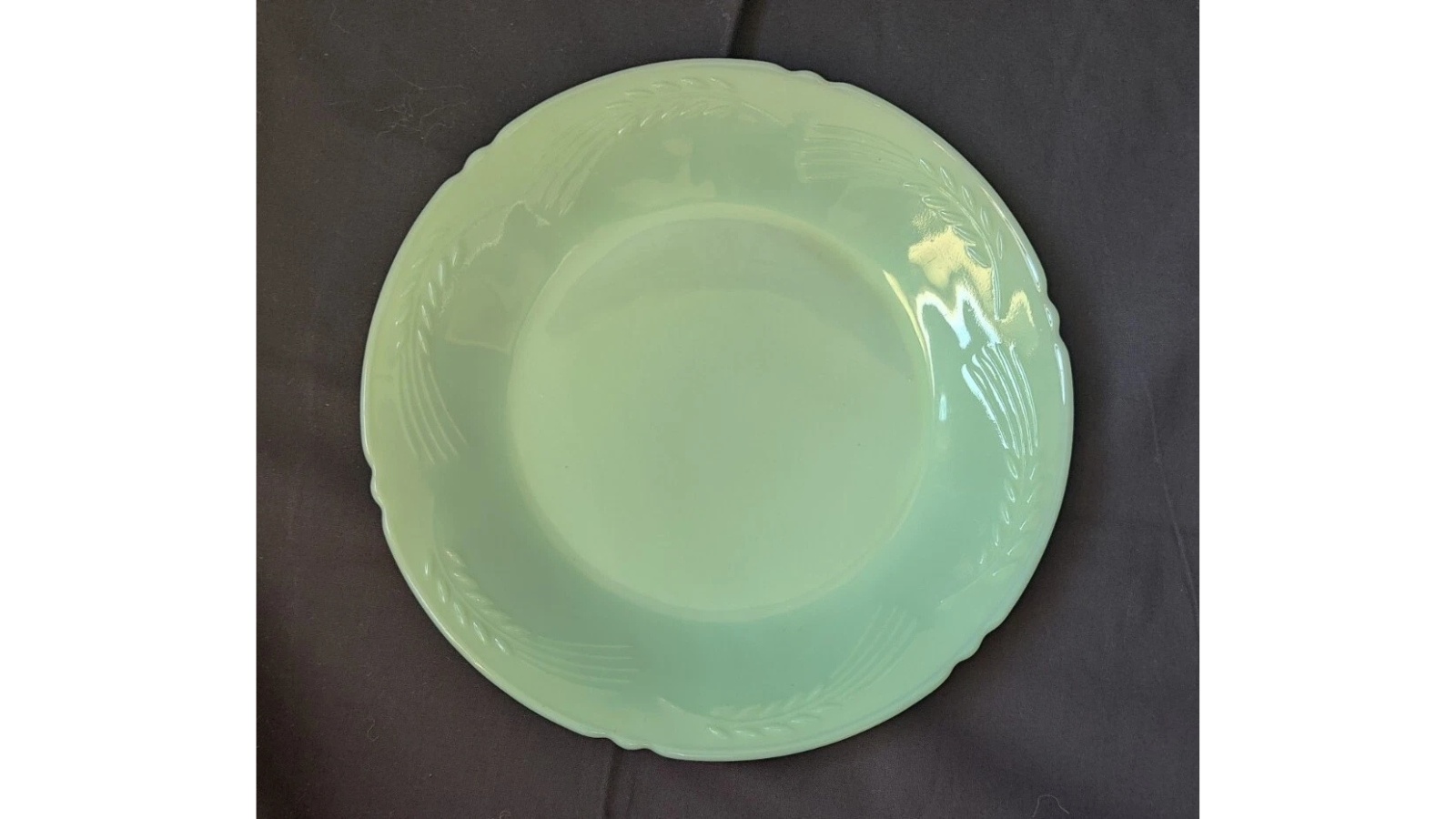
On a Sheaves of Wheat dinner plate, the grain motif runs around the outer border. You’ll see upright stalks and tied-looking bundles, with the details forming part of the glass itself. The rim also has shallow notches, giving the plate a gently shaped edge rather than a perfectly round, smooth outline.
The saucer has a similar notched rim and the same wheat decoration. Cups show the design around their outside walls. I recommend holding a possible find sideways under a good light, because the raised details can disappear into the soft, opaque jadeite color when you’re looking straight down.
Don’t confuse it with Fire-King Jane Ray, which has repeated narrow ribs radiating across the surface, or the earlier Alice pattern, which uses flowers rather than sheaves of grain. Nor is every green piece with wheat on it this particular Fire-King design. The motif must be molded, and the shape should agree with documented examples.
Which plates and bowls really belong to the line?
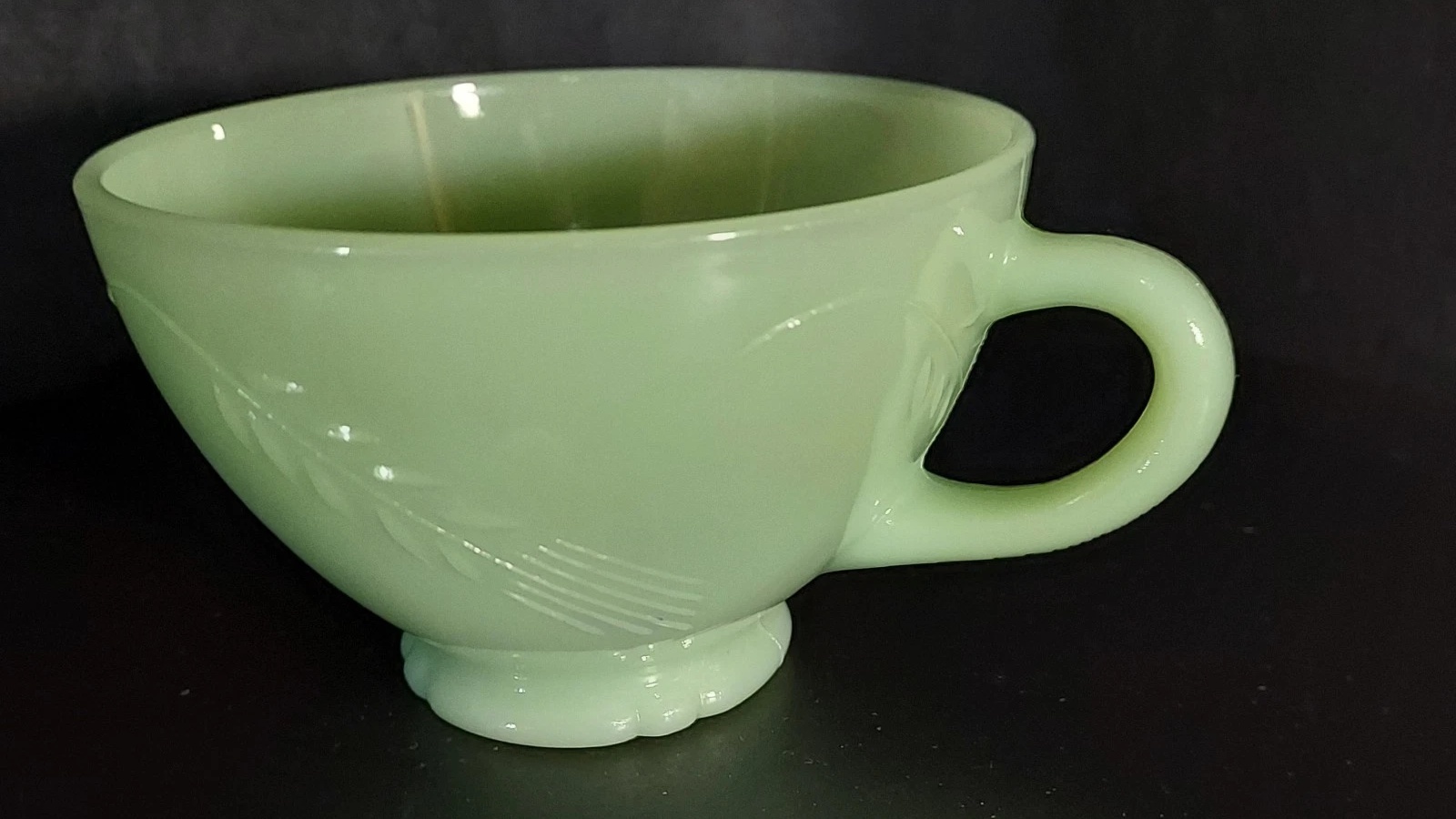
The established jadeite pieces include a roughly 9-inch dinner plate, a 6-inch saucer, a small handled cup of about 6½ fluid ounces, and a 4½-inch berry or dessert bowl. That small bowl is sometimes called a nappy, an old glassware term for a shallow open serving bowl. It’s an especially appealing size for a little fruit or a handful of nuts.
Collector guides also describe a 7-by-10-inch snack tray in jadeite. There are differences between identification references about how many forms belong to the line, however. A replacement-dinnerware catalog separately lists a finger bowl and coupe soup bowl. Those labels don’t necessarily establish entirely different original molds, so I wouldn’t claim every differently named bowl was a distinct factory-issued piece without comparing its actual dimensions and shape.
The pattern was also made in clear glass, sometimes described as Crystal. Clear tumblers are documented, but that doesn’t mean a jadeite tumbler existed. I would be particularly cautious about a supposedly matching wheat pitcher, mug, or enormous mixing bowl unless it could be matched to a reliable pattern reference.
Don’t expect a Fire-King stamp on the bottom

This is the detail that trips up collectors. Original jadeite Sheaves of Wheat pieces are documented as unmarked. You shouldn’t expect to turn one over and find the words FIRE-KING, OVEN WARE, or a special Sheaves of Wheat stamp molded into the underside.
Those words do appear on other genuine Fire-King products, and the Anchor Hocking anchor-and-H trademark is another real maker’s mark. But a general guide to Fire-King backstamps cannot tell you that this particular piece ought to bear one. Likewise, a tiny molded number, an imagined logo, or a missing label isn’t conclusive evidence on its own.
My advice is to start with the wheat design, the known form, its proportions, and the opaque green glass. Compare all of those with a documented example. An unmarked base is entirely consistent with the pattern, but it isn’t a guarantee of authenticity by itself.
Check condition before you bring it home

These pieces are decades old, so a little surface wear is hardly shocking. But I still check the areas most likely to take a knock. Run your eyes carefully around the notched rims of plates and saucers, especially where the edge curves inward. Little chips can hide there.
Check a cup’s lip and the points where the handle joins the body. On bowls, tilt the surface toward the light to look for utensil scratches, cloudy patches, or fine hairline cracks. An ordinary scratch may be perfectly acceptable to you; a crack is something I’d take much more seriously, especially if you hope to use the dish.
Clean older jadeite gently with mild dish soap, warm water, and a soft cloth. I wouldn’t put a treasured piece through the dishwasher, scrub its molded decoration with abrasives, or subject it to abrupt temperature changes. There’s no reason to make an old plate prove it can survive modern kitchen punishment.
And there’s no need to assemble an entire matching set. A single wheat-decorated saucer or little dessert bowl is lovely in its own right. That’s what I enjoy about collecting practical vintage glass: each secondhand find has a history, and it doesn’t need to be complete to deserve a place in your kitchen.
You might also like…
The CorningWare Pattern Collectors Dream Of Finding At A Thrift Store
The Blue-And-White Pyrex Pattern Collectors Dream Of Finding At A Thrift Store
The Pink Pyrex Pattern Collectors Dream of Finding at a Thrift Store

