

Affiliate disclosure: This post may contain affiliate links. Please see full disclosure.
A speckled beige bowl covered in tiny brown mushrooms is exactly the sort of thing you could miss on a crowded thrift store shelf. Forest Fancies doesn’t have the bright turquoise, pink, or orange colors people often associate with vintage Pyrex. It’s brown, cream, a little odd, and very obviously from the early 1980s. That’s also much of its charm.
Forest Fancies was introduced in 1981 and remained in production through 1986, making it one of the final patterns produced on Pyrex’s familiar opaque opalware. It sits alongside Autumn Harvest, Shenandoah, and Colonial Mist as one of the last four decorated opalware patterns still being made before that line disappeared. That puts Forest Fancies at an interesting point in Pyrex history. It wasn’t an experimental one-off, but it arrived when the classic patterned Pyrex range was already shrinking.
The design has held up rather well, too. The earthy colors and unapologetically mushroom-heavy artwork feel less dated than plenty of early-’80s kitchenware. Among the retired ’80s Pyrex patterns, Forest Fancies is one of the easiest to recognize once you know what you’re looking for.
Forest Fancies came at the end of opal Pyrex
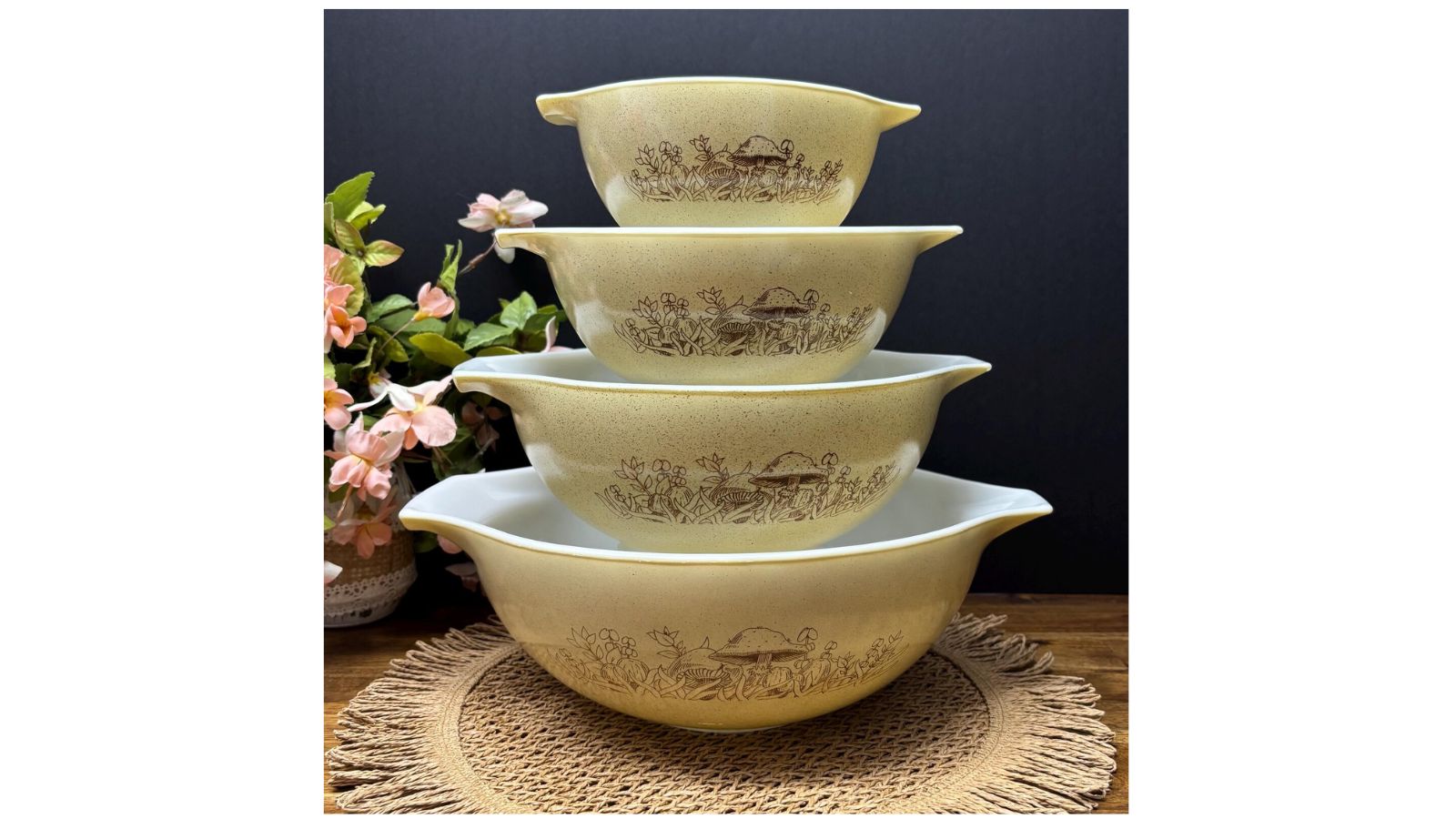
Forest Fancies was designed by Marc G. Rubin and replaced the earlier Homestead pattern. Homestead had already used a brown-speckled look, but Forest Fancies leaned much harder into the woodland theme. Its warm almond-colored exterior was decorated with dark brown mushrooms, leaves, and low-growing plants, with a white opalware interior. The original marketing played up the idea of an enchanted forest floor, which is an unusually accurate bit of advertising copy. The dishes really do look like somebody illustrated the damp patch beneath a log.
More interestingly, Forest Fancies tells you quite a bit about what was happening to Pyrex by the 1980s. The range was no longer being produced across the huge variety of shapes familiar from earlier decades. By the time Forest Fancies arrived, refrigerator sets, divided dishes, and oval casseroles were no longer part of the lineup. Instead, Forest Fancies appeared on mixing bowls, Cinderella bowls, Bake, Serve and Store dishes, and round casserole sets, with some larger casseroles available individually.
The lids are another useful detail. Forest Fancies casseroles originally came with clear glass lids rather than the opaque lids seen with Homestead. In 1986, production of Forest Fancies ended along with the rest of Pyrex’s decorated opalware line. It is therefore not simply a mushroom pattern from the ’80s. It belongs right at the end of a much longer run of patterned kitchenware.
How to recognize Forest Fancies at a thrift store
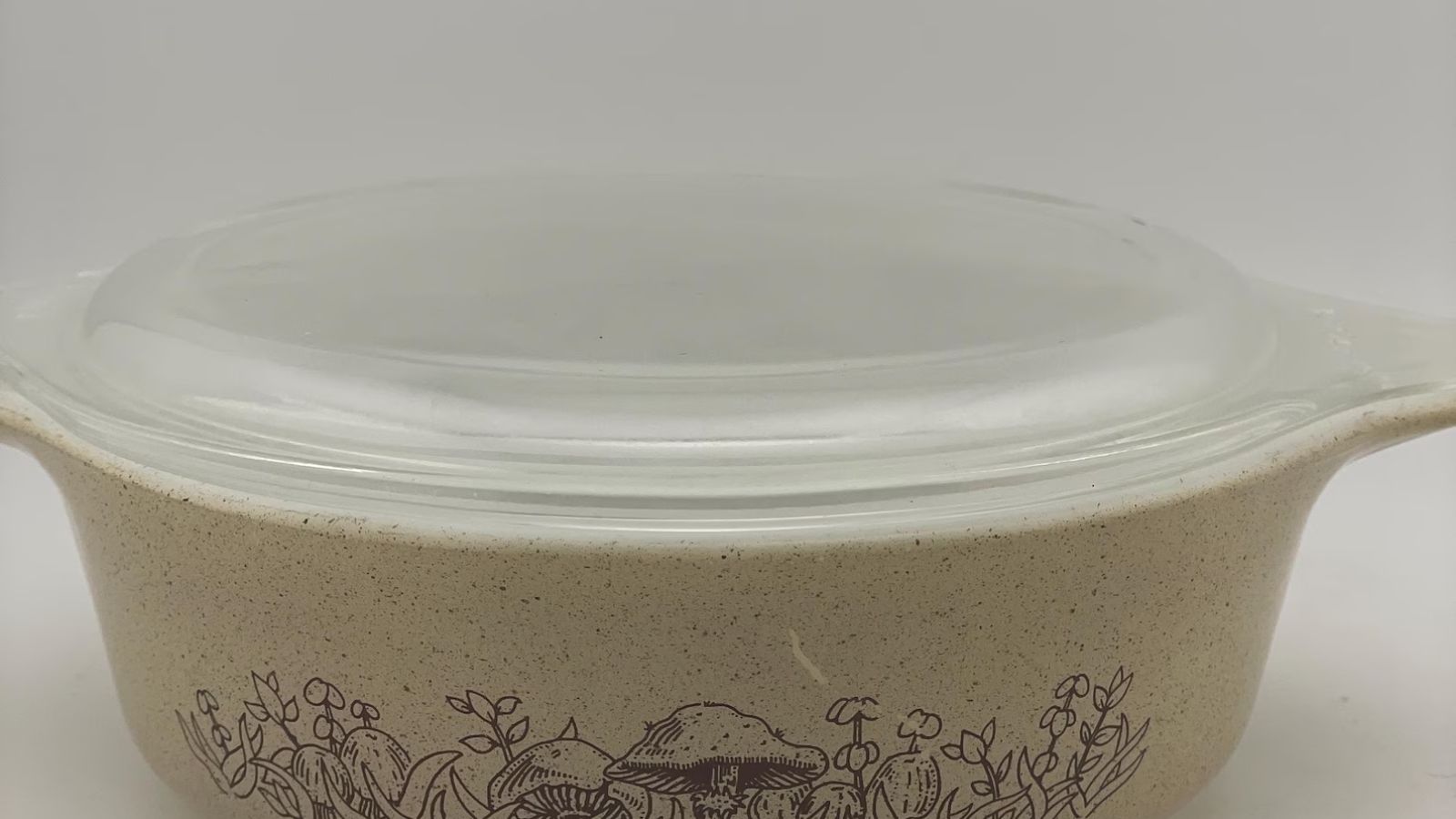
The color is your first clue. Genuine Forest Fancies pieces have a warm tan or almond-speckled exterior rather than plain white glass, with the decoration printed in dark brown. Look closely at that decoration and you’ll see a surprisingly detailed little patch of vegetation, including several mushrooms of different sizes among leaves and grasses. The interiors are white, which makes the brown-speckled exterior particularly easy to spot when bowls are stacked together.
Shape matters as much as the artwork. Forest Fancies was made in three- and four-piece mixing bowl sets, four-piece Cinderella bowl sets, round casserole sets, and the smaller Bake, Serve and Store dishes. If you find a casserole with its original lid, that lid should be clear glass. An opaque lid from another Pyrex pattern may fit perfectly well, but it isn’t the original Forest Fancies pairing.
It’s also worth remembering what you shouldn’t find. There was no Forest Fancies refrigerator set or divided dish because Pyrex had already stopped making those forms by this point. The smaller selection was a consequence of Forest Fancies arriving so late in the opalware era.
For a keeper, look past the excitement of seeing mushrooms and check the actual piece. Inspect the rim and handles for chips, look carefully for cracks, and see how much of the brown decoration remains. Some wear is hardly surprising after roughly four decades in somebody’s kitchen. A crisp mushroom scene on an intact bowl, though, is the sort of thrift-store find that deserves a second look.
You might also like…
The CorningWare Pattern Collectors Dream Of Finding At A Thrift Store
The Blue-And-White Pyrex Pattern Collectors Dream Of Finding At A Thrift Store
The Pink Pyrex Pattern Collectors Dream of Finding at a Thrift Store

