
Affiliate disclosure: This post may contain affiliate links. Please see full disclosure.
The lid on a Dansk Kobenstyle casserole doubles as a trivet, so you can bring the pot straight to the dinner table. Turn the lid upside down, with its distinctive crossed handle underneath, and the lid becomes a stand for the casserole. Designed by Jens H. Quistgaard, these colorful midcentury pots combine Scandinavian styling with useful details.
Years of thrifting and collecting have made me fussy about enamel condition and completeness. A sound interior and correctly fitting lid matter more than finding the perfect shade of turquoise. Knowing the differences between early Danish production, later French pieces, and modern reissues also helps you recognize what you’re looking at.
How to identify a Dansk Kobenstyle casserole

Kobenstyle casseroles have rounded bodies, smooth enamel finishes, and sculptural metal handles welded to their sides. They’re made from enamel-coated steel, not cast iron, making them noticeably lighter than many traditional casseroles.
The lid is the most recognizable feature. Instead of an ordinary knob, it has a raised X-shaped handle. When inverted on a stable, heat-suitable surface, the handle sits underneath while the casserole rests on the lid itself. You’ll still need oven mitts to handle hot pieces.
When examining a secondhand casserole, check that the lid fits the rim evenly and doesn’t rock excessively. Look closely at the crossed handle, too. It should be intact and securely attached. A mismatched lid might fit poorly or lack the original trivet function.
Kobenstyle came in several sizes and forms, including saucepans with wooden handles. Those belong to the same collection but have different care requirements from the double-handled casseroles.
Original Kobenstyle colors and later additions
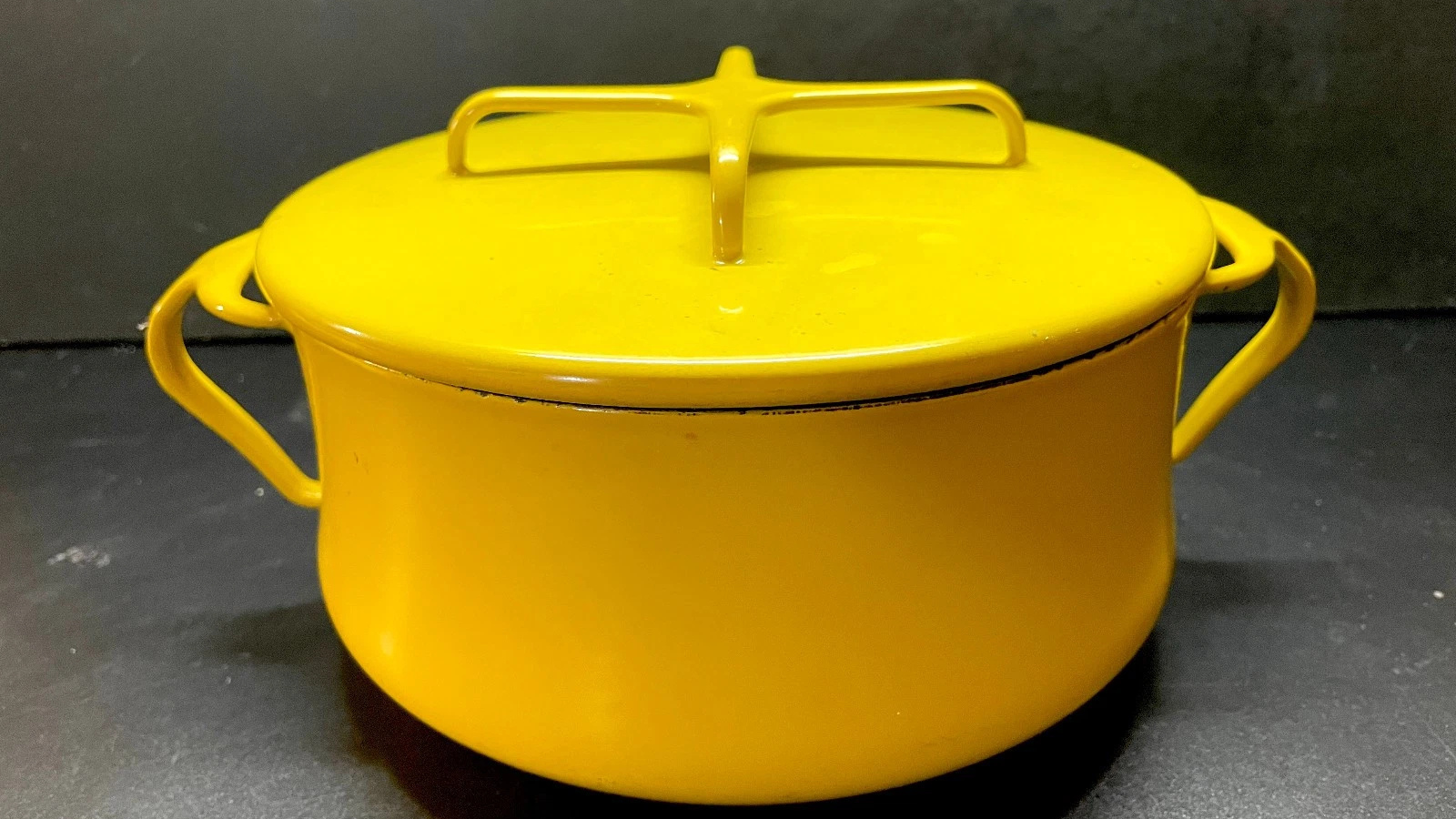
The earliest Kobenstyle colors included Chinese red, turquoise, mint green, and yellow. All four were already advertised in 1955, making them useful reference points when identifying early pieces.
Although Kobenstyle is usually dated to 1956, its design and advertising history reaches back to 1955.
The palette expanded over subsequent decades. Blue, black, white, orange, brown, and additional greens appeared during the 1960s and 1970s. Earlier turquoise and mint green finishes can look different from later blues and greens, but shades aren’t reliable enough to establish an exact manufacturing period.
Some collector descriptions use terms such as lime green rather than mint green, which can make comparisons confusing. It helps to compare examples of vintage production rather than relying entirely on a seller’s color description.
Kobenstyle returned to production in 2012 after a lengthy absence, with familiar shapes and colors appearing again.
Red, yellow, and blue versions are available as modern pieces, so a classic-looking color doesn’t guarantee vintage age. That’s worth remembering when building a kitchen collection around recognizable vintage dishware designs. Markings and construction provide stronger clues than color alone.
Understanding Dansk marks and production dates

Turn the casserole over and examine the entire underside. The country of manufacture and wording of the mark can help narrow its age, although neither provides an exact manufacturing year.
Early Danish-made examples may carry Dansk Designs Denmark, the initials IHQ, and sometimes a circular symbol featuring four ducks. Markings varied, so don’t expect every authentic early casserole to have precisely the same stamp.
IHQ identifies Jens H. Quistgaard. It isn’t a date code, and its presence doesn’t establish a particular year.
Manufacturing shifted from Denmark to France around the mid-1960s. French-made examples can be marked Dansk Designs France IHQ or Dansk International Designs France IHQ.
A France mark doesn’t mean you’ve found a reproduction. French production is part of Kobenstyle’s vintage history. Likewise, Dansk International wording doesn’t pinpoint an exact year.
Modern versions, including examples associated with the 2012 relaunch, may be marked Thailand. The current collection is designed in Denmark and made in Thailand, so don’t mistake a statement about design origin for proof of Danish manufacture.
I prefer photographing the complete underside and checking the logo, wording, country, material, and overall design together. An unmarked piece isn’t automatically fake, but I wouldn’t assign it a confident date without several consistent identifying features.
Check the enamel carefully before buying
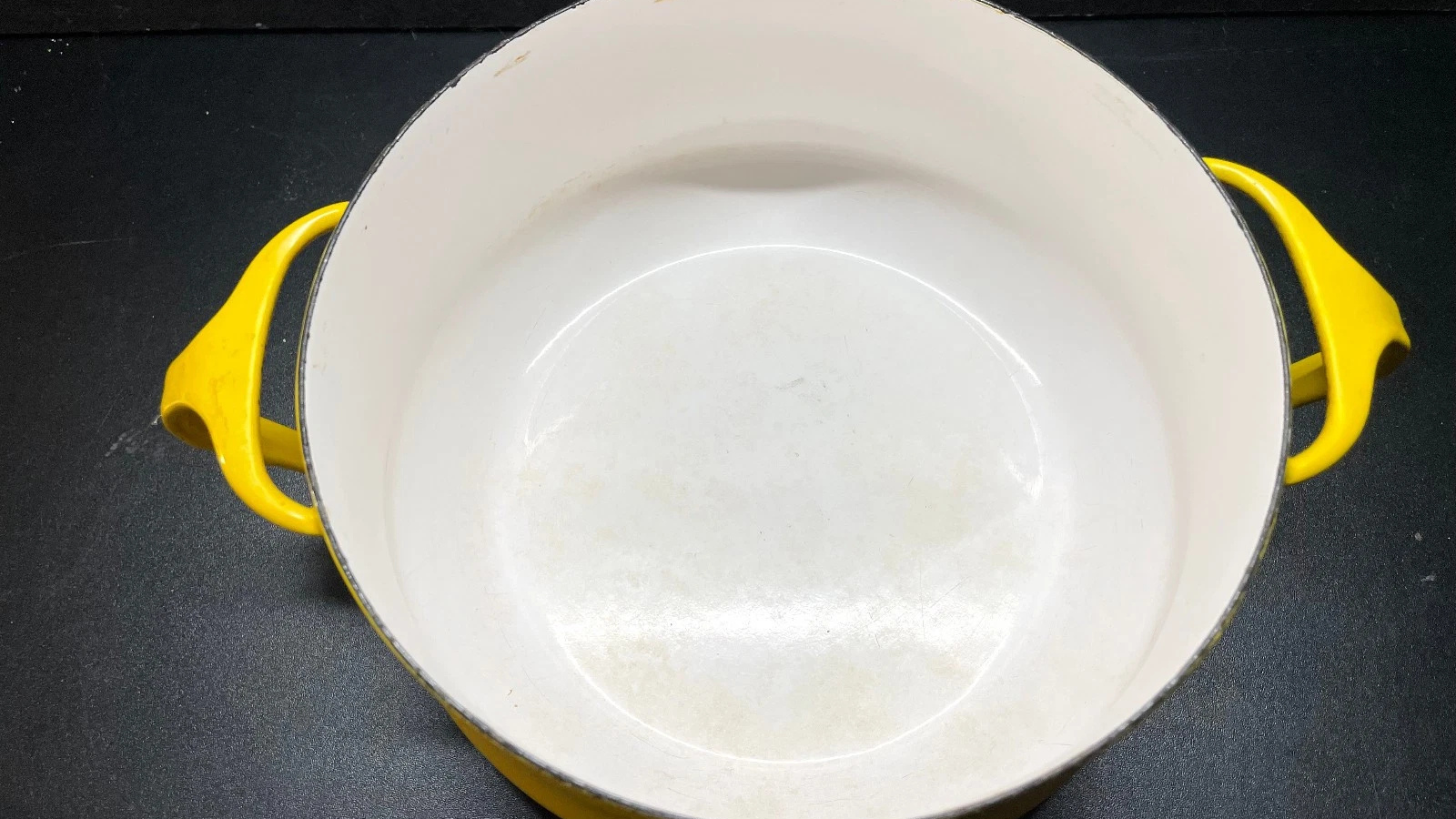
An intact interior and matching lid outweigh an attractive color every time. A less fashionable casserole in excellent condition is a better choice than a bright red example with damaged cooking enamel.
Inspect the interior under bright, angled light. Check the base and curved sides for chips, exposed steel, rust, flaking enamel, and fine networks of hairline cracks known as crazing. These cracks can be difficult to spot without changing the angle of the light.
Ordinary staining isn’t the same as missing enamel, but don’t assume discoloration will clean away. I would pass on a casserole with chipped, deeply cracked, flaking, or rusty interior enamel if I wanted something for cooking. Visual inspection alone also cannot establish the food safety of vintage enamel.
Next, examine the rim, underside of the lid, welded handle joints, and bottom. Watch for dents, loose handles, rust, and warping that makes the casserole wobble. Inspect suspicious chips visually rather than touching potentially sharp edges.
Don’t mistake the original black rim finish for damage. Look for jagged gaps, missing enamel, and exposed metal before deciding whether a dark area is rust or a chip.
A damaged example can still be attractive as a display piece, provided it’s kept out of cooking use.
To preserve enamel in good condition, heat gradually over low to medium heat, avoid heating an empty casserole, and allow it to cool before washing. Use warm, soapy water and a soft sponge, then dry thoroughly. Avoid abrasive cleaners, steel wool, dishwashers, microwaves, and metal utensils. Sudden temperature changes can also damage the enamel finish.
Check the instructions for your particular model before oven use, especially if it has wooden handles. With proper care, a well-preserved Kobenstyle casserole can remain a useful part of your kitchen rather than sitting permanently on display.
You might also like…
The Old Cast-Iron Skillet Collectors Are Always on the Hunt For
How to Rescue a Rusty Cast-Iron Pan and When It’s Time To Give Up
24 Cast Iron Skillet Recipes for Simple, Hearty Homestead Meals

