
Affiliate disclosure: This post may contain affiliate links. Please see full disclosure.
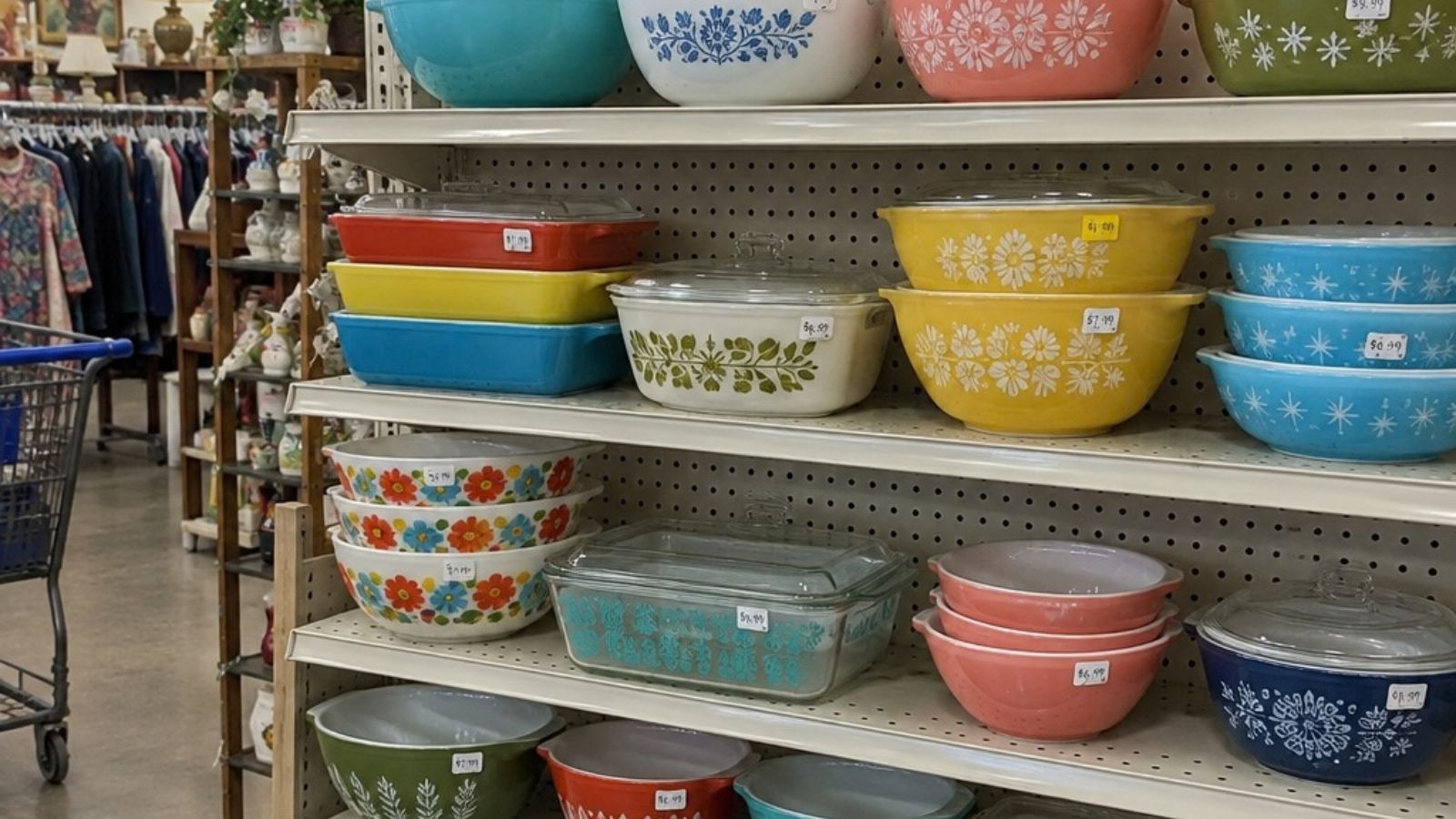
Those little rectangular Pyrex dishes in red, blue, and yellow are worth a much closer look when you come across them at a thrift store. They’re part of the original Primary Colors refrigerator set, introduced in 1947, and they’re every bit as appealing today as they were in a midcentury kitchen.
The set is known as Pyrex 500, or the Oven-Refrigerator Set, and it isn’t simply a collection of pretty glass containers. Its four dishes were designed to fit together neatly, with clear glass lids that allowed you to see what was inside. It’s practical, space-conscious kitchenware that also happens to be rather lovely.
As an avid thrifter and collector, I have a soft spot for things that were made to earn their place in the kitchen. These dishes have exactly that appeal. Even a single surviving piece can be a satisfying find, especially when its original lid is still intact.
The colorful Pyrex set designed for real kitchens

The familiar Primary Colors mixing bowls arrived in 1945, but the refrigerator dishes followed two years later. Corning’s test kitchen had a direct hand in their development. Lilla Cortright helped research the stackable design, and test kitchen staff had prototypes tried in a Pennsylvania community before the finished products were released.
That practical testing explains what makes the set so clever. The smaller containers weren’t just made in different capacities. They were proportioned to sit side by side on top of the largest dish, creating a tidy stack instead of a jumble of mismatched containers.
The original set had four rectangular dishes in three sizes, each with its own clear glass lid. Two were red, one blue, and the largest a cheerful yellow. Unlike the iconic four-color mixing bowl set, there’s no green dish in the original refrigerator set.
The colored exteriors were applied to white opal glass, so the interiors were white. It’s an attractive contrast, and one of the easiest details to notice when you’re examining an individual piece.
Know your 501, 502, and 503 dishes

The numbers molded into the bases are particularly useful when you’re hunting for individual pieces. The original configuration is quite specific, and knowing it saves you from trying to match an unrelated Pyrex dish to the set.
501: The two small red dishes
A complete 500 set has two red 501 containers, each holding 1 1/2 cups. They’re small enough for leftovers, a little butter, or other odds and ends from the kitchen. Their straight-sided rectangular shape and bright color make them easy to recognize once you’ve seen a few.
502: The medium blue dish
The blue 502 holds 1 1/2 pints, or 3 cups. It sits alongside the two red dishes on top of the yellow base container. This is an especially useful piece to learn because blue Pyrex refrigerator dishes from other collections can look quite similar at a glance.
503: The large yellow dish
The yellow 503 holds 1 1/2 quarts, or 6 cups. It’s the foundation of the stack, with the three smaller containers arranged over its lid. It’s also the only size in the original set with handles on the dish and lid. Without its lid, you might easily mistake one for a small baking dish or loaf pan.
The clear lids are part of what makes these pieces so appealing. They’re glass rather than plastic, and the design allows the dishes to stack with the lids in place. They aren’t modern airtight food-storage boxes, though, so don’t expect a leakproof seal.
The lid detail that helps date a find

One of the most interesting things about the Pyrex 500 series is that the clear lids changed over time. If you’re building a period-correct collection, this is worth checking before you get too excited about finding a replacement.
The earliest lids, used from the 1947 introduction until roughly 1959, have narrow raised ribs running lengthwise along the top, with a smooth strip down the center. Turn one over and the underside is smooth.
Later lids have a smooth upper surface instead, with wider-spaced ribs or fluting underneath. That change seems to have happened around 1960. The original Primary Colors scheme was sold long enough that you can encounter it with either legitimate style.
Both versions fit dishes of the corresponding size, which is useful if you actually want to use your collection. But it also means a later lid could have been paired with an earlier base. A rib pattern helps you estimate the period of a lid; it doesn’t prove the whole dish and lid left the factory together.
Check for the molded Pyrex markings and appropriate lid size rather than assuming any ridged glass cover is correct. Some similar-looking European lids fit particular dishes but weren’t originally made for these American sets.
What to inspect at the thrift store

My first check is always the rim and the lid. Glass lids are often the vulnerable part of vintage refrigerator dishes, especially around the corners and edges. Hold the pieces to the light and look carefully for tiny chips, hairline cracks, and rough spots. Take particular care around the handles on a 503.
Next, look at the paint. It’s normal to see some wear on glassware that’s spent decades being handled, washed, and stacked. A little scuffing doesn’t bother me nearly as much as a damaged rim. But large areas of missing color can spoil the effect if you’re collecting for display.
Turn the dish over and read the molded number. You’ll commonly see variations such as 501, 502, or 503 with additional letters or digits. Those differences aren’t automatically signs of a fake, and minor changes to molds and markings occurred during production.
If you find a lidless dish, don’t dismiss it. Completing a set one piece at a time is part of the fun of thrifting. Just remember that finding the correct undamaged glass lid may take more patience than finding another colorful base.
Enjoying your vintage Pyrex finds

There’s something wonderfully cheerful about that yellow, blue, and red stack on an open kitchen shelf. I wouldn’t insist on having all four dishes before enjoying one or two. A bright yellow 503, for example, is attractive enough on its own.
For care, hand-wash with a soft cloth and gentle dish soap to help preserve the colored finish. Skip abrasive cleaners and the dishwasher. I also wouldn’t use decades-old pieces for sudden temperature changes or treat them like modern freezer-to-oven cookware. If the decoration is worn or you’re uncertain about the condition, display or dry storage is a sensible choice.
For me, the appeal is the combination of cheerful design and genuinely thoughtful engineering. The original Pyrex 500 set wasn’t made simply to look pretty. Every size had a purpose, and the dishes fit together in a way that’s still satisfying to see almost 80 years later. That’s exactly the sort of vintage kitchenware I love finding among the ordinary thrift-store shelves.
You might also like…
The CorningWare Pattern Collectors Dream Of Finding At A Thrift Store
The Blue-And-White Pyrex Pattern Collectors Dream Of Finding At A Thrift Store
The Pink Pyrex Pattern Collectors Dream of Finding at a Thrift Store

