
Affiliate disclosure: This post may contain affiliate links. Please see full disclosure.
When people talk about “the biggest spider,” they’re usually mixing two different records: the longest leg span and the heaviest body. A few species are genuine monsters on both counts. Others are lighter but stretch an impressive distance from tip to tip.
Most of these spiders are shy, nocturnal ambush hunters. They eat insects, frogs, small lizards, and the odd unlucky rodent. Almost all of them would much rather sprint away from a human than bite one.
Below are 18 of the largest spiders known, focusing on both bulk and leg span.
1. Giant huntsman spider (Heteropoda maxima)

The giant huntsman from Laos is the current leg-span record holder. Measured adults can reach around 25–30 cm across, which is roughly the width of a dinner plate or two U.S. dollar bills end to end.
It was only described in 2001 after being found in caves, which is why it doesn’t show up in older spider books. Like other huntsman spiders, it has long, laterally stretched legs that point out to the sides in a crab-like posture. This makes the spider look even bigger when it’s flattened against a rock wall. Huntsman spiders do not build webs to catch prey; instead, they roam and pounce on insects and other invertebrates at speed.
Despite the size, this species isn’t considered especially dangerous to people. Huntsman bites can be painful, but they’re usually local in effect, and most encounters end with the spider sprinting for cover. For local ecosystems, though, a spider this large is a serious nighttime predator, helping to keep insect and other invertebrate populations in check.
2. Goliath birdeater (Theraphosa blondi)
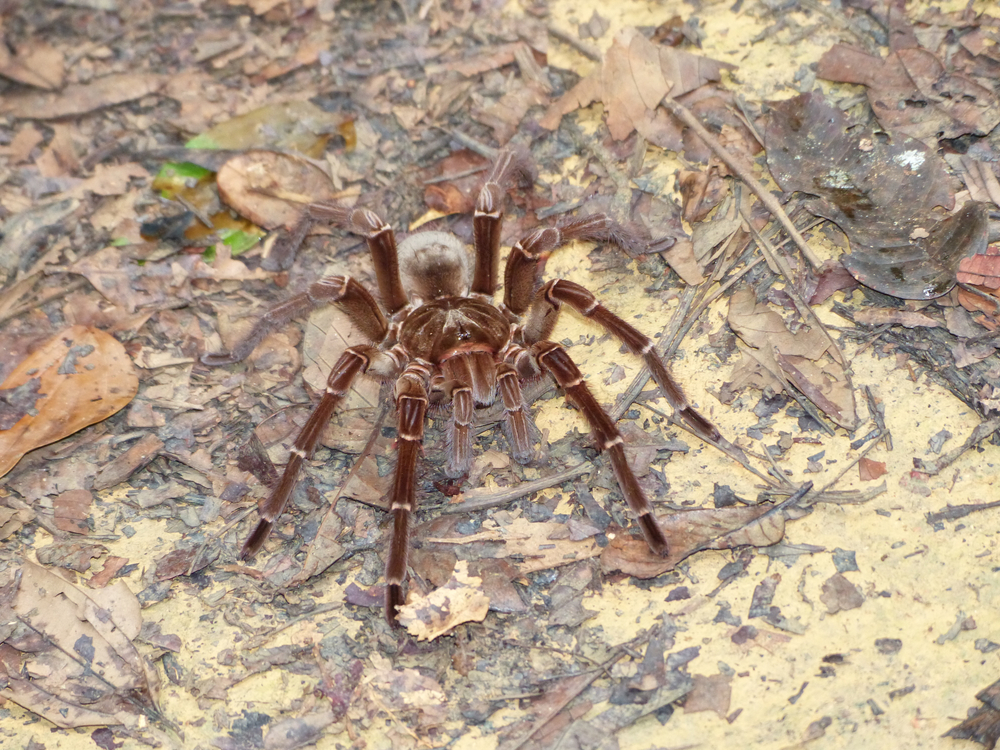
If you’re going by body mass rather than leg span, the Goliath birdeater is at the top of the list. Females can weigh up to about 170–175 g (around 6 oz), with a leg span up to about 30 cm and a body length of roughly 13 cm.
This tarantula lives on the rainforest floor in northern South America, especially in parts of Venezuela, Guyana, and Brazil. It spends most of the day hidden in deep burrows, coming out at night to ambush large insects, worms, frogs, and sometimes small rodents. The “birdeater” name dates back to an 18th-century engraving of a different tarantula eating a hummingbird; in reality, birds are an occasional meal, not the main diet.
Goliath birdeaters defend themselves with several tools. They can rear up to show off fangs nearly 2 cm long, hiss by rubbing structures on their legs, and flick clouds of urticating hairs from the abdomen. Those hairs are barbed and can cause intense itching or eye irritation. Their venom is powerful enough to subdue prey quickly, but in humans it’s usually compared to a wasp sting, with the hairs doing most of the damage.
3. Pinkfoot goliath birdeater (Theraphosa apophysis)

The pinkfoot goliath is another South American tarantula that rivals T. blondi for sheer size. Hobby and care-sheet sources report leg spans in the 25–30 cm range, putting it firmly in the “giant dinner-plate spider” category.
Juveniles have distinctive pinkish tips on the legs, which is where the common name comes from. As they mature, they darken into a deep brown or black spider with subtle colour highlights. Like its relatives, T. apophysis is a burrowing species from humid tropical forest, and it prefers deep, damp substrate and steady warmth. It has a reputation for fast growth and a strong feeding response in captivity, which means it will eagerly pounce on almost anything that moves near its burrow entrance.
In terms of behaviour, this species is usually described as nervous and defensive. It will kick urticating hairs readily and can adopt a threat posture if disturbed. That makes it impressive to see, but not something to handle. In its natural habitat, this attitude is a good survival strategy when you’re a large, slow-growing spider sitting out in the open at night.
4. Burgundy goliath birdeater (Theraphosa stirmi)
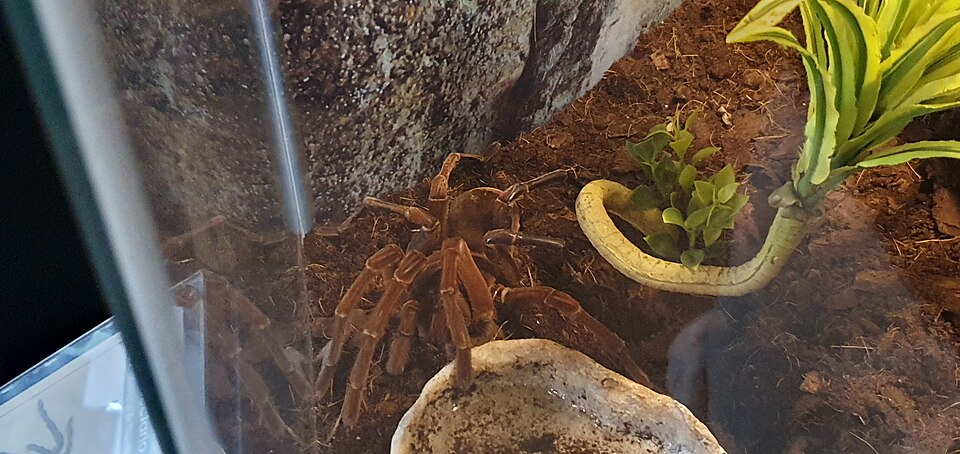
The burgundy goliath is the third member of the Theraphosa trio. Adults typically reach leg spans around 23–28 cm, with a thick-set body and heavy legs that make them one of the heaviest tarantulas in the world.
Theraphosa stirmi is native to parts of Guyana and Brazil. It looks similar to T. blondi at first glance but tends to have a slightly different leg pattern and a more burgundy tone to the hairs. As with the other goliaths, this species spends most of its time hidden in burrows, venturing out at night to ambush prey. Their diet is broad: beetles, roaches, other spiders, small amphibians, and whatever else they can overpower.
Like T. blondi, burgundy goliaths can stridulate (produce a rasping sound) when threatened, and they rely heavily on urticating hairs for defence. The hairs from Theraphosa species are particularly irritating, so even researchers use eye protection when working with them. Their combination of weight, size, and defensive tools earns them a spot near the very top of any “largest spider” list.
5. Brazilian salmon pink birdeater (Lasiodora parahybana)
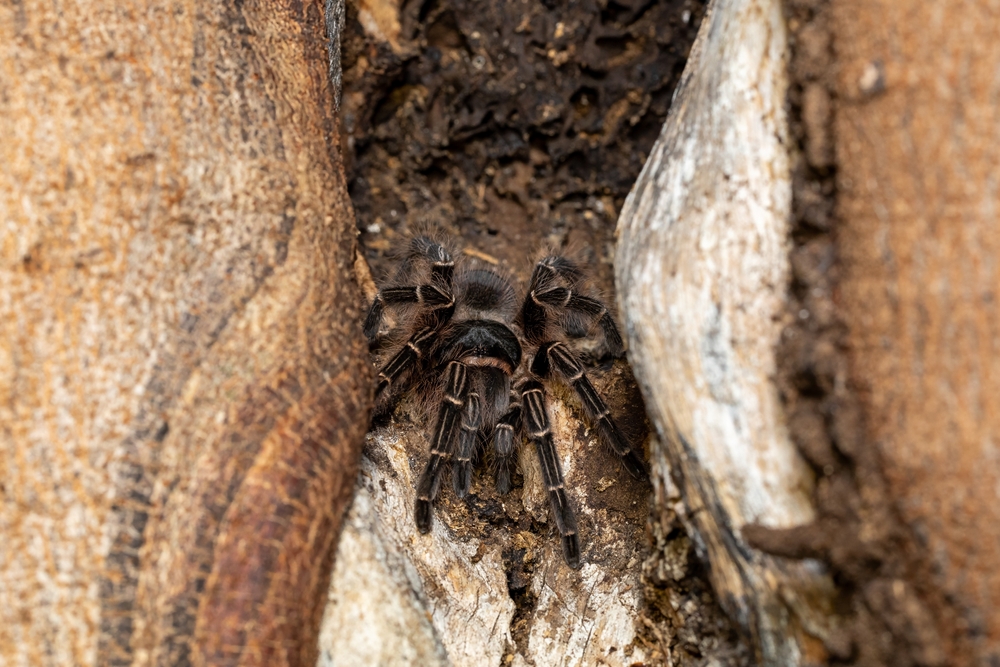
Lasiodora parahybana from northeastern Brazil is often listed as the fourth-largest tarantula in the world, just behind the three Theraphosa species. Adult females can reach leg spans of about 25–28 cm and weigh over 100 g.
The salmon pink birdeater has a dark body covered in lighter hairs, with distinctive pinkish or salmon-coloured setae on the legs and abdomen. It grows quickly and eats readily, which is why it has become a very common species in the tarantula hobby. In the wild it lives in Brazilian rainforest and scrub, usually in burrows or natural cavities in the ground.
One notable feature is how many young it can produce. A single egg sac may contain well over a thousand spiderlings, which helps explain how the species became so common in captivity. When threatened, L. parahybana will kick urticating hairs and can stand its ground rather than bolting. It’s impressive, large, and hardy, but not a spider that appreciates being handled.
6. Brazilian giant tawny red tarantula (Grammostola anthracina)
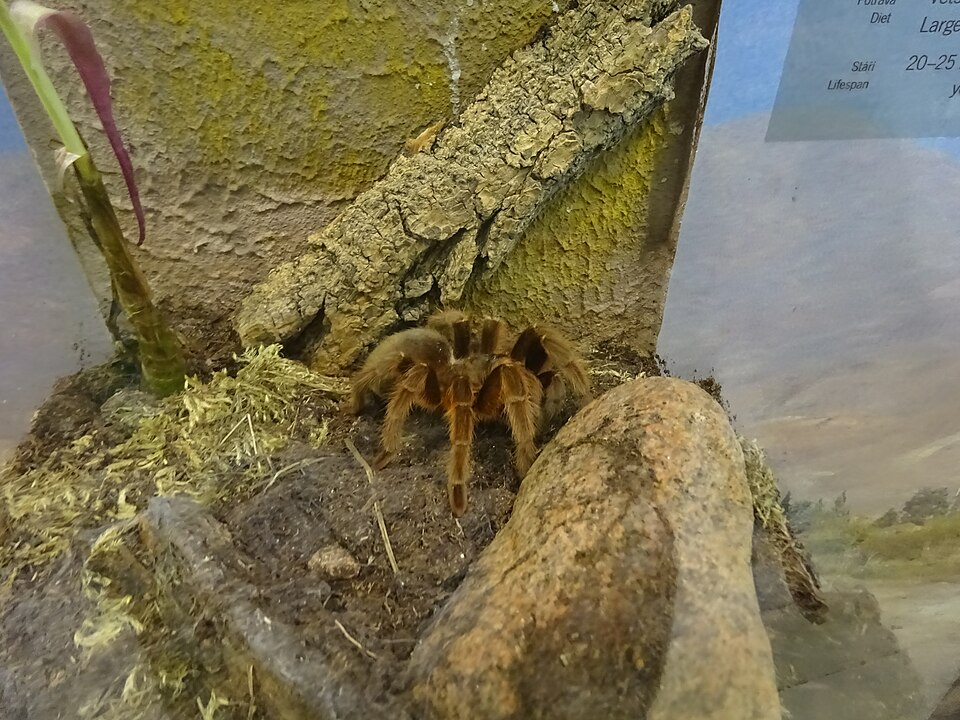
The Brazilian giant tawny red tarantula doesn’t get as much publicity as the goliaths, but it quietly reaches leg spans around 23 cm and can live for decades.
This species is found across Uruguay, Paraguay, Brazil, and Argentina. It’s a terrestrial spider that spends much of its time in burrows or hiding under stones and roots in grassland and scrub. The overall colour is a glossy brown or tawny red, with long hairs that give it a slightly “shaggy” look. These traits, plus its long lifespan (reports suggest up to around 30 years for females), have made it a sought-after species in the pet trade, which has raised some concerns about collection pressure on wild populations.
Unlike some of the more reactive giants, G. anthracina is often described as relatively calm, especially once settled. It will still defend itself if pushed, but it’s less likely to bolt or snap compared with more nervous genera. For sheer size plus a long life, it’s one of the most substantial spiders in South America.
7. Chaco golden-knee tarantula (Grammostola pulchripes)
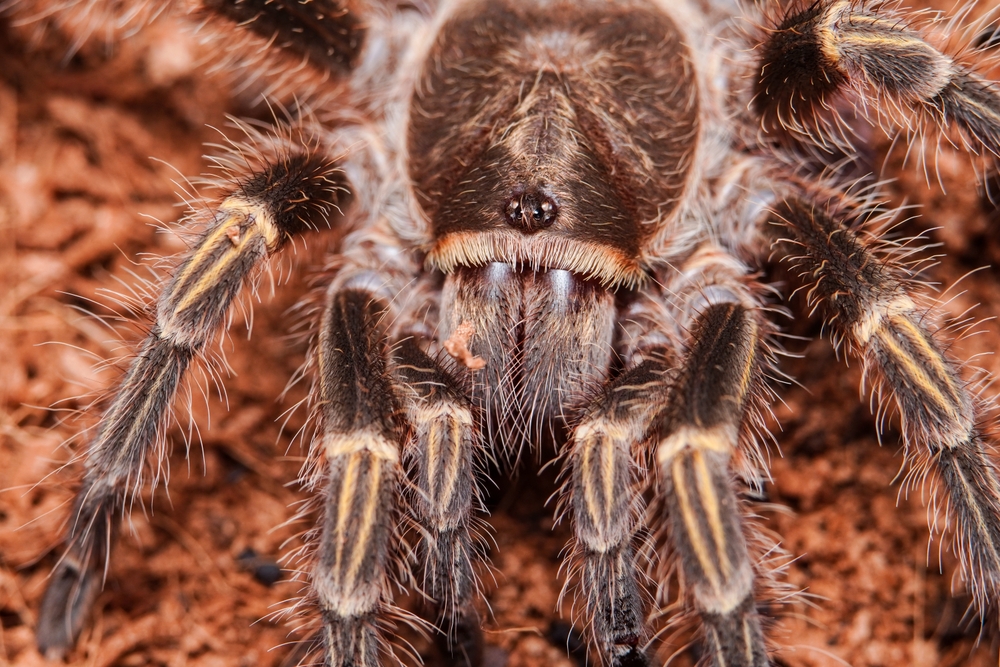
The Chaco golden-knee is another big Grammostola species. Adults commonly reach leg spans of 17–22 cm, putting them firmly in the “giant” category even if they’re a bit smaller than the goliaths.
Native to the grasslands of Paraguay and Argentina, these tarantulas are easy to recognise. They have dark bodies with bold golden bands on the leg joints, especially visible when the spider sits at the entrance of its burrow at dusk. In captivity they’re known for being calm and often visible; instead of hiding constantly, they’ll frequently sit out in the open, which adds to their popularity.
Females can live for more than 20 years, while males have shorter lives, as is typical for tarantulas. They rely mainly on their size and urticating hairs for defence rather than extreme speed or aggression. As a result, many keepers consider the Chaco golden-knee one of the best “showpiece” giant tarantulas: large, striking, and generally manageable.
8. Colombian giant tarantula (Xenesthis immanis)
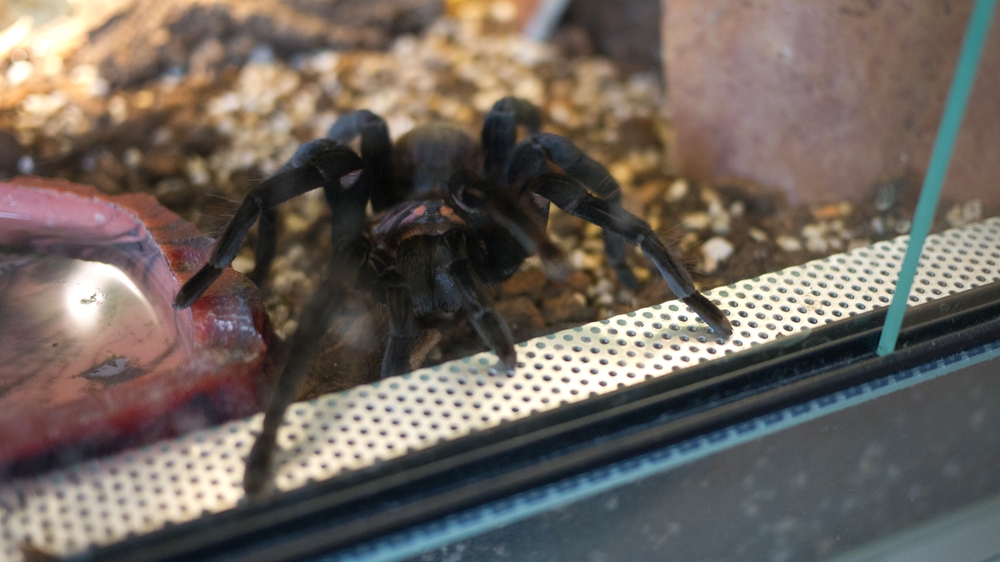
Xenesthis immanis is sometimes called the Colombian giant or Colombian lesser black tarantula. Adults can reach leg spans of around 20–23 cm, with some sources suggesting they may exceed 9 inches (23 cm) in exceptional cases.
This species is native to Colombia, Venezuela, and Peru. It’s a terrestrial tarantula that digs burrows in humid tropical forest and edges. The colour is a dark, almost black base with purple or bronze sheen on the legs and a reddish or rust-toned abdomen, making it one of the more visually striking big spiders.
One of the most interesting things about X. immanis is its relationship with tiny microhylid frogs. Field observations suggest a kind of mutualism: the spider may tolerate frogs living in or near its burrow, and those frogs eat ants and other small predators that would otherwise attack the tarantula’s eggs. In return, the frog gains a safe shelter and some protection from larger predators thanks to the giant spider at the door.
9. Colombian giant redleg (Megaphobema robustum)
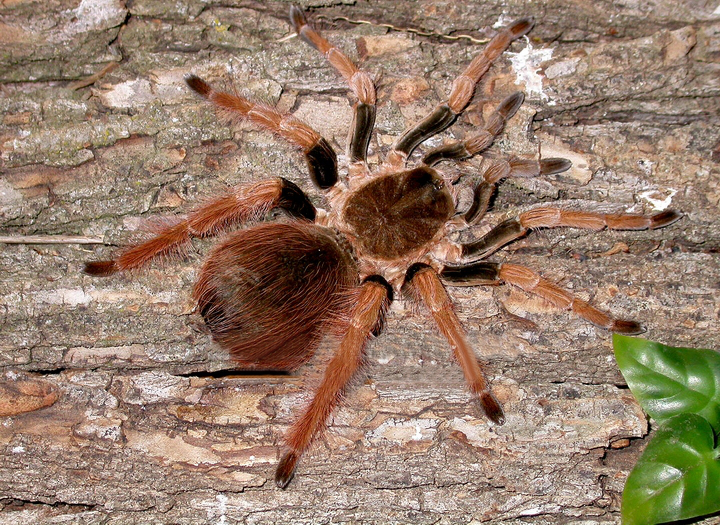
The Colombian giant redleg is another heavy-bodied South American tarantula, often reaching leg spans around 18–20 cm. What it lacks in absolute record-breaking size, it makes up for in attitude and looks.
This species is known for vivid orange-red hairs on its back legs and abdomen contrasted with a darker body. It inhabits tropical forest in Colombia and neighbouring areas, where it lives in burrows and hunts at night. Like many burrowers, it prefers deep, damp substrate and secure retreats. In the wild, it feeds on a mix of large insects and small vertebrates that stray too close to its hiding place.
Megaphobema robustum has a distinctive defensive behaviour: when startled, it may spin and kick with its heavily built back legs, almost like a tiny bull. It can also flick urticating hairs and adopt a threat posture. That combination of size and drama makes it an impressive, if slightly intimidating, giant.
10. Mankulam pink-banded ornamental tarantula (Poecilotheria rajaei)
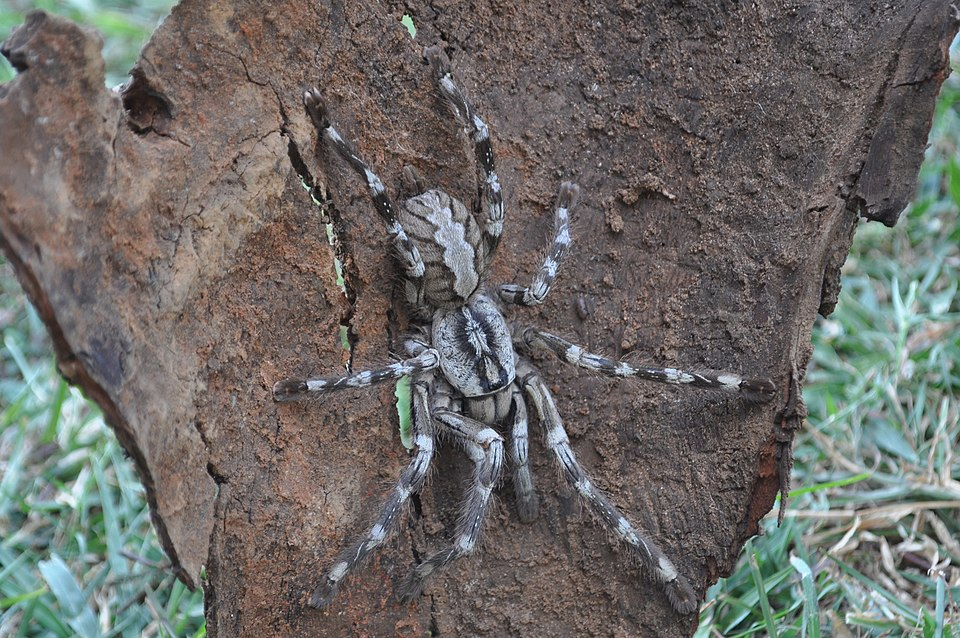
Poecilotheria rajaei is a relatively recent addition to the list of huge spiders. Officially described in 2012 from Sri Lanka, it has a leg span of up to about 20 cm.
This arboreal tarantula is patterned in grey, yellow, and pink tones, with a pale band on the abdomen and bold markings on the legs. It normally lives in old-growth trees, but deforestation has forced some populations into man-made structures like abandoned buildings and old hospital quarters, which is how some of the first specimens were found. Media reports dubbed it a “face-size tarantula,” but that’s more of a headline nickname than a formal common name.
Its venom is strong enough to kill small vertebrates such as rodents, lizards, and little birds, but it’s not known to be deadly to humans. Even so, bites from Poecilotheria species can be very painful and may cause significant symptoms, so they’re treated with care by both local people and keepers. With habitat loss continuing in parts of Sri Lanka, there is concern about how many of these large arboreal spiders are left in the wild.
11. Indian ornamental tree spider (Poecilotheria regalis)
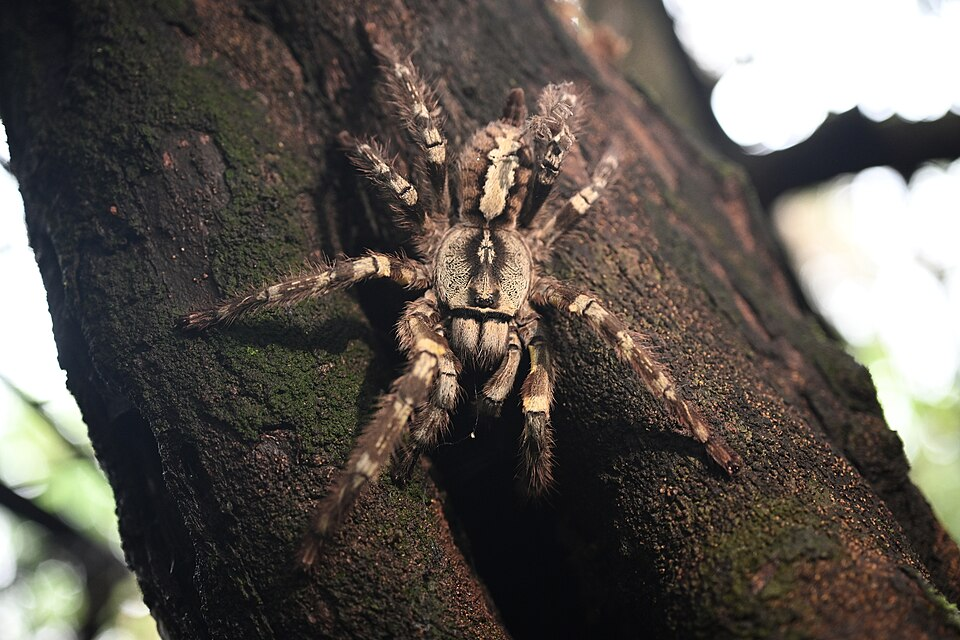
The Indian ornamental tree spider is one of the largest and best-known Poecilotheria species. Adults typically have leg spans of about 18–20 cm, making them big, fast arboreal hunters.
- regalis lives in trees in southeastern India, often in hollows, bark crevices, and old woodpecker holes. The colour pattern is striking: white and black bands on the legs, a pale starburst pattern on the carapace, and bright yellow patches under the front legs that are flashed as a warning when the spider feels threatened. This mix of camouflage and warning colour helps it disappear against tree bark until it decides to stand its ground.
In captivity, Poecilotheria species are known for being fast and sometimes defensive. Their venom is considered medically significant, and bites can cause intense pain and systemic symptoms, although serious incidents are rare. They are strictly “look, don’t touch” giants – impressive animals that do best left alone in their high retreats.
12. King baboon spider (Pelinobius muticus)

The king baboon spider from East Africa is one of the heaviest tarantulas outside South America, with leg spans often quoted up to 20–23 cm.
It’s a deep-burrowing species from dry scrub and savanna in countries such as Kenya, Tanzania, and Uganda. Using its massively thick back legs, it digs burrows that can extend well down into the soil, where temperatures and humidity stay more stable than on the surface. At night, it waits near the entrance for beetles, cockroaches, and other invertebrates to pass by, then drags them underground.
The king baboon lacks urticating hairs, so it relies on other defences: an intimidating threat posture, a loud rasping sound produced by rubbing its legs (stridulation), and a very painful bite. There are no confirmed human deaths from this species, but its venom is considered strong, and bites can cause significant local and systemic symptoms. That combination of size and defensiveness earns it a lot of respect.
13. Hercules baboon spider (Hysterocrates hercules)
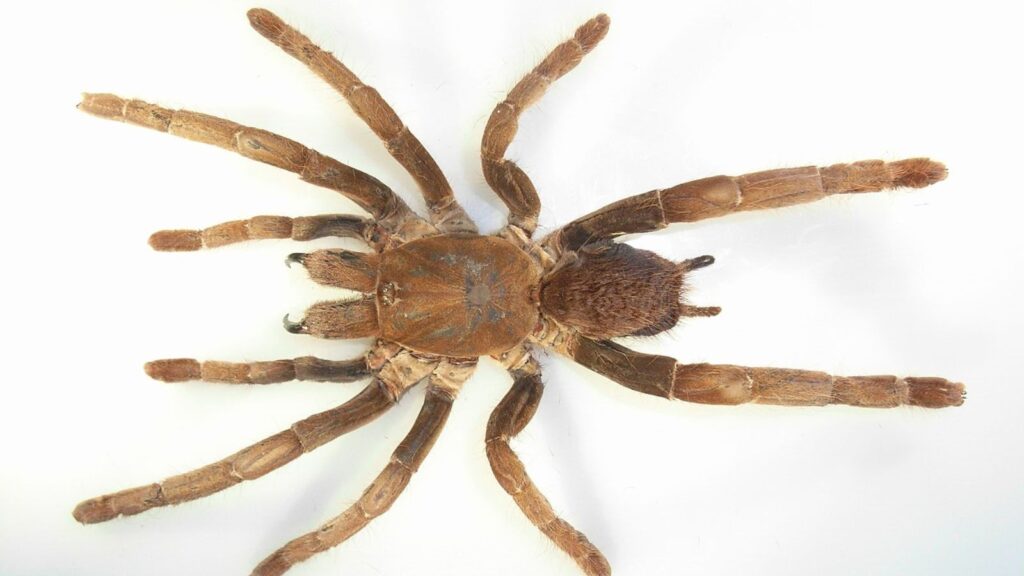
The Hercules baboon spider is one of the most mysterious giants. As far as we know, only a single preserved specimen exists, held by the Natural History Museum in London, and it was collected more than a century ago.
What little information is available suggests a leg span around 20 cm, making it comparable to the king baboon and easily one of Africa’s largest spiders. Researchers are not even sure whether it still survives in the wild or has quietly slipped into extinction. The original specimen came from West Africa, likely in the region of Nigeria or Cameroon.
Because so few examples have ever been found, almost everything said about its behaviour is an educated guess based on other baboon spiders. If it resembles its relatives, it was probably a burrowing, ground-dwelling tarantula that hunted insects and small vertebrates at night. Whether more individuals are still out there is an open question that may only be answered if someone stumbles across one in the field.
14. Brazilian wandering spiders (Phoneutria species)
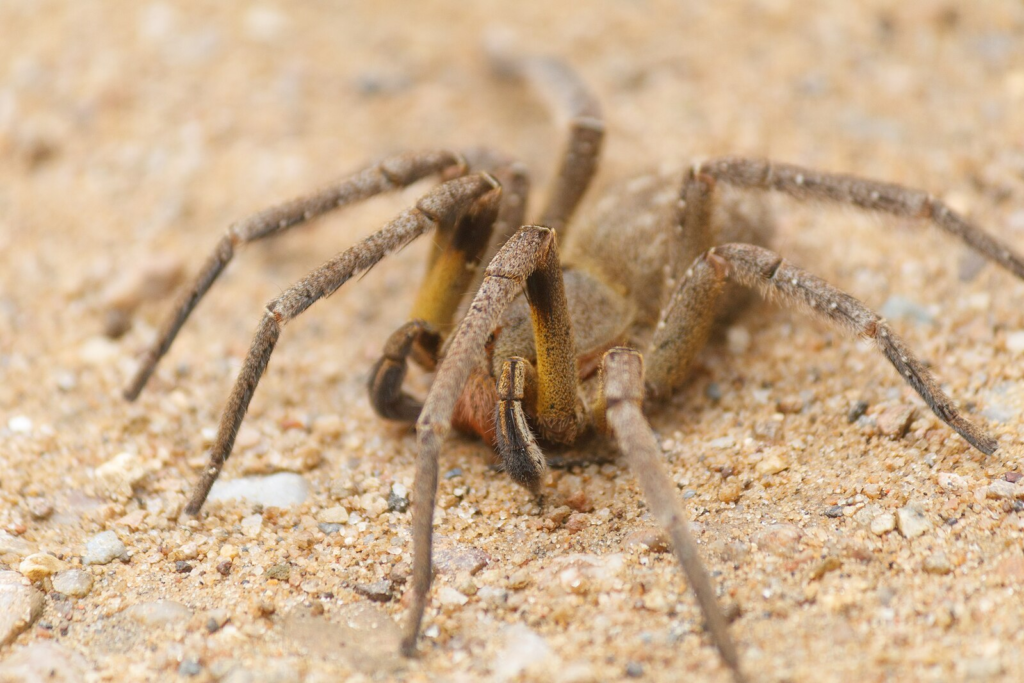
The Brazilian wandering spiders – particularly Phoneutria nigriventer and P. fera – are famous less for their size and more for their venom. Even so, they’re big spiders. P. nigriventer has a body length around 5 cm and leg spans up to about 15 cm, and some sources note similarly large measurements for related species.
These are active hunters that roam the forest floor at night instead of building capture webs. They often take cover in banana plants, wood piles, and crevices, which is why they sometimes turn up in fruit shipments and sheds. Their venom is strongly neurotoxic and can cause intense local pain, sweating, rapid pulse, and, in some cases, serious systemic effects. Modern antivenom and medical care mean fatalities are now rare, but bites are still treated as emergencies.
In nature, this venom helps them quickly overpower not only insects but also frogs, lizards, and even small bats. When threatened, they raise their front legs high in the air in a classic threat posture. Between their size, speed, and venom, Phoneutria species are probably the most intimidating spiders on this list to meet in person, even though they spend their lives avoiding conflict where they can.
15. Giant desert huntsman (Cerbalus aravaensis)

Cerbalus aravaensis is the largest huntsman spider known from the Middle East, with a leg span of about 14 cm.
It lives in the Arava Valley on the border between Israel and Jordan, mainly in sand-dune habitats. The spider constructs a burrow in the sand and covers the entrance with a thin, camouflaged door made of silk and grains of sand. This “trapdoor” helps conceal the spider from predators and keeps the burrow environment stable during the extreme heat of the day. At night, especially in summer, the spider becomes active and hunts across the dune surface.
Because its habitat is limited and dunes are threatened by development, C. aravaensis is considered vulnerable. It’s a good example of how some of the world’s biggest spiders aren’t just curiosities; they’re part of fragile ecosystems that can be disturbed or destroyed quite quickly.
16. Giant golden orb-weaver (Trichonephila / Nephila komaci)
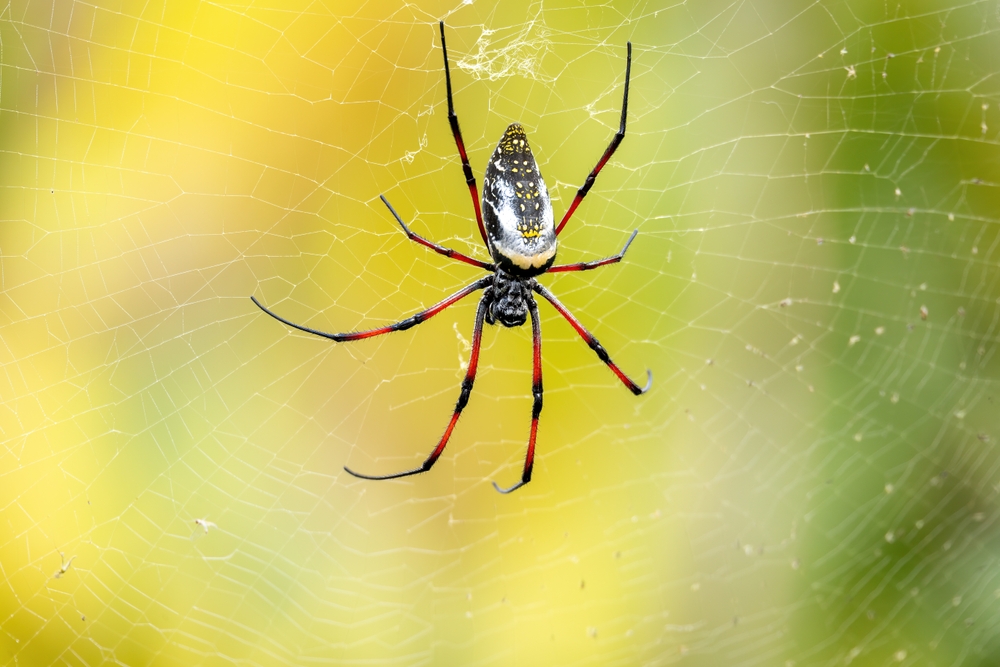
Trichonephila komaci (often still called Nephila komaci) is the largest known golden orb-weaving spider. Females have body lengths around 4 cm and leg spans of about 12 cm, while males are tiny in comparison.
These spiders build big golden-tinted orb webs more than a metre across, often in forest edges and clearings. The silk is strong enough to occasionally trap small birds or bats, although insects are the usual prey. The size difference between males and females is extreme: a full-grown female can be several times larger than a male, which may spend much of his life in the edge of her web, waiting for chances to mate.
Males of this genus have a rather grim mating tactic. In some cases, they break off parts of their genitalia inside the female, which acts as a mating plug to block rivals. Even so, females with several plugs from different males have been found, so it doesn’t always work. For humans, bites from golden orb-weavers are usually no worse than a bee sting, but walking into one of their enormous webs is something most people remember.
17. Giant fishing spiders (Ancylometes rufus and relatives)
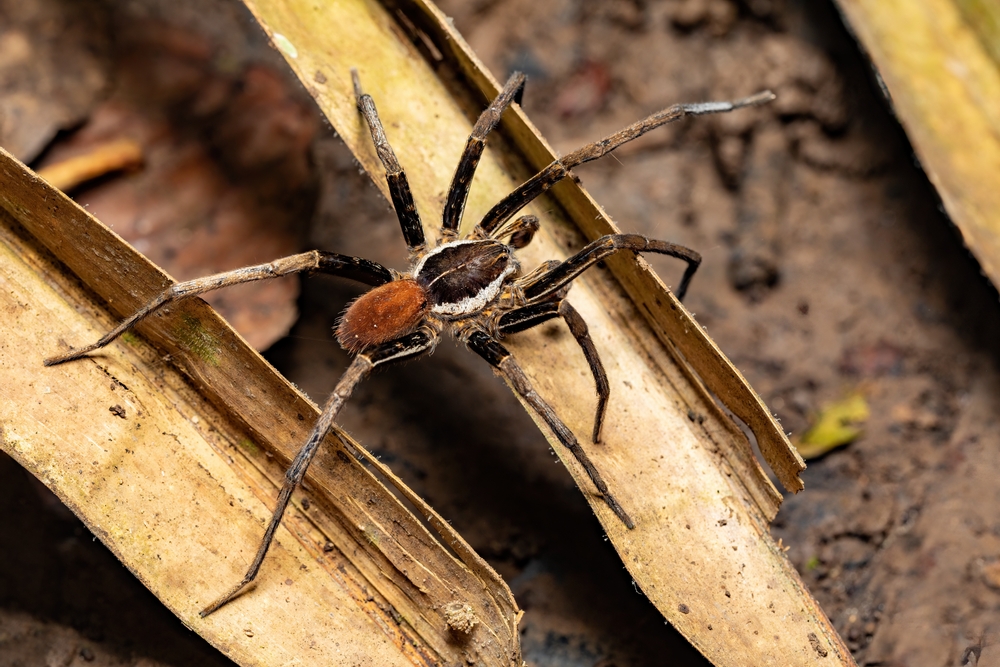
Spiders in the genus Ancylometes are among the largest araneomorph (non-tarantula) spiders. For Ancylometes rufus, females have body lengths around 4–5 cm and leg spans that can reach 18–20 cm, making them bigger than many people’s hands.
These spiders live near streams, ponds, and flooded forest in the Amazon region and other parts of northern South America. They are strong swimmers and can run across the surface film of the water or dive underneath, carrying a thin layer of air around their bodies. That allows them to ambush tadpoles, small fish, aquatic insects, and even frogs, as well as prey on land along the shore.
For people, they’re more of a surprise than a real threat. Bites are uncommon and usually happen only if someone grabs or corners the spider. Out in the forest at night, they are part of a wider group of semi-aquatic predators that blur the line between land and water.
18. Pantropical huntsman spider (Heteropoda venatoria)
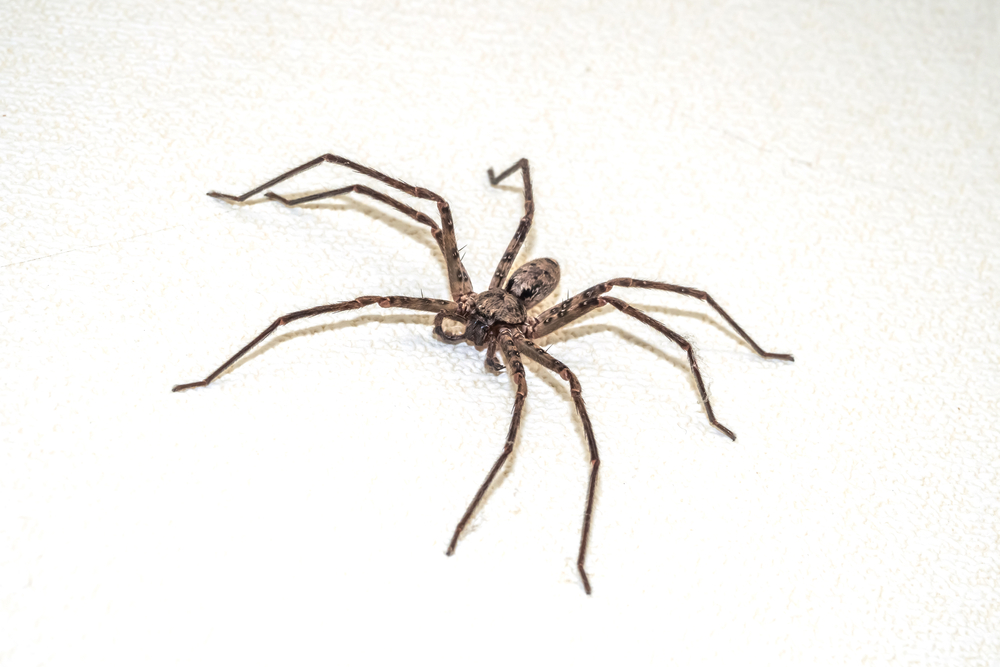
The pantropical huntsman, Heteropoda venatoria, is probably the “giant spider on the wall” most people have actually met in real life. Adult females commonly reach leg spans of around 10–12 cm (4–5 inches), with males slightly smaller but leggier, so they still look huge when they’re spread flat against a wall or ceiling.
Originally from Asia, this species has hitched rides with humans for centuries and is now found across the tropics and subtropics worldwide, including parts of the southern United States, Central and South America, Africa, and Oceania. It thrives in and around buildings, sheds, and warehouses, where it quietly hunts cockroaches, moths, and other nocturnal insects. Many people tolerate or even welcome it indoors for that reason, even if its size can be a bit of a shock at first glance.
Like other huntsman spiders, H. venatoria doesn’t build a web to catch prey. Instead, it relies on speed and strong eyesight, sprinting across walls and floors at night to grab insects with its long legs. The flattened body and sideways “crab-like” leg posture help it squeeze behind pictures, window frames, and loose bark. For humans, the venom is tuned to invertebrate prey; bites are uncommon, and when they do happen they’re usually limited to brief, localized pain and mild swelling. The real impact this species has on people is psychological, there’s nothing quite like turning on the kitchen light and seeing a hand-sized spider calmly watching you from the cupboard door.