
Affiliate disclosure: This post may contain affiliate links. Please see full disclosure.

Disclosure: This post contains affiliate links. Click here to read my affiliate policy.
Black spots on peppers are one of the most common pepper plant problems. The location of the discoloration and its overall appearance help you to identify the root cause of your pepper plants turning black.
As you’ll see from my complete pepper growing guide, peppers are reasonably easy to grow, as long as you provide the right environmental conditions.

However, even if you try your best to grow healthy plants, you may find your peppers or your pepper plants fall victim to viruses, fungi, and other diseases that you can’t always prevent.
Let’s take a look at some of the most common causes of peppers turning black.
Why Are Your Pepper Plants Turning Black?
While there are many reasons why your pepper plants might turn black, you shouldn’t overlook some of the most obvious. Before you start looking for which diseases may cause dark brown or black areas on your peppers, you should first turn your attention to the elements that you can control. Overwatering, under watering, and overfeeding, are among the three most common causes of black leaves on your peppers.
Overwatering, Underwatering, and Inconsistent Watering.
If you notice that your plants stunted, the leaves are curling, and the pepper plants are losing leaves all that curling up and turning black, this can indicate the plant is not getting enough or perhaps getting too much water. The other water-related problem may be inconsistent watering.
Like tomatoes, pepper plants need regular watering throughout the growing season and should not be allowed to go completely dry. Neither should they be left soaking wet constantly as this smothers the roots and their beneficial microorganisms in the soil. The key is to water on a schedule, or use tomato waterers or drip irrigation to make sure that the peppers have a constant supply of water, but that the ground is never soaking.
Overfertilizing
Overfertilizing and can burn your pepper plants, causing black areas or brown patches on the leaves and stems. Over fertilization can also cause pepper leaves to blacken at the edges, curl up, and fall off. Peppers are heavy feeders, but it’s important not to over fertilize, and to use the correct type of fertilizer for each stage during the growing season. Check out the fertilizing peppers information in our bell pepper growing guide.
Why Are There Black Spots on My Green Peppers?
If you notice in black spots on the pepper fruit itself, whether that’s on immature green peppers, those in the process of maturing, or those so ready to be picked, there are a handful of most likely culprits. These are blossom end rot, sunscald, anthracnose, or wet rot. Let’s take a look at these common pepper plant problems.
Blossom End Rot

If your pepper plants are afflicted with blossom end rot, you’ll see a dark, leathery spot on the bottom of the pepper pod with flower was attached. As this malady continues, the sport gets larger and change from a tan to dark brown or black. You also see that the spot becomes more leathery and may also appear sunken.
The cause of blossom end rot in peppers is a lack of calcium. This calcium deficiency may be caused by a lack of calcium in the soil, inconsistent watering which inhibits calcium uptake and mobilization, excessive magnesium in the soil competing with calcium uptake by the plants roots, or too much nitrogen in the soil.
Because blossom end rot occurs when the fruit first sets, by the time the pepper and its spots are big enough to notice, there’s nothing you can do to cure it. You can prevent it getting worse, and perhaps afflicting other pepper plants that are still producing new fruit, you can test your soil, adjust your watering habit, and make sure that there is plenty of calcium available in the soil around the pepper roots.
There’s no cure for blossom end rot, and the only way to avoid it is to ensure your soil is healthy, well-balanced, and that your pepper plants have a regular watering schedule.
Peppers that mature with blossom end rot are safe to eat. However, they do not store well. If any of my pepper fruits get blossom end rot, I let them mature and use them just like fully healthy peppers. I simply cut away the bad spot.
if you want to know more, check out this detailed article about blossom end rot in peppers from the University of Georgia.
Sunscald

If you plant peppers in areas of intense sun and heat, sunscald is definitely something to look out for and guard against. If your peppers are suffering from sunscald, you’ll notice white to yellow blisters on the skin of your fruit. These heat blisters appear on the side of the fruit that gets the most intense sun exposure.
In extreme cases, the fruit can also crack.
As the problem continues, a black mold sets in and grows on the blisters, hence sunscald is often described as exhibiting black spots on the skin of the fruit.
You can’t sure sunscald and, although you can’t control how much sun your area gets, in periods of intense heat, you can use row covers to provide shade. Additionally, you can plan to combat sunscald by companion planting peppers with complementary plants that provide shade.
Anthracnose

Anthracnose causes big brown or black lesions on the pepper fruits. This is a soil-borne fungal pathogen, caused by the fungus Colletotrichum. The lesions appear anywhere on the pepper pods and, as the disease progresses, pink spores appear and rapidly fill the black lesions.
Anthracnose is one of the more problematic causes of black spots on peppers because it can infect an entire plant or crop of plants. Plus, it can survive in the soil for many years, so unless you sterilize your soil or are certain of your ability to water cleanly, without splashing soil up onto the leaves of your plants, if your peppers get this fungal pathogen, you can’t grow anything else that’s susceptible to anthracnose in that same area for at least 2 years.
You can’t cure anthracnose. Once the plant is infected, it won’t survive. So, as soon as you identify the presence of anthracnose, remove and destroy the afflicted plant. Do not compost it. Inspect your other plants but make sure you wash your hands between touching an infected plant and a new plant you’re inspecting, otherwise there’s a high likelihood that you’ll spread the spores from one plant to the next.
Wet Rot

If you live in hot, humid areas, your peppers are at a high risk of developing wet rot, which is another fungal pathogen. Dark gray to black fungal growths appear on the fruit and the peppers quickly start to rot. If you don’t properly prune your pepper plants to allow adequate airflow and to reduce the risk of splashing infected soil during rain or watering, your plants are at much higher risk. This is particularly true in humid areas, as fungal diseases of this type thrive in damp, warm conditions with minimal airflow.
Like with anthracnose, if wet rot is the cause of your peppers turning black, there’s nothing you can do. Follow the same procedure to remove and destroy infected plants. Inspect the others for evidence of the same disease, and make sure you don’t grow anything susceptible to this infection, such as other members of the nightshade family, in the same spot for at least 2 years.
Cucumber Mosaic Virus

One of the many mosaic viruses that infect peppers, cucumber mosaic virus attacks the fruit as well as the leaves. Pepper plants infected with cucumber mosaic virus, or CMV, have chlorotic lines on their leaves and necrotic ringspots on the leaves and fruits. The rings often start out a pale tan and eventually, as the disease progresses, turs black.
It’s rare that the fruit is the only place you’ll see problems with this disease, though. Mostly, the entire plant in afflicted, and you’ll see chlorotic leaves, stunted growth, and falling leaves.
There’s no cure or prevention when it comes to CMV. This destructive virus can quickly infect a whole crop of peppers, nightshades, and any other plant that’s at risk. There are also very few varieties of peppers and other plants that are resistant to CMV. However, one of the main ways it spreads is via aphids who feed on infected plants and often infected weeds, then pass the virus to previously healthy plants. Therefore, aphid control is critical, as is proper weed control.
Black Spots on Pepper Leaves: Causes
With many diseases, the first signs infection will appear on the leaves, often as black spots, edges, or lesions. Here are some of the most common offenders.
Sooty Mold

Black sooty mold presents as rapidly spreading sections of leaves covered in a black mold that you can wipe or wash off and that looks like soot from a chimney. Black sooty mold is caused, once again, by aphids. When they feed, aphids leave behind honeydew, which is a sweet, sticky substance that the mold grows on.
The best way to control sooty mold is to control aphids. Use companion planting to repel aphids and bring in natural predators to keep their numbers down. If your plants show signs on sooty mold, remove and destroy the affected leaves.
Fusarium Wilt

Fusarium wilt is caused by the soil-borne Fusarium oxysporum fungus. This fungal disease can live in the soil, without a host, for up to 5 years. And it doesn’t just attack peppers or nightshades. Sadly, fusarium wilt can infect many different edibles and ornamentals, from asparagus to basil.
If your plants have fusarium wilt, you’ll notice the lower leaves turning yellow to black and falling off before the infection works its way up the plant to attack the newer leaves. This nasty fungal pathogen blocks the water vessels of the plant, causing wilt, poor nutrient uptake, dehydration, and death.
Like many other fungal diseases, there’s no cure for fusarium wilt, so if you suspect that’s what’s causing your pepper plant problems, you need to remove and destroy the affected specimens. And limit possible spread by always watering gently at ground level so no water splashes up onto the plants.
Bacterial Leaf Spot

Bacterial leaf spot is caused by Pseudomonas cichorii and presents as dark brown to black spots on the leaves and chocolate brown to black streaking on the stems. As the lesions get older, they stay black but get papery and, in extreme cases, the stems end up with wet rot and they’ll fall over and die.
Because bacterial leaf spot lives in the soil, like with other diseases, you can prevent or significantly reduce the chances of infection by watering low or using drip irrigation. But you can’t cure it, so you’ll need to get rid of infected plants.
Why Are There Black Spots on My Pepper Plant Stems?
Black spots or streaks on the stems of your peppers can also indicate that you’ve got specific pepper plant problems. Here are some of the most common diseases that cause black spots on your pepper plant stems.
Phytophthora Blight
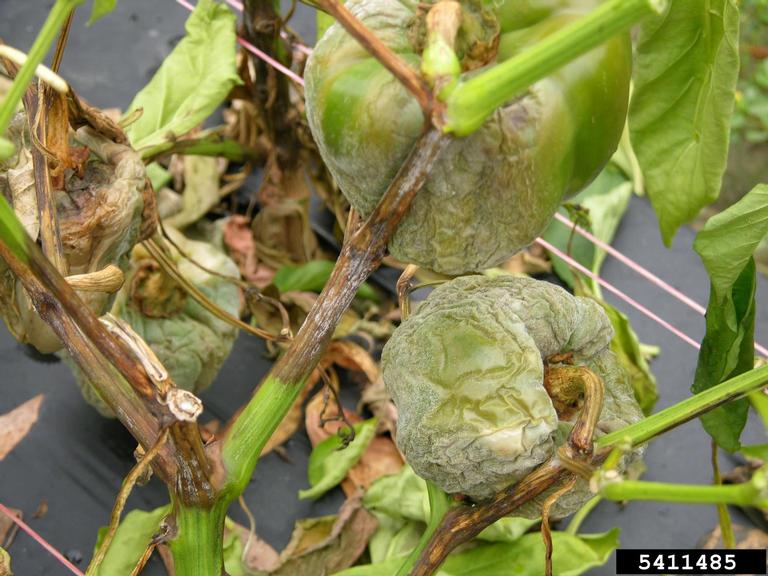
Phytophthora blight attacks stems, fruits, and roots of pepper plants and is caused by oomycete phytophthora capsici. It can sweep through an entire crop of peppers and kill the whole lot. It’s a devastating pepper plant disease.
You’ll see black lesions on the pepper plant stems and leaves and fruit may start to wilt although they generally remain attached to the stems. Eventually, the bell peppers will start to rot and will collapse in on themselves.
There’s no cure other than removing the infected plants. And the only ways to reduce the risk of infection are careful watering, correct bottom pruning, and good crop rotation.
Sclerotinia

Sclerotinia is a fungal disease that thrives in damp conditions with overly moist soil and overcrowded plants. You’ll first see dark brown or black lesions on the stem of the peppers close to the ground. Eventually, these lesions spread up the stems and into the leaves, causing chlorosis, leaf drop, and death. The black lesions eventually get covered with a white mold.
There’s no reliable treatment for sclerotinia once it takes hold, so the best you can do is take preventative measures. Plant peppers 12 to 18 inches apart and make sure you bottom prune properly to reduce the risk of splashing spores from the soil onto the foliage. Practice good tool hygiene, too, as sclerotinia can infect around 400 different plant species. Keep weeds down and practice crop rotation.
How Can I Stop My Pepper Plants Getting Black Spots?
Even if there is a treatment available, prevention is better than cure. You can prevent your bell peppers or hot peppers getting black spots by planting the right pepper seeds, maintaining the right conditions, pruning and watering correctly, and ruthlessly getting rid of affected plants.
RELATED ARTICLE: What Temperature is too Cold for Peppers?
Choose the Right Pepper Variety
Choosing the right pepper variety is critical to the success of your crop. If, for example, you know that your area is likely infected with phytophthora blight, choose pepper seeds, such as yellow admiral, Bastille, or chablis, that are resistant to that disease.
Practice Proper Crop Rotation
Crop rotation is so important, whatever you’re growing. Just growing new pepper varieties each year in the same spot isn’t enough. You need to grow plants from an entirely different family in each spot each season. For example, pepper growers should never plant other nightshades like potatoes, tomatoes, or eggplants in a bed that pepper were in the season before. Instead, that grower should follow peppers with a totally different crop with different nutrient needs and common problems.
In this case, while there are loads of thing you could plant after peppers, the Three Sisters – corn, beans, and pumpkins are an excellent choice because you get a lot of food from a small space, the three plants have differing nutritional needs than peppers, and they return a lot of nitrogen to the soil. And, while they do share some pests and diseases, as long as you’ve removed all the diseased plant parts from the pepper crop, you shouldn’t have too many issues.
Maintain Good Soil Health
Practicing good soil health is also vital to the success of your plants, whether you’re growing peppers, apples, or berries. Remember to add plenty of organic matter in the form of mulch, manure, or homemade compost to improve drainage, soil structure, and available nutrients.
Prune Off the Lower Leaves
Bottom pruning peppers has a few different benefits. Getting rid of the lower leaves makes it less likely that water with infected soil will splash up onto the leaves during rain or from overhead watering.
Plus, it opens up the plants at the lower level, allowing more air to circulate, which creates less favorable conditions for fungal diseases.
Don’t Splash Water
While you can’t control the rain, you can control the way you water. Overhead watering causes splashback. When the water droplets hit the ground, they pick up or disturb soil particles and potentially spores which can get onto the plant’s foliage and let a fungal infection take hold.Instead, use drip irrigation or water at ground level to eliminate splashing.
Root Out Infected Plants
Be ruthless. If you spot a diseased plant that you’re pretty certain has a disease for which there’s no treatment, pull it out. Don’t try to save it. If you do, you risk losing your whole crop because you tried to save one plant. In the right conditions, a fast-spreading fungus can decimate a whole crop in just a couple of days. It happened to me in 2021 – I lost a whole crop of tomatoes in just three days!
FAQs About Black Spots on Peppers
It depends on the cause, but in general, yes, peppers with black spots are safe to eat. If the spots are small or localized and the flesh inside is nice and healthy, I just trim away the affected areas of skin and eat the rest of the pepper. Use common sense. If the peppers have huge blackened areas, appear rotten, smell bad, or have big water-soaked spots then no, don’t eat them.
You may not be able to help your peppers fully recover from a calcium deficiency. Usually, by the time you notice the signs, such as the presence of blossom end rot, it’s too late. But you can rebalance your soil and possibly provide more nutrients for the remaining plants if they are still setting fruit. Adding crushed eggshells, lime, gypsum, or bone meal around the base of plants (but not touching the stems) can help to add calcium where it’s most needed.
Yes, you can eat pepper with blossom end rot. Just cut away the affected portion of the pepper and eat the rest. Remember, blossom end rot is not a pathogen. Rather, it’s a symptom of calcium deficiency.