

Affiliate disclosure: This post may contain affiliate links. Please see full disclosure.

Growing corn, beans, and squash together in the same bed produces measurably higher total yields than any of the three crops planted as separate monocultures. That’s not folk wisdom. It’s the reason this system has been the backbone of Indigenous agriculture across North America and Mesoamerica for over a thousand years.
Corn provides a living trellis for climbing pole beans. Beans fix atmospheric nitrogen directly into the soil, feeding the corn and squash. Squash vines sprawl as living mulch, retaining soil moisture, suppressing weeds, and deterring pests with their prickly stems. Each plant solves a specific problem for the others, and together they create a self-sustaining growing system that builds soil rather than depleting it.
This guide covers everything you need to grow a successful Three Sisters garden: the science behind the symbiosis, precise planting timing and spacing, the variety choices that actually work (and the ones that don’t), how to handle pollination (the step most guides skip entirely), and how to troubleshoot the problems that derail most first attempts.
I’m an organic permaculture specialist, as most of you know by now, and I love the three sisters technique. It’s so spectacularly effective and so wonderfully, elegantly simple. It’s like the ultimate companion planting technique, with each plant supporting the other two, and each producing more from a smaller space because of the presence of the others. It’s genuinely amazing!
- The history behind the Three Sisters
- How the Three Sisters system works: the science
- Why the Three Sisters were a dietary staple
- Soil preparation and building the mound
- When to plant: soil temperature, not just frost date
- How to plant a Three Sisters garden: step by step
- Choosing your varieties: which ones actually work
- Three Sisters garden layouts
- Watering and ongoing care
- The fourth and fifth sisters
- Harvesting the Three Sisters
- Troubleshooting common problems
- Frequently asked questions
- What are the Three Sisters in companion planting?
- How do you plant the Three Sisters step by step?
- Why isn't my Three Sisters corn pollinating well?
- Can you grow Three Sisters in a raised bed?
- Does the Three Sisters method actually improve soil health?
- What is the fourth sister?
- What's the minimum space for a Three Sisters garden?
- Do Three Sisters plants need fertilizer?
- Can you grow Three Sisters from transplants instead of direct sow?
- You might also like…
The history behind the Three Sisters
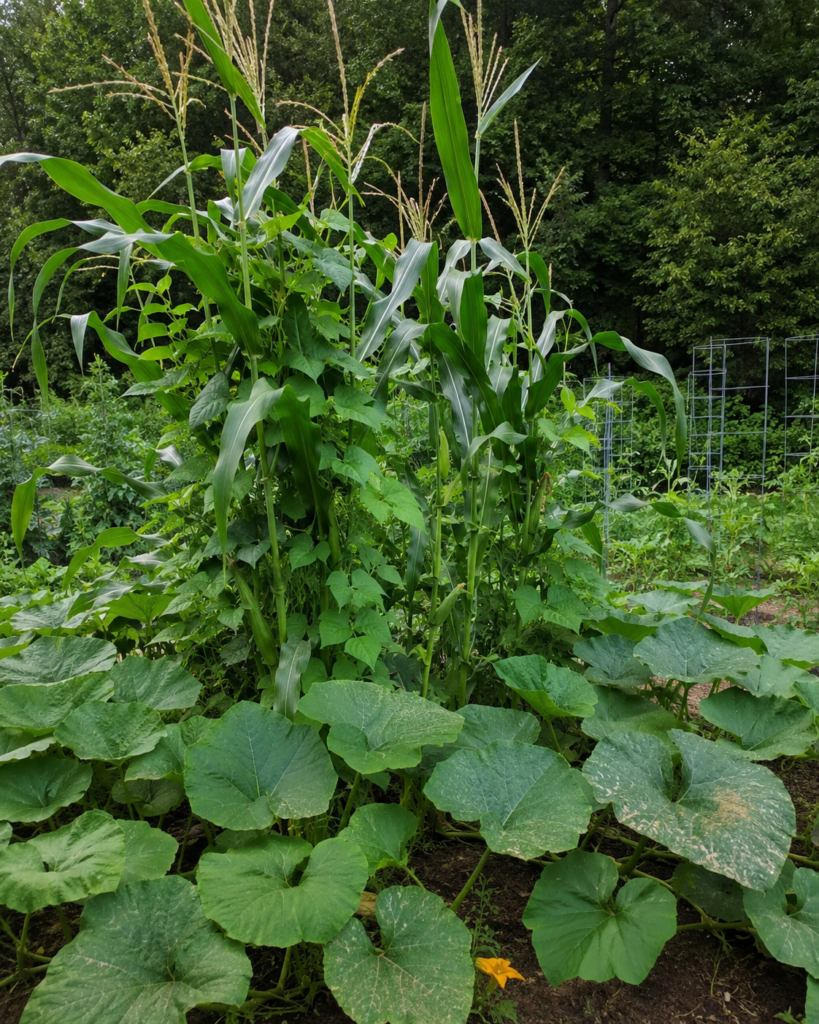
The Three Sisters planting method is most thoroughly documented among the Haudenosaunee (Iroquois) Confederacy, whose agricultural traditions centered on this trio for centuries before European contact. The Pueblo peoples of the American Southwest practiced closely related versions, and Mesoamerican milpa farming, which dates back well over a thousand years across what is now Mexico and Central America, used strikingly similar combinations of corn, beans, and squash.
The name “Three Sisters” comes from Haudenosaunee tradition, where these crops were understood as inseparable, to be grown, eaten, and celebrated together. The Wampanoag people of coastal New England expanded the system to include a fourth sister in the form of sunflowers at the plot perimeter. Mesoamerican milpa farmers often added amaranth as a fifth crop.
What’s remarkable is that Indigenous farmers developed this system through centuries of careful observation, long before anyone understood nitrogen fixation or polyculture yield dynamics. Modern agricultural research has confirmed what those farmers already knew: this combination works, and it works better than growing any of the three crops alone.
For seed sourced directly from those same agricultural traditions, Native Seeds/SEARCH maintains one of the most comprehensive collections of traditional Three Sisters varieties in North America, with many grown by the same communities that developed this system.
How the Three Sisters system works: the science
The three crops succeed together because each one solves a problem that the others create.
Corn: the big sister
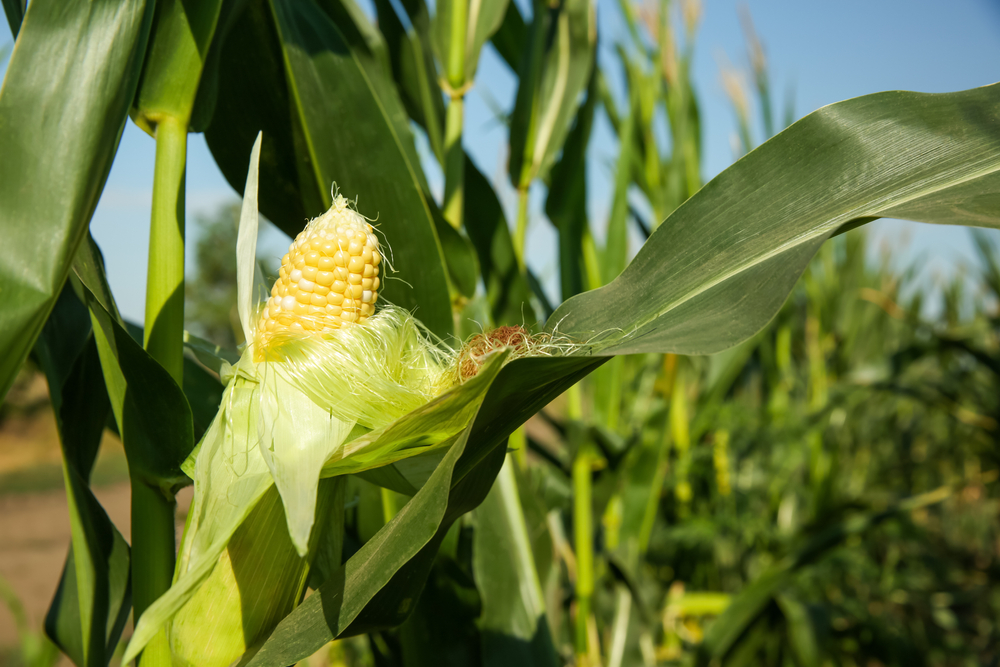
Corn (Zea mays) grows tall and fast, providing the vertical structure that pole beans need to climb. Its root system is also stabilized by the beans winding around it, and the two plants physically anchor each other in wind in a way neither achieves alone.
Here’s the part most guides bury or skip entirely: corn is wind-pollinated, and it needs to be grown in blocks, not in a single isolated mound. Corn sheds pollen from the tassel at the top of the plant; that pollen needs to fall onto the silks below, and each individual strand of silk leads to a single kernel. Insufficient pollination produces poorly-filled ears with gappy, missing kernels. One lonely mound of four to six corn plants doesn’t generate enough pollen for reliable pollination. You need a minimum of four mounds planted in close proximity, in a grid or cluster rather than a line, for the wind to do its job properly. This is the single most common reason first-time Three Sisters gardens disappoint.
Beans: the middle sister
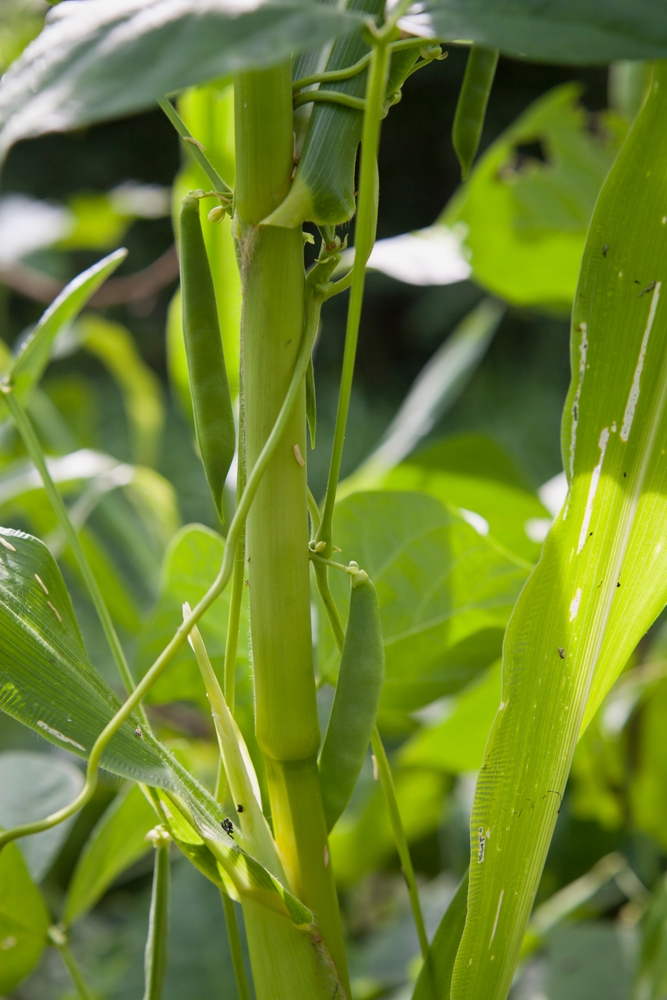
Pole beans (Phaseolus vulgaris, and in the case of Scarlet Runner, Phaseolus coccineus) host colonies of nitrogen-fixing bacteria, primarily Rhizobium spp., in nodules on their roots. These bacteria pull nitrogen directly from the air (where it’s abundant but unavailable to plants as N₂) and convert it into ammonium (NH₄⁺), a plant-available form deposited directly in the root zone. Corn is one of the heaviest nitrogen-feeding crops in the vegetable garden. The beans are essentially running a free, continuous fertilizer drip-line for it throughout the season.
Do not apply nitrogen fertilizer (synthetic or otherwise) once your beans are established. High nitrogen in the soil suppresses Rhizobium activity. The bacteria stop fixing nitrogen when there’s already plenty in the soil. You’ll feed the corn short-term while dismantling the system that feeds it long-term.
You can give the nitrogen-fixing process a significant boost by coating your bean seeds with a commercial Rhizobium inoculant before planting. It’s inexpensive, takes thirty seconds, and makes a real difference in soil that hasn’t grown legumes recently.
RELATED POST: 17 Best Oregano Companion Plants (And 3 You Should Avoid)
Squash: the little sister
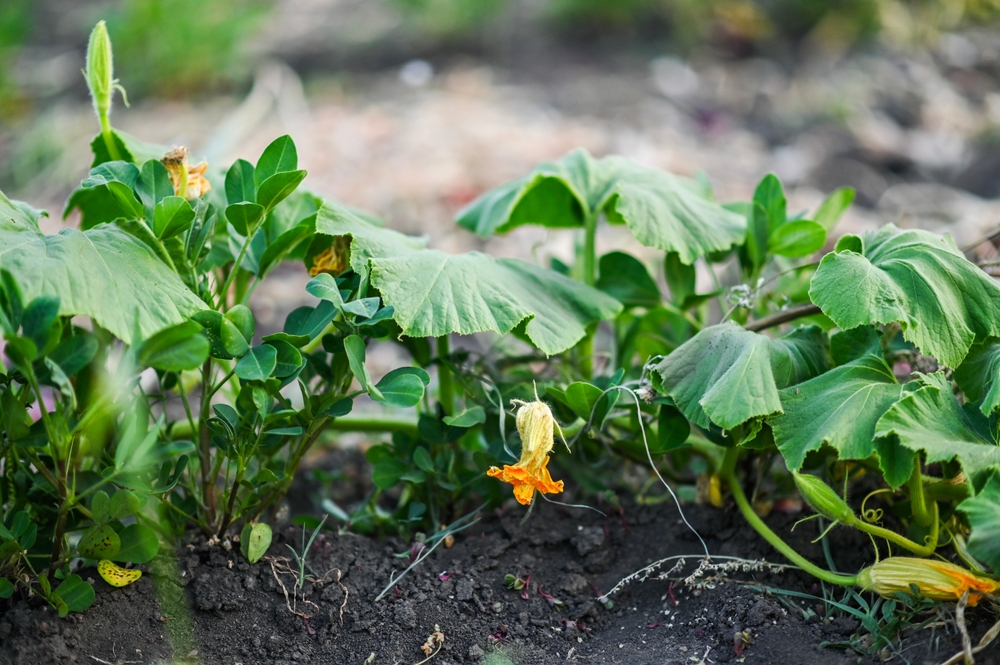
Squash (Cucurbita spp.) is the ground-layer workhorse of the trio. The large, fast-spreading leaves shade the soil surface, reducing evaporation and suppressing weeds as effectively as several inches of conventional mulch. The prickly texture of squash stems and leaf undersides physically deters raccoons, groundhogs, and other mammals, which dislike pushing through it to get to the corn and beans.
The key word in that description is “spreading.” The squash in a Three Sisters planting needs to be a vining variety with genuine sprawl. Compact bush-type squash (most standard zucchini, for instance) grow as a tight clump and don’t spread across the soil. They don’t provide living mulch, they don’t deter pests, and they don’t do the job. Vining winter squash varieties are the correct choice. More on this in the varieties section.
RELATED POST: 102 Pumpkin and Squash Recipes
Why the Three Sisters were a dietary staple
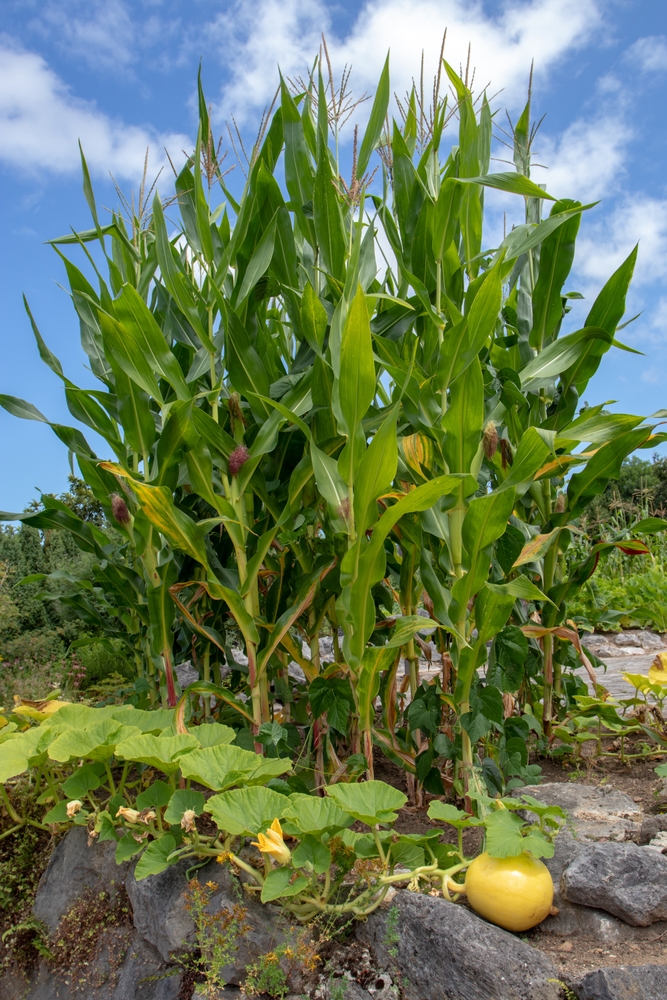
The nutritional dimension of this combination is as elegant as the horticultural one. Corn is rich in carbohydrates but lacks sufficient lysine, an essential amino acid. Beans are high in protein and fiber and supply the lysine that corn lacks. Eaten together, corn and beans provide a nutritionally complete protein containing all essential amino acids, which is precisely why this pairing was a dietary cornerstone for so many Indigenous communities across the Americas. Squash adds vitamins A and C, potassium, and antioxidants to round out the nutritional picture.
All three crops also store exceptionally well through winter: corn as dried grain, beans dried in the pod, squash through its cured hard rind. This wasn’t just a clever companion planting arrangement. It was a complete, storable food system.
Soil preparation and building the mound
The mound at the center of Three Sisters planting isn’t arbitrary. It serves three specific functions: improved drainage (critical for squash, which is highly susceptible to root rot in waterlogged soil), concentrated nutrient availability in a defined area, and gentle elevation that separates the corn-and-bean zone from the sprawling squash vines, making both easier to harvest later in the season.
Traditional technique calls for burying organic matter beneath each mound before raising it. Fish scraps were the classic material, but aged manure, finished compost, or a combination of both work perfectly in a modern garden. This creates a slow-release nutrient cache that feeds heavy-feeding corn and squash throughout the growing season.
Build each mound 4 to 5 feet in diameter and 10 to 12 inches high, with a flattened top and gently tapering sides. Space mound centers at least 4 feet apart, and remember that you need a minimum of four mounds in close proximity for corn pollination. Aim for a soil pH of 6.0 to 6.8, which suits all three crops. Test your soil before building mounds if you haven’t grown vegetables in that spot before. It’s worth the small investment to know what you’re starting with.
RELATED POST: How to Sterilize Soil to Kill Pests and Diseases – Easy, Natural Pest and Weed Control
When to plant: soil temperature, not just frost date
Every Three Sisters guide tells you to plant after your last frost date. That’s necessary but not sufficient. What actually determines germination success is soil temperature, and in a cooler spring, soil temperature lags significantly behind frost-free air temperature.
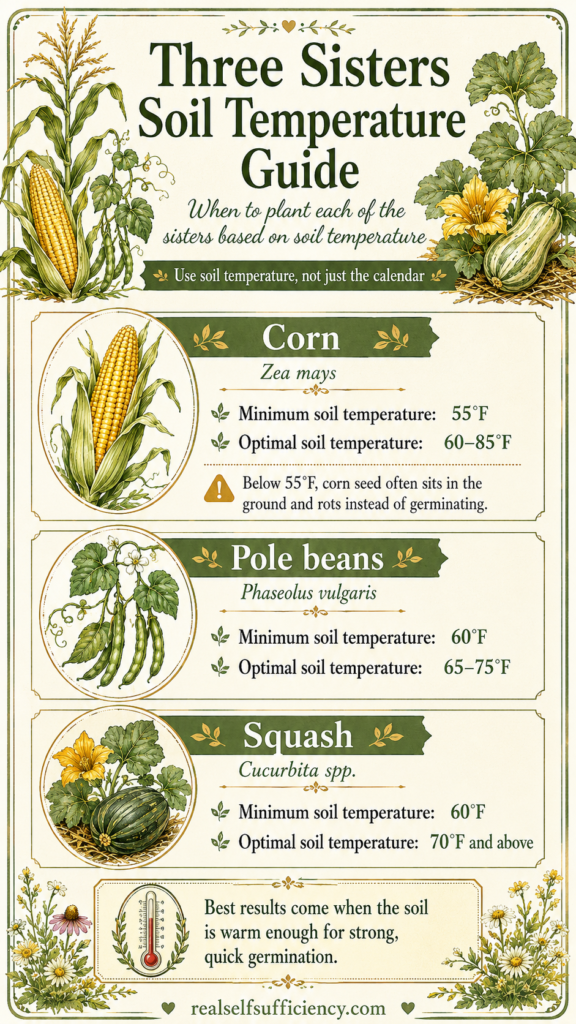
- Corn (Zea mays): minimum soil temperature 55°F; optimal 60–85°F. Below 55°F, corn seed sits in the ground and rots rather than germinates.
- Pole beans (Phaseolus vulgaris): minimum soil temperature 60°F; optimal 65–75°F.
- Squash (Cucurbita spp.): minimum soil temperature 60°F; optimal 70°F and above.
A soil thermometer is a $10 tool that prevents a wasted planting. Push it 2 to 3 inches into the soil in the morning. That reading is your germination temperature.
The staggered planting sequence
Plant all three crops at the same time and the squash will smother the bean seedlings before they have a chance to establish. Get the beans in too early and they’ll overwhelm young corn before it’s sturdy enough to support them. The timing between each planting is the critical variable most guides underspecify.
- Week 1: Plant corn
- Weeks 2–3 (when corn reaches 4–6 inches tall): Plant pole beans
- Weeks 3–4 (approximately one week after beans emerge): Plant squash
Planting calendar by USDA zone
Where you live plays a significant role in when you should be planting your three sisters.
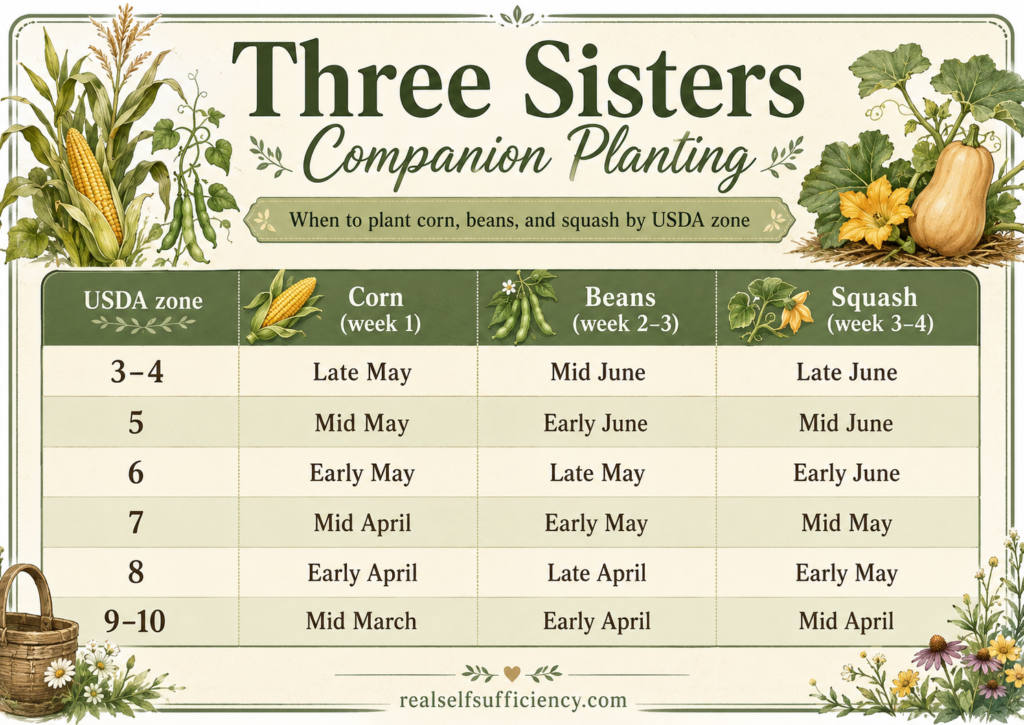
Or for those of you who want a plain, printable version:
| USDA zone | Corn (week 1) | Beans (week 2–3) | Squash (week 3–4) |
|---|---|---|---|
| 3–4 | Late May | Mid June | Late June |
| 5 | Mid May | Early June | Mid June |
| 6 | Early May | Late May | Early June |
| 7 | Mid April | Early May | Mid May |
| 8 | Early April | Late April | Early May |
| 9–10 | Mid March | Early April | Mid April |
How to plant a Three Sisters garden: step by step
Site selection: Full sun is non-negotiable. These are all high-light crops, so aim for 8 hours of direct sun, with 6 as the minimum. Avoid low-lying areas where water pools after rain.
Step 1: Build the mounds. Work a generous amount of aged manure or finished compost into the soil before mounding. Build each mound 10 to 12 inches high and 4 to 5 feet in diameter with a flattened top. Space mound centers 4 feet apart, in a grid of at least four mounds.
Step 2: Plant the corn. Once soil temperature hits 55°F minimum, sow 4 to 6 corn kernels per mound in a circle roughly 12 to 18 inches in diameter on the flattened mound top, spaced 6 to 8 inches apart and 1 inch deep. Once seedlings are 3 to 4 inches tall, thin to the 3 to 4 strongest plants per mound. In zones 3–5, starting corn indoors 2 to 3 weeks before your last frost date gives a meaningful head start on the growing season and is well worth the extra step.
Step 3: Plant the pole beans. When corn seedlings reach 4 to 6 inches (roughly 2 to 3 weeks after germination), plant 4 to 6 pole bean seeds around each corn plant, one seed about 3 to 4 inches from each stalk. For an extra productivity boost, coat bean seeds in Rhizobium inoculant before planting. For the first week or two, you may need to gently guide bean vines toward their corn stalks. After that, they find their own way up.
Step 4: Plant the squash. About a week after beans emerge, plant 3 to 4 squash seeds in the spaces between mounds, roughly 12 inches from the mound edge. Thin to the strongest plant per location once seedlings are established. From early on, direct squash vines outward and away from the corn mounds so you can access them at harvest without trampling your way through a tangle of vines.
Direct sowing vs. transplants: Either works. In zones 3–5 with short growing seasons, starting all three crops indoors (corn 2 to 3 weeks before last frost, squash 3 to 4 weeks before) can add several weeks of productive harvest. In zones 6 and warmer, direct sowing is perfectly reliable once soil temperatures are right.
Choosing your varieties: which ones actually work
Not all corn, bean, and squash varieties are suited to Three Sisters growing. Modern breeding has optimized many varieties for monoculture conditions, short-season production, or uniformity. Those qualities don’t always translate well to this system. Here’s what to look for.
Corn
The corn stalk needs to reach at least 6 feet tall. Shorter modern hybrid varieties get overwhelmed by bean vines before the beans have anything sturdy to climb, and the whole system collapses. Taller is better. Traditional heirloom dent and flour corns are the most reliable choice, and they were literally bred for this role. Sweet corn works too, as long as you verify the mature height before you buy.
Best choices: Black Aztec (also called Black Mexican, dual-use sweet and dent corn), Bloody Butcher (a striking deep-red dent corn that can reach 10 to 12 feet, and hard to beat on structure), Glass Gem (the multicolored heirloom flour corn developed by Cherokee farmer Carl Barnes, a functional and beautiful choice with genuine cultural resonance), Hopi White (a traditional Pueblo variety with excellent drought tolerance).
Pole beans
Pole beans only. Never bush beans. Bush beans don’t climb, won’t stabilize the corn stalks, and get shaded out. The most aggressively vigorous hybrid climbing varieties can pull down young corn before the stalks are fully sturdy, so stick to moderately vigorous heirlooms.
Best choices: Scarlet Runner (Phaseolus coccineus, brilliant red flowers, strong pollinator attractor, striking in the garden), Trail of Tears (a Cherokee heirloom with direct cultural ties to Three Sisters growing tradition, producing glossy purple-black pods), Rattlesnake Pole (a productive Appalachian heirloom with distinctive purple-streaked pods), Kentucky Wonder (the reliable, time-tested classic), Cosse Violette (a French heirloom with gorgeous deep purple pods that turn green when cooked).
Squash
Vining winter squash varieties are the correct choice. The vine needs to spread widely and cover the soil surface. That’s the whole point. Bush-type squash simply don’t do this job. Avoid pumpkins and squash with very large leaves (some reach 18 inches or more across), which create too much shade and inhibit airflow through the planting.
Best choices: Butternut (C. moschata, excellent storage, moderate-sized leaves, vigorous but not overwhelming vines), Acorn Table Queen (C. pepo, compact fruits, manageable vines), Hubbard types (C. maxima, traditional choice, excellent storage, long productive vines), New England Pie pumpkin (C. pepo, smaller-leafed, good for tighter plots), Delicata (C. pepo, shorter season, smaller fruits, beautiful markings).
Varieties at a glance
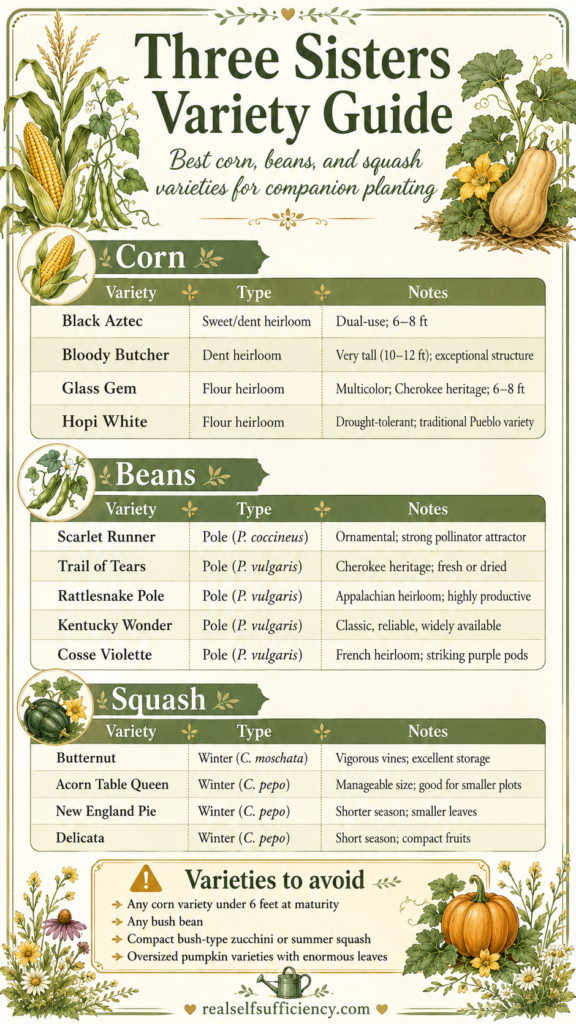
And again, for those who want an unfussy, ink-saving printable version…
| Crop | Variety | Type | Notes |
|---|---|---|---|
| Corn | Black Aztec | Sweet/dent heirloom | Dual-use; 6–8 ft |
| Corn | Bloody Butcher | Dent heirloom | Very tall (10–12 ft); exceptional structure |
| Corn | Glass Gem | Flour heirloom | Multicolor; Cherokee heritage; 6–8 ft |
| Corn | Hopi White | Flour heirloom | Drought-tolerant; traditional Pueblo variety |
| Beans | Scarlet Runner | Pole (P. coccineus) | Ornamental; strong pollinator attractor |
| Beans | Trail of Tears | Pole (P. vulgaris) | Cherokee heritage; fresh or dried |
| Beans | Rattlesnake Pole | Pole (P. vulgaris) | Appalachian heirloom; highly productive |
| Beans | Kentucky Wonder | Pole (P. vulgaris) | Classic, reliable, widely available |
| Beans | Cosse Violette | Pole (P. vulgaris) | French heirloom; striking purple pods |
| Squash | Butternut | Winter (C. moschata) | Vigorous vines; excellent storage |
| Squash | Acorn Table Queen | Winter (C. pepo) | Manageable size; good for smaller plots |
| Squash | New England Pie | Winter (C. pepo) | Shorter season; smaller leaves |
| Squash | Delicata | Winter (C. pepo) | Short season; compact fruits |
Varieties to avoid: Any corn variety under 6 feet at maturity; any bush bean; compact bush-type zucchini or summer squash; oversized pumpkin varieties with enormous leaves.
Three Sisters garden layouts
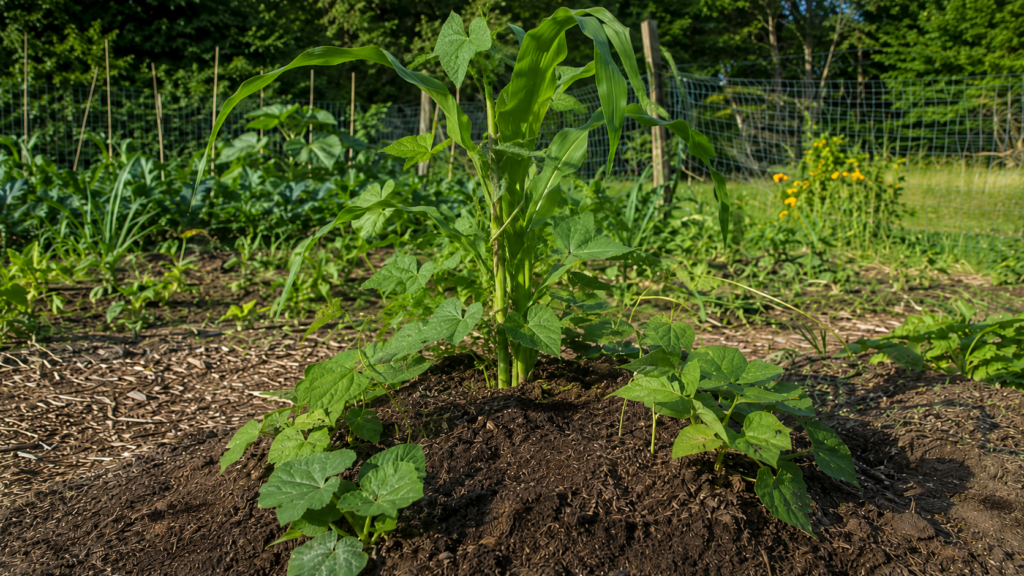
Classic hill method: The traditional configuration with multiple mounds in a grid, 4 feet between centers, squash planted in the flat ground between mounds. This is the most flexible approach and works well in any in-ground garden with enough space. A grid of four to six mounds is the minimum for good corn pollination; the more mounds you have, the better everything works.
Row configuration: For long, narrow gardens, arrange mounds in two parallel rows rather than a grid. The corn across both rows still pollinates each other effectively. Direct squash vines down the center aisle between the rows.
Raised bed adaptation: It’s possible to grow Three Sisters in a raised bed, but the bed needs to be large enough to be worth doing. A 4×8 raised bed can hold two mounds with eight bean plants and two to three squash. That’s workable but tight, and the companion dynamics function better with more space. Two 4×8 beds side by side, or a single 4×10 bed, is a more realistic minimum. The squash will want to spill over the bed edge. Let it. It will happily sprawl onto the surrounding path or lawn and still do its mulching and pest-deterrence job.
Single-mound workaround: If space only allows for one mound, hand-pollinate the corn. During the 1 to 2 week pollination window, when tassels are releasing pollen and silks are visible at the ear tips, shake each tassel over the silks of the ears below every morning. It takes 30 seconds per plant and dramatically improves kernel fill.
Watering and ongoing care
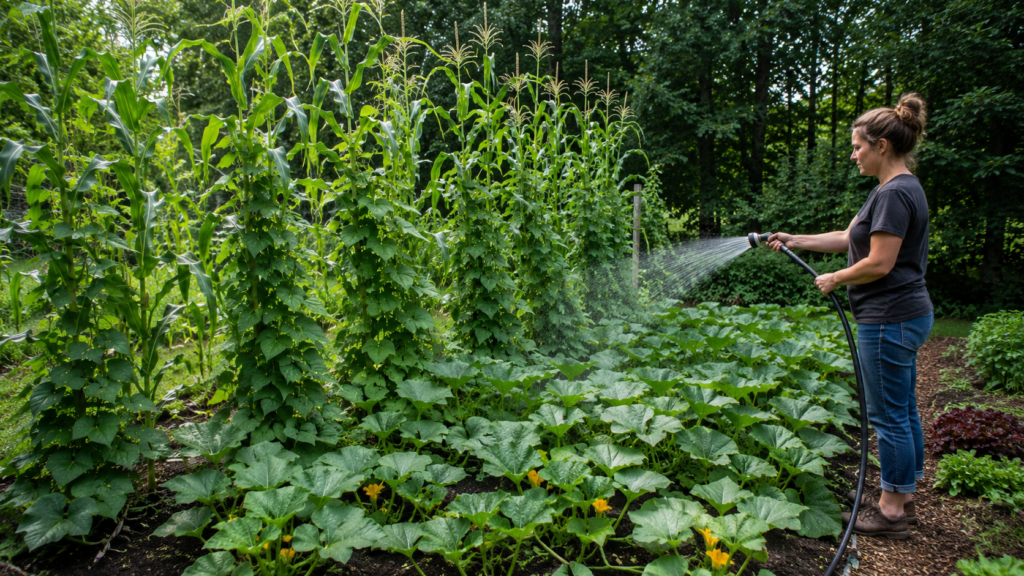
Corn, beans, and squash are all high-water crops. Water deeply once a week during dry spells rather than watering shallowly and frequently. Deep, infrequent watering encourages roots to grow down in search of moisture rather than concentrating at the surface.
Water at the base of plants, not overhead. Wet squash foliage is an invitation for powdery mildew, which will move in by late summer anyway but there’s no reason to accelerate it.
Two watering windows are critical and worth marking on your calendar. The first is corn silking, when tassels emerge and silks appear at the ear tips. The plant is actively pollinating. Drought stress at this precise moment causes direct kernel abortion. Don’t let the soil dry out during this window. The second is squash fruit set. Small fruits will abort in dry conditions before they have a chance to develop.
Keep weeding for the first three weeks after planting. After that, squash vines spread rapidly and suppress weeds automatically. One of the great practical rewards of this system is that your weed pressure drops significantly once squash is established. You go from regular weeding to occasional maintenance.
Do not apply nitrogen fertilizer once your beans are up and growing. It’s counterproductive, as high soil nitrogen suppresses Rhizobium activity and defeats the biological fertilizer system you’ve set up.
The fourth and fifth sisters

Several Indigenous traditions expanded beyond the core trio with additional companion crops.
Sunflowers (Helianthus annuus) are the most historically documented addition. The Wampanoag tradition is the clearest example. Plant them around the perimeter of the Three Sisters plot, not within it. They attract pollinators (which benefits the squash in particular), provide additional trellising for beans at the plot edges, and their seeds are a valuable food crop. Their height also provides afternoon shade on the squash, which can reduce heat stress during hot summers.
Amaranth (Amaranthus spp.) was a common component of Mesoamerican milpa farming alongside the three sisters. It tolerates full sun, produces edible seeds and greens, and adds a visually striking element to the planting with its tall, colorful seed heads.
Bee balm (Monarda spp.) appears in Pueblo-style planting traditions. It’s a powerful pollinator attractor with traditional medicinal uses, and it works well at the edges of a Three Sisters plot.
For pest management around the perimeter, marigolds deter squash bugs and nematodes, and nasturtiums function as a trap crop, since aphids prefer them over your vegetables, drawing pest pressure away from your main crops. The nasturtium flowers are also edible, which earns them extra points. Catnip planted around the border helps deter squash bugs.
Harvesting the Three Sisters
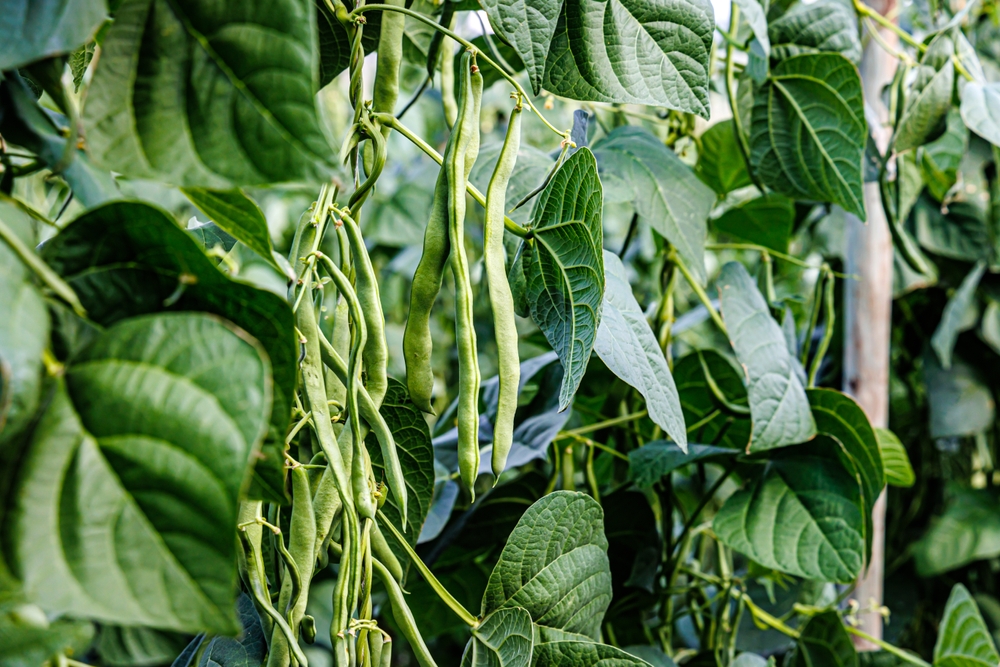
Pole beans: For fresh eating, harvest when pods are firm and bright and the beans inside are just beginning to swell, typically 50 to 70 days from planting depending on variety. Frequent picking keeps the plants producing. For dried beans, leave pods on the vine until they rattle and the vine begins to die back naturally. Harvest before first frost and finish drying indoors if needed, laid out in a single layer in a warm, airy spot.
Corn: Sweet corn is ready at the milk stage, when silks have turned brown and dry, the ear feels full and rounded at the tip, and pressing a kernel releases milky juice. Grain corn for drying stays on the stalk until the husks are fully papery and dry, then comes inside to finish drying before shelling. Step carefully through the squash vines to get to the corn. It’s one of the few moments this system requires navigation.
Winter squash: Leave on the vine until the skin resists a fingernail scratch and the stem begins to dry and cork over. Harvest before first frost and cure in a warm, dry location, around 80°F, for 10 to 14 days. Curing hardens the skin significantly, extending storage life from weeks to months.
End-of-season soil care (the most overlooked step): When clearing the bed at season’s end, leave the bean root systems in the soil. The Rhizobium nodules on those roots are packed with fixed nitrogen. As they decompose over winter, they release that nitrogen directly into the soil for next season’s crops. Chop squash vines and lay them as mulch over the bed. Add corn stalks to the compost heap or, if you have a shredder, chip them as additional mulch material. The Three Sisters build your soil while they feed you. That’s the most concrete and practical argument for this system over conventional planting.
Troubleshooting common problems
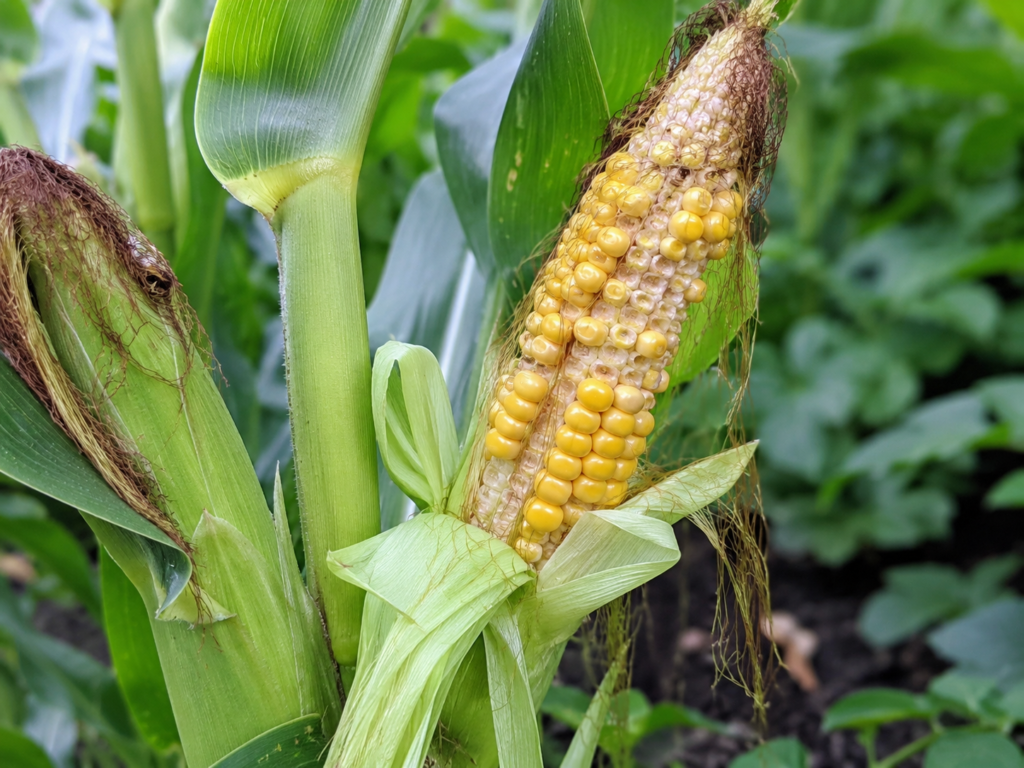
Poorly-filled ears with missing kernels: Almost always a pollination problem from isolated planting. Grow a minimum of four mounds in close proximity in a grid, not a line. If you’re limited to fewer mounds, hand-pollinate each morning during the pollination window by shaking the tassels over the silks below.
Beans smothering young corn: Beans were planted too early, before corn reached 4 to 6 inches, or you’ve chosen an extremely vigorous climbing variety. Stick to the timing sequence, and choose moderately vigorous heirloom varieties rather than turbo-charged hybrids.
Squash not setting fruit: Insufficient pollinator activity, or unusually wet and cool weather during the fruit-set window. Hand-pollinate using a small paintbrush or by removing a male flower (the one on a long thin stem with no small fruit at the base) and touching it directly to a female flower (which has a tiny proto-squash at its base). Do this in the morning when flowers are freshly open.
Powdery mildew on squash: Some mildew by late summer is essentially inevitable on squash, and doesn’t mean the planting has failed. Minimize it by watering at the base only, improving airflow where possible (don’t let the planting get so dense that air can’t circulate), and choosing mildew-tolerant varieties when you can. The squash typically continues producing right through mild mildew pressure.
Squash vine borers: The most destructive pest for squash in the eastern half of the country. Protect stems early in the season by wrapping the base of each squash stem with a strip of aluminum foil when plants are young. Vine borer moths lay eggs at the stem base, and physical barriers are the most effective deterrent. Use floating row cover from transplant to first flowering to block adults entirely, then remove it so pollinators can access the flowers. If you find entry holes and frass (sawdust-like debris) at the stem base, the larvae can be surgically removed with a sharp knife. Cut along the stem carefully, remove the caterpillar, and mound soil over the cut section of stem to encourage re-rooting.
Mounds eroding: Heavy rain or loose, sandy soil can wash mounds down over the season. Mulch the sides of each mound with straw to hold structure. Build mounds on the higher side initially, as they’ll settle and compact over the first few weeks.
Frequently asked questions
What are the Three Sisters in companion planting?
The Three Sisters are corn, pole beans, and vining squash grown together in a mutually beneficial system. Corn provides a natural trellis for beans. Beans fix atmospheric nitrogen into the soil via Rhizobium bacteria on their roots, directly feeding the corn and squash. Squash vines sprawl as living mulch, retaining soil moisture, suppressing weeds, and deterring mammals with their prickly stems. The method was developed by Indigenous peoples across North America and Mesoamerica. The Haudenosaunee (Iroquois), Pueblo, and Mesoamerican milpa farming traditions all documented versions of this combination.
How do you plant the Three Sisters step by step?
Build mounds of amended soil 10 to 12 inches high and 4 to 5 feet across, spaced 4 feet apart. Plant corn first in a circle on each mound. When corn reaches 4 to 6 inches tall, roughly 2 to 3 weeks later, plant 4 to 6 pole bean seeds around each corn stalk. About a week after beans emerge, plant squash seeds in the spaces between mounds. This staggered sequence is essential: it gives each crop time to establish before its neighbors crowd it.
Why isn’t my Three Sisters corn pollinating well?
Corn is wind-pollinated and needs to grow in blocks, not isolated mounds. A single mound of 4 to 6 plants doesn’t generate sufficient pollen for reliable ear fill. Grow at least four mounds in a close grid. If space limits you to fewer, hand-pollinate by shaking each tassel over the silks below each morning during the 1 to 2 week pollination window.
Can you grow Three Sisters in a raised bed?
Yes, but the bed needs to be large. A 4×8 raised bed is the minimum. It holds two mounds with beans and a couple of squash plants, which is workable but tight. The companion dynamics work better with more space, so two adjacent 4×8 beds or a 4×10 bed gives meaningfully better results. The squash will inevitably spill over the edges, which is fine. It can sprawl onto the path and still do its job.
Does the Three Sisters method actually improve soil health?
Yes, in two specific ways. Bean roots host Rhizobium bacteria that fix atmospheric nitrogen into plant-available ammonium throughout the growing season, directly feeding the corn and squash without any synthetic inputs. At season’s end, leaving the bean root systems in the soil releases that stored nitrogen as the nodules decompose over winter. Repeated Three Sisters planting in the same beds builds measurably better soil over time.
What is the fourth sister?
Several Indigenous traditions added a fourth crop to the trio. The Wampanoag tradition most thoroughly documented the addition of sunflowers (Helianthus annuus), planted at the plot perimeter to attract pollinators and provide additional food. Mesoamerican milpa farming commonly included amaranth (Amaranthus spp.) as a grain crop alongside the three sisters. Bee balm (Monarda spp.) appears in some Pueblo-style plantings as a pollinator attractor.
What’s the minimum space for a Three Sisters garden?
You need at least four corn mounds in close proximity for reliable pollination, which requires roughly a 10×10 foot plot. A single isolated mound of corn will typically produce poorly-filled ears regardless of how well everything else goes. If you genuinely only have space for one or two mounds, plan to hand-pollinate the corn during its 1 to 2 week pollination window.
Do Three Sisters plants need fertilizer?
Beyond building good, compost-rich soil before planting, the Three Sisters largely feed themselves. The beans supply nitrogen to the corn and squash through Rhizobium fixation. The one rule: do not apply nitrogen fertilizer once beans are established. High soil nitrogen suppresses Rhizobium activity and undermines the biological fertilizer system the beans provide. Topdress with finished compost if plants look pale or stressed, but hold off on any nitrogen-heavy amendments.
Can you grow Three Sisters from transplants instead of direct sow?
Yes, and in zones 3 to 5 with short growing seasons it can make a real difference to overall harvest size. Start corn and squash indoors 2 to 3 weeks before last frost date. Beans are faster and can go in as direct sow once the corn transplants are established and the soil is warm enough. Whether you direct sow or transplant, the sequencing rules remain the same: corn first, then beans at 4 to 6 inches, then squash a week after beans emerge.
You might also like…
12 Best Herbs and Flowers for Companion Planting With Vegetables
Companion Plants for Cucumbers: Organic Pest Control and Big Harvests
13 Best Plants For Companion Planting Cantaloupe Melons (And 3 to Avoid)


A group of us in a friends garden tried a variation of this. It worked but not to its full potential. Thank you for this explanation. It was simple and easily drawn out. I am excited to try this again this year. Thank you and happy planting for 2021
Hey Kenda,
Good luck to you too! If your plants need a boost, you can always make some nettle tea. But hopefully your plants will thrive this year! 🙂
This is a good explanation of the three sisters which I am going to try here in Australia when spring arrives.
Good luck! It’s definitely worth it, particularly if you’re growing in a smaller space. Just remember to add plenty of compost, manure, or other nutrient-rich organic matter to the growing area before you plant, as planting all three varieties in a small space puts significant nutrient demand on the soil.