
Affiliate disclosure: This post may contain affiliate links. Please see full disclosure.
I’ve been thrifting and collecting vintage kitchenware long enough to know that some things can sit untouched on a crowded estate-sale table all morning, while others barely make it through the door before somebody claims them. Sears’ Merry Mushroom pieces fall very firmly into the second category. If I spot those fat little orange and brown mushrooms poking out from behind a stack of old casserole dishes, I’m going over for a look.
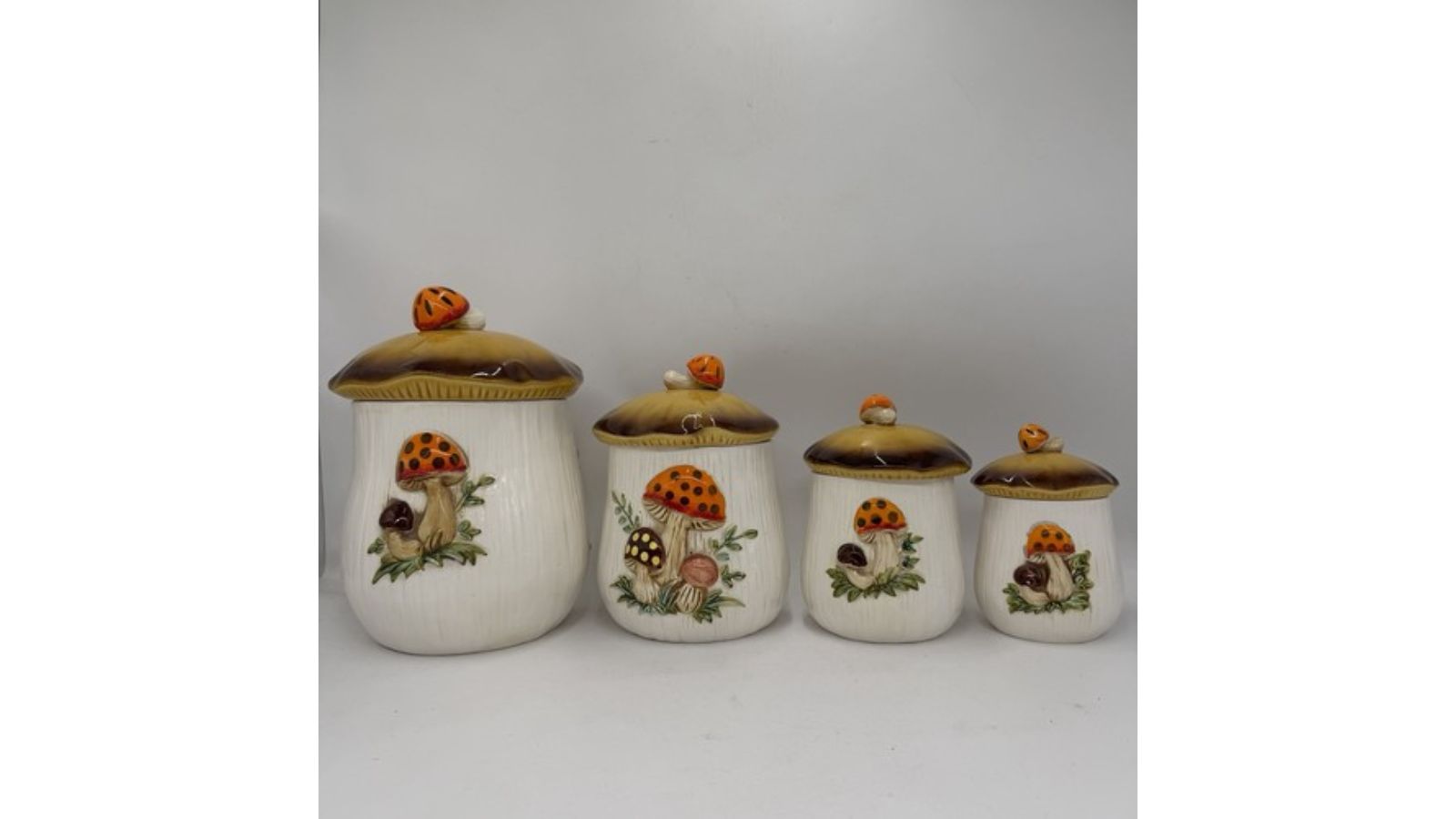
And, yes, they’re extremely ’70s. That’s rather the point. The familiar ceramic canisters have off-white bodies covered in raised orange, yellow, and brown mushrooms, usually topped with glossy brown or mustard-colored lids. They are cheerful, slightly ridiculous, and almost impossible to mistake for modern minimalist kitchenware. The collection is also much bigger than the canister sets that tend to get all the attention. Sears put Merry Mushroom designs on cookware, clocks, spice containers, tableware, linens, utensils, planters, and all sorts of other kitchen pieces.
That enormous range is part of what keeps collectors hunting. Finding one canister isn’t necessarily difficult. Finding the missing piece from a particular set, in the right year and color, with its proper lid and no chips, is another matter entirely. And that’s where a cheap estate-sale find gets interesting.
Sears went all-in on Merry Mushroom
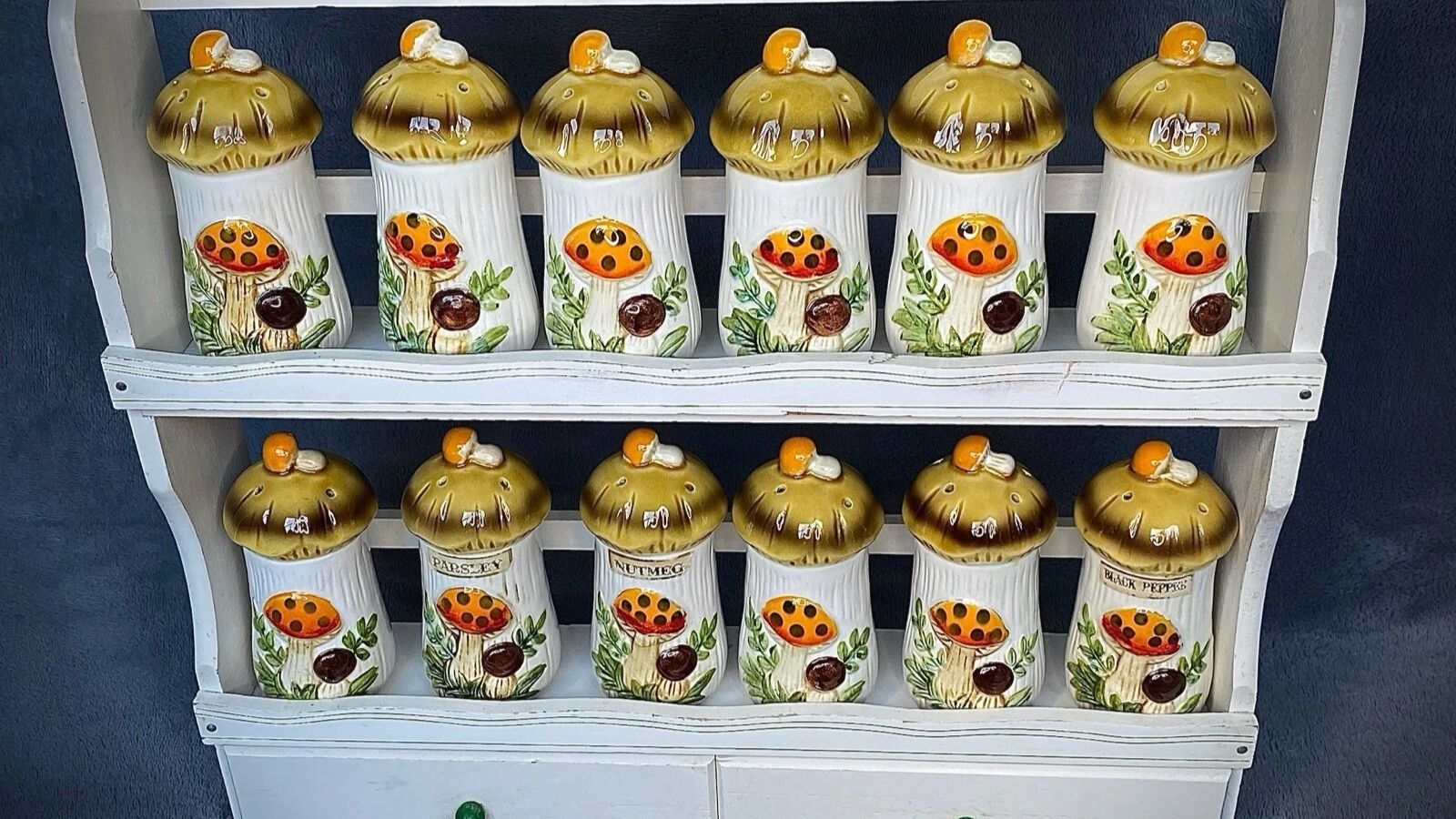
Merry Mushroom wasn’t a short-lived novelty pattern. The collection appeared in Sears catalogs from 1970 through 1987 and eventually grew to more than 250 different products. That number makes considerably more sense once you understand Sears’ idea of “kitchen coordinates.” Rather than selling one matching dinnerware set, the company plastered the same design over practically everything in the room, from the stovetop to the table.
The mushrooms clearly had staying power. By 1978, Sears catalogs contained 83 different Merry Mushroom items, the biggest selection offered in any single year. As a collector, that’s the detail I find dangerous. It means there’s always another oddball piece you didn’t know existed. You can start out perfectly content with four canisters and then discover the matching napkin holder, spice cabinet, wall clock, plant tools, or cheese board. Suddenly you have a new problem.
The ceramic pieces are also genuinely distinctive. A 1973 Sears catalog described them as kiln-glazed, hand-decorated ceramics imported from Japan, with embossed mushrooms in orange, brown, and yellow against an off-white background. They were built around a very specific look, and that look has aged far better than plenty of other coordinated kitchens from the same period. House Digest has already noted that Merry Mushroom jars have started turning up on modern thrifting wish lists again. I can understand why. One or two pieces among wood, stoneware, and other old kitchen finds look charming. An entire Merry Mushroom kitchen may require considerably more commitment.
Check the bottom before you hand over your money

okthrifts via eBay
If I find Merry Mushroom at a thrift store or estate sale, the first thing I do is turn it over. Many genuine ceramic pieces have Sears, Roebuck and Co. markings, a copyright year, and a country of origin. Japan is common, but don’t automatically reject a piece marked Mexico. Several legitimate 1978 markings include “Made in Mexico,” while others were made in Japan or carried import stickers. The markings varied enough that identifying a piece by one supposedly universal stamp is a good way to leave something genuine behind.
Then I check the boring stuff, because boring stuff is what decides whether you’ve found a bargain. Look closely around the rim and underneath the lid for chips. Check the mushroom-shaped knobs, handles, and raised decoration. Hairline cracks are easy to miss in a busy sale. And make sure the lid actually belongs to the canister. Even serious collectors note that old sets have been mixed and matched over the decades, so two pieces sitting together today were not necessarily sold together originally.
I also wouldn’t value one from an optimistic online asking price. Actual sales are much more useful. In 2026, one four-piece Sears Merry Mushroom canister set realized $310 at auction, while another four-piece 1978 set sold for $180. A larger 13-piece grouping sold for $399.99. Condition, completeness, year, and the particular pieces involved all matter, obviously. Still, if I saw a clean, complete set priced like ordinary old kitchen canisters at an estate sale, I wouldn’t wander off to think about it. Someone else will happily do the thinking for you.
You might also like…
The Pink Pyrex Pattern Collectors Dream of Finding at a Thrift Store
The CorningWare Pattern Collectors Dream Of Finding At A Thrift Store
Why Are Thrift Shoppers Taking UV Flashlights Into the Glassware Aisle?

