
Affiliate disclosure: This post may contain affiliate links. Please see full disclosure.
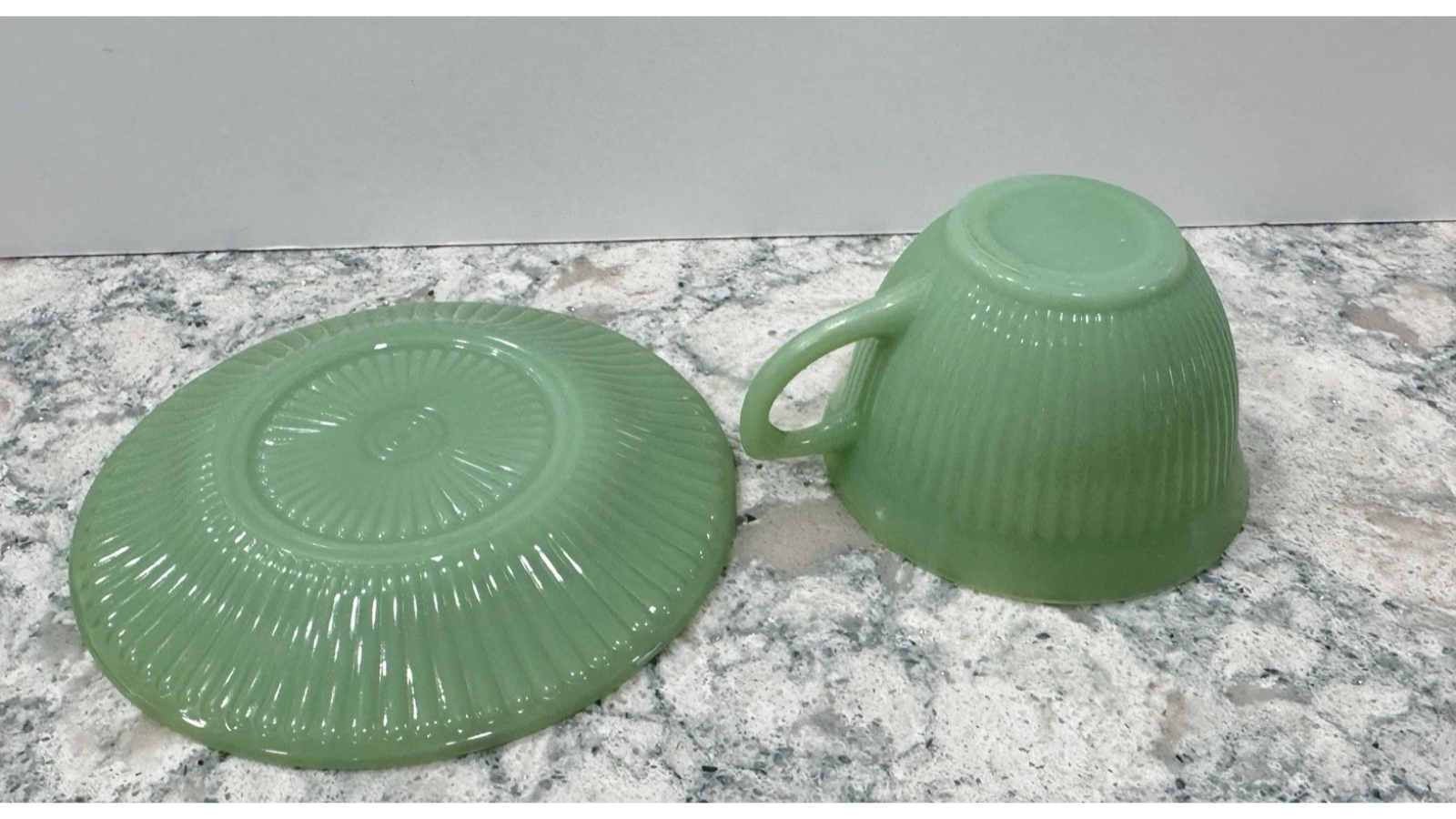
Fire-King Jane Ray is the vintage dinnerware to look for when a stack of milky green dishes has a border of fine, tightly spaced raised ribs. The decoration is molded into the glass, with narrow rays spreading around the edge of plates and saucers. There are no bright flowers or gold flourishes to announce it. You need to look a little closer, which is part of the appeal.
As an avid thrifter and collector, I put more weight on the details of a piece than whatever exciting description is stuck to its price tag. With Jane Ray, the useful clues are the ribbing, the shape, and the relatively light construction. Green glass alone doesn’t settle the identification.
It’s also a pattern you can appreciate without chasing the most unusual piece. A few ribbed bowls or a cup and saucer make a lovely small collection. I like vintage kitchenware that earns its space because you enjoy looking at it, rather than because somebody has declared it a must-have.
Look for fine rays around a plain center

Jane Ray plates have a rayed border surrounding a plain center. Picture lots of narrow lines running outward toward the rim, rather than circles running around the plate. On cups and bowls, check the outside for the ribbed decoration, too.
Tilt a piece toward the light so the raised details cast little shadows. This is more useful than staring straight down at a plate under flat store lighting. Then compare the whole profile with a clear photograph of the same shape. A bowl needs a bowl comparison, not just a vaguely similar green saucer.
The familiar green version belongs to Anchor Hocking’s Fire-King range. Its production is commonly dated to 1945 through 1963, although collector references differ on the exact endpoints. Mid-century is a sound description; a precise year for an individual thrift-store plate needs more evidence.
The color is part of its charm, but the relief decoration gives Jane Ray its character. I recommend learning that outline before shopping. It’s much easier to recognize a familiar rim than to remember a long list of backstamp dates while balancing a stack of dishes.
Jane Ray feels lighter than Restaurant Ware

Fire-King Restaurant Ware is thicker, heavier, and undecorated, with the substantial construction associated with diners and institutional dining. Jane Ray is noticeably thinner. Put comparable plates beside each other and look at the edge thickness as well as the decoration.
Compare like with like. A large Jane Ray serving bowl may weigh more than a small Restaurant Ware saucer simply because there’s more of it. Weight helps when the shapes and sizes are comparable; it isn’t a stand-alone test.
Both can belong in a collection of vintage Fire-King Jade-ite, but they create quite different effects. The heavy plain dishes have that appealing lunch-counter look. Jane Ray has a finer texture that I find particularly attractive in a small group of cups or bowls, where you can actually see the sides.
Check the rest of the decoration before naming the pattern

Alice is the comparison that deserves particular attention. Its plates and saucers have a floral border as well as an inner band of rays. Spotting ribbing and stopping there can leave you calling an Alice plate Jane Ray. Look all the way from the plain center to the outer edge.
Other green Fire-King patterns have quite different outlines. Charm has square plates, while Sheaves of Wheat carries molded wheat decoration. Shell has a more pronounced shell-like relief and a scalloped edge. These differences matter more than whether two dishes look exactly the same shade of green.
When I assess a mixed stack, I check each piece separately. Matching color doesn’t make a matching pattern, and a cup resting on a saucer isn’t proof that they started life together. A mixed collection can look wonderful. You simply want to know what you’re choosing.
Turn it over, then check the condition

Jane Ray can carry variations of OVEN Fire-King GLASS or OVEN Fire-King WARE, sometimes with MADE IN U.S.A. Some examples are unmarked. An empty base doesn’t automatically rule a piece out, but it does make a careful shape comparison more useful.
A Fire-King mark identifies the brand, not the pattern by itself. Also watch for the year 2000 on Anchor Hocking’s later Jade-ite reproductions. Those belong to a different production period, whatever their resemblance to older green glass.
Once the identification looks right, slow down and inspect the rim, foot, handles, and any lid. Hold the piece against the light and turn it through a full circle. I give cracks and chipped drinking edges far more weight than a little ordinary surface wear. Don’t let the pleasure of recognizing a pattern talk you into overlooking damage you wouldn’t otherwise accept.
Build a collection you actually enjoy
Jane Ray offers more than plates and teacups. The range includes dessert bowls, cereal bowls, a vegetable bowl, a creamer, and a covered sugar bowl. Choose a shape you like, then photograph its front, base, and profile to keep a useful reference on your phone.
For care, start gently with handwashing in soapy water rather than putting vintage Jade-ite in the dishwasher. I wouldn’t buy a dull, rough piece on the assumption that a vigorous scrub will restore its gloss.
You don’t need a complete service to make Jane Ray worth bringing home. Start with one sound piece whose ribbing you can identify confidently. Leave room for the next find, and let the collection grow at a pace your shelves can accommodate.
You might also like…
The CorningWare Pattern Collectors Dream Of Finding At A Thrift Store
The Blue-And-White Pyrex Pattern Collectors Dream Of Finding At A Thrift Store
The Pink Pyrex Pattern Collectors Dream of Finding at a Thrift Store

