
Affiliate disclosure: This post may contain affiliate links. Please see full disclosure.
A white Pyrex bowl covered in rows of turquoise eyes would have me digging through the rest of the thrift-store shelf. Find two matching bowls and the original metal bracket, and you may have one of the most distinctive mid-century Pyrex chip-and-dip sets: Eyes, originally sold as the Hot ‘N’ Cold Chip and Dip Set.
The pattern is easy to recognize once you know it, but identifying an original set takes more care. The bowl sizes are unusual, the bracket matters, and some authentic examples don’t have the Pyrex stamp you’d normally expect underneath.
Those little turquoise eyes are the giveaway
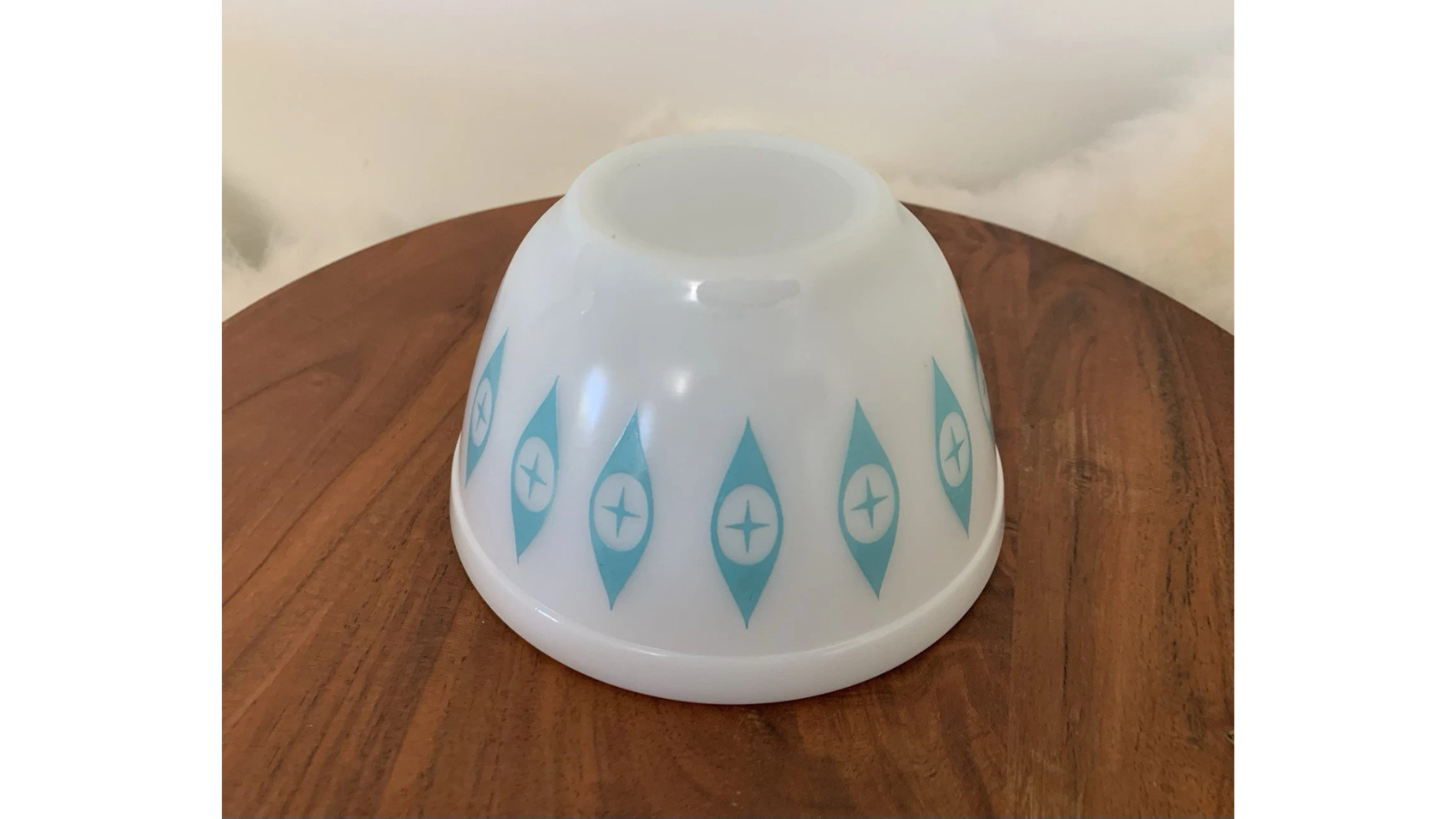
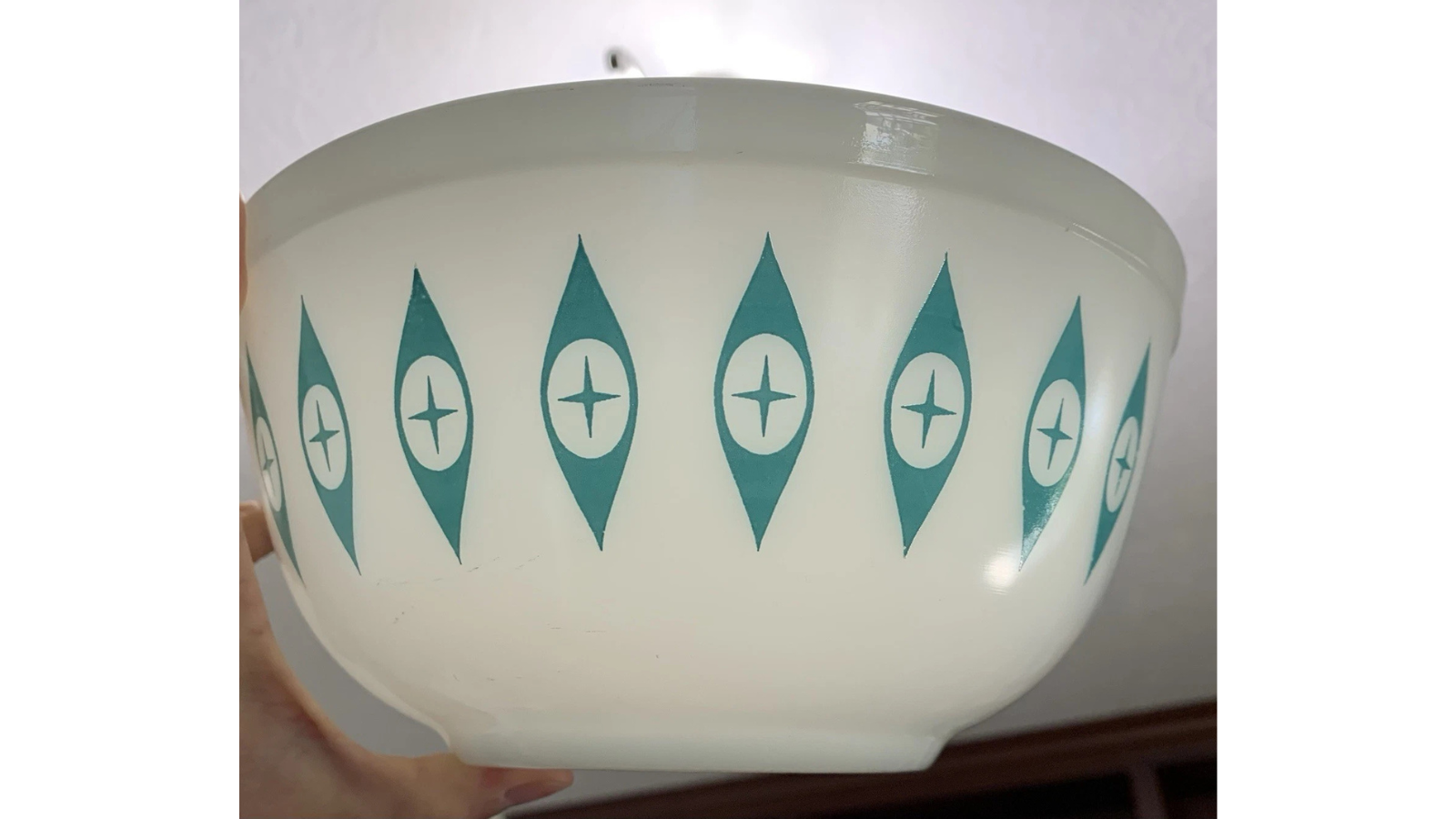
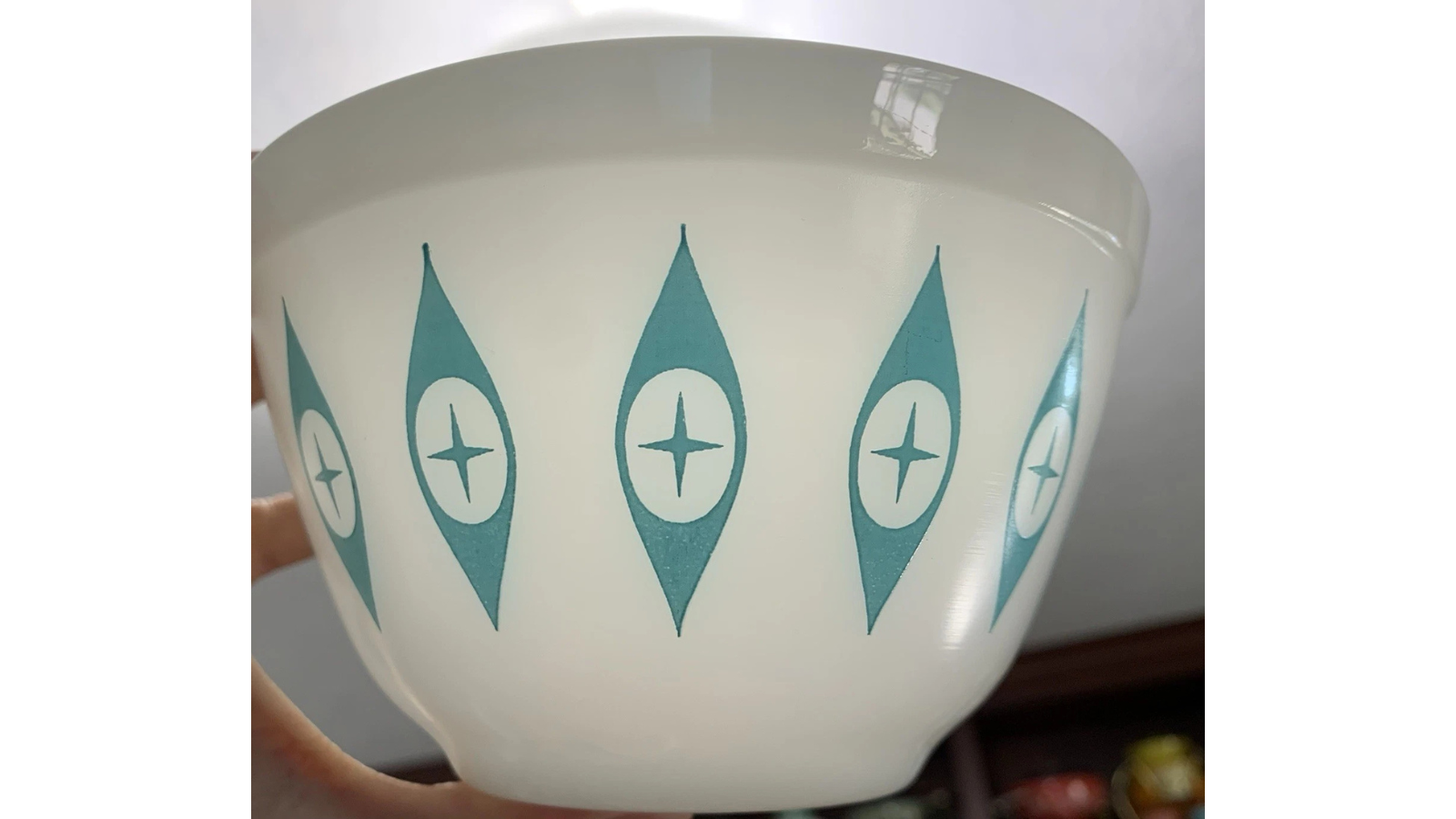
The Eyes pattern dates to the 1950s, although its precise introduction year isn’t firmly established. Sometimes called Atomic Eyes, it has a wonderfully space-age design: white opal glass with upright turquoise diamonds, each surrounding a white oval with a little turquoise cross in its center.
There’s something pleasingly odd about it. The repeating shapes look like eyes looking back at you, yet the colors are cheerful enough to fit into a retro kitchen. I love a design you can identify from halfway down the shelf, even when most of the bowl is hidden behind other dishes.
The original set used two particular bowl sizes
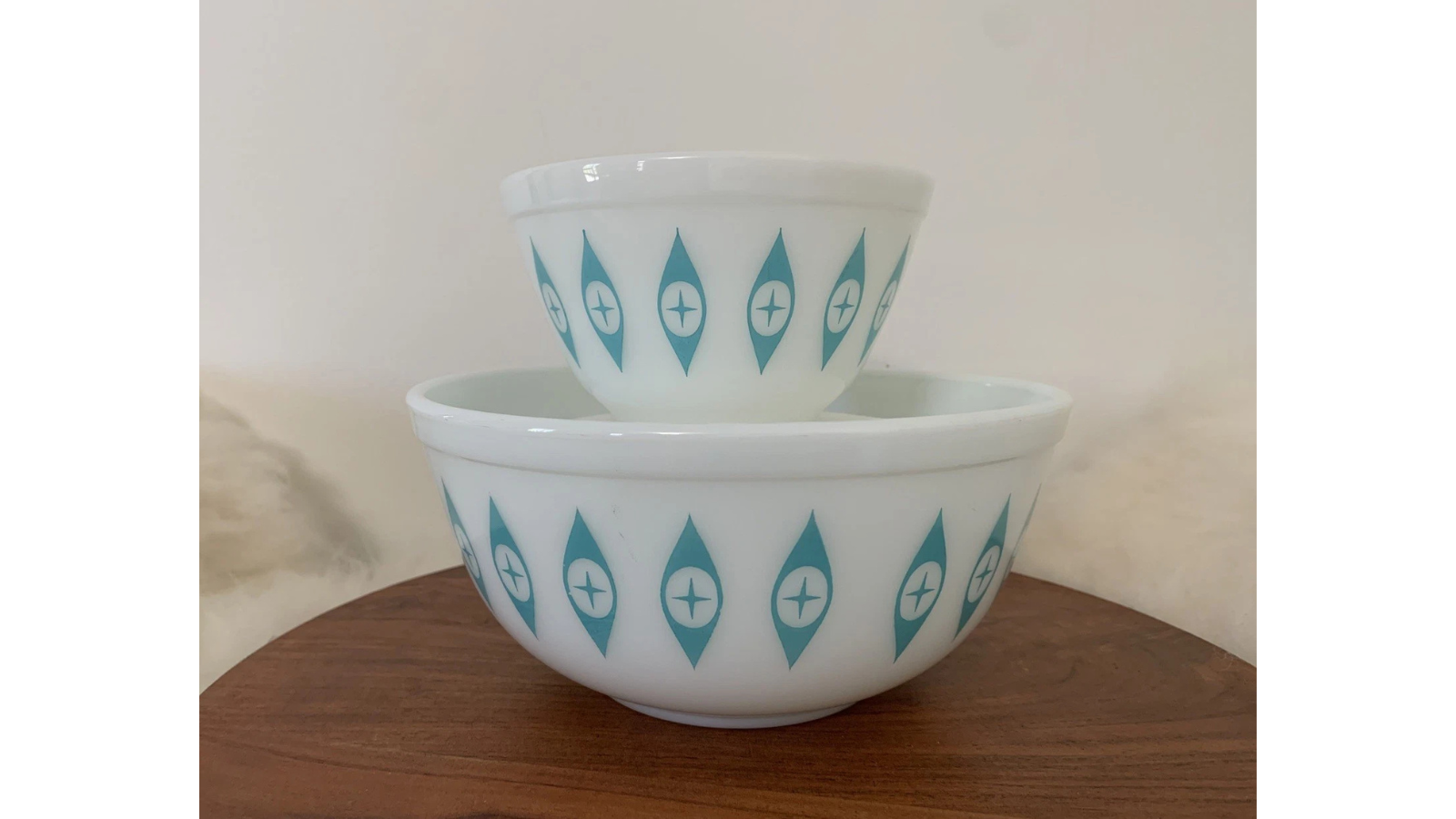
The Hot ‘N’ Cold set paired a 401 dip bowl with a 403 mixing bowl. A 401 holds 1½ pints, while a 403 holds 2½ quarts. Both have the classic round Pyrex mixing-bowl shape, without the handles and pouring spouts found on Cinderella bowls.
The larger 403 held the chips, while the smaller 401 sat above them for the dip. This is an unusual pairing, because many other Pyrex chip-and-dip sets used a four-quart bowl underneath.
Look for two bowls with the same turquoise decoration rather than assuming any white Pyrex bowl of a convenient size belongs to the set. If you find just one, it’s still a lovely piece to collect and use for serving. I wouldn’t pass up a clean example because its partner is missing.
The metal bracket makes all the difference
The original arrangement included a grooved, formed-metal bracket that hooks onto the larger bowl and holds the smaller one above it. Without that bracket, you have two matching mixing bowls rather than the complete serving arrangement.
I’d check the metal as carefully as the glass. Is it straight? Does it sit firmly on the larger bowl? Does the ring support the smaller one without wobbling? Look for rust, bent sections, and repairs, and don’t force a bracket over the rim to make it fit. Brackets became separated from their bowls, and one borrowed from another set isn’t automatically an original Eyes accessory.
The packaging provides another identification clue. The set was sold as Hot ‘N’ Cold, with the box marked HC-9. You don’t need the box to enjoy it, but it confirms what the bowls and bracket originally belonged to.
An unstamped bowl isn’t necessarily a fake
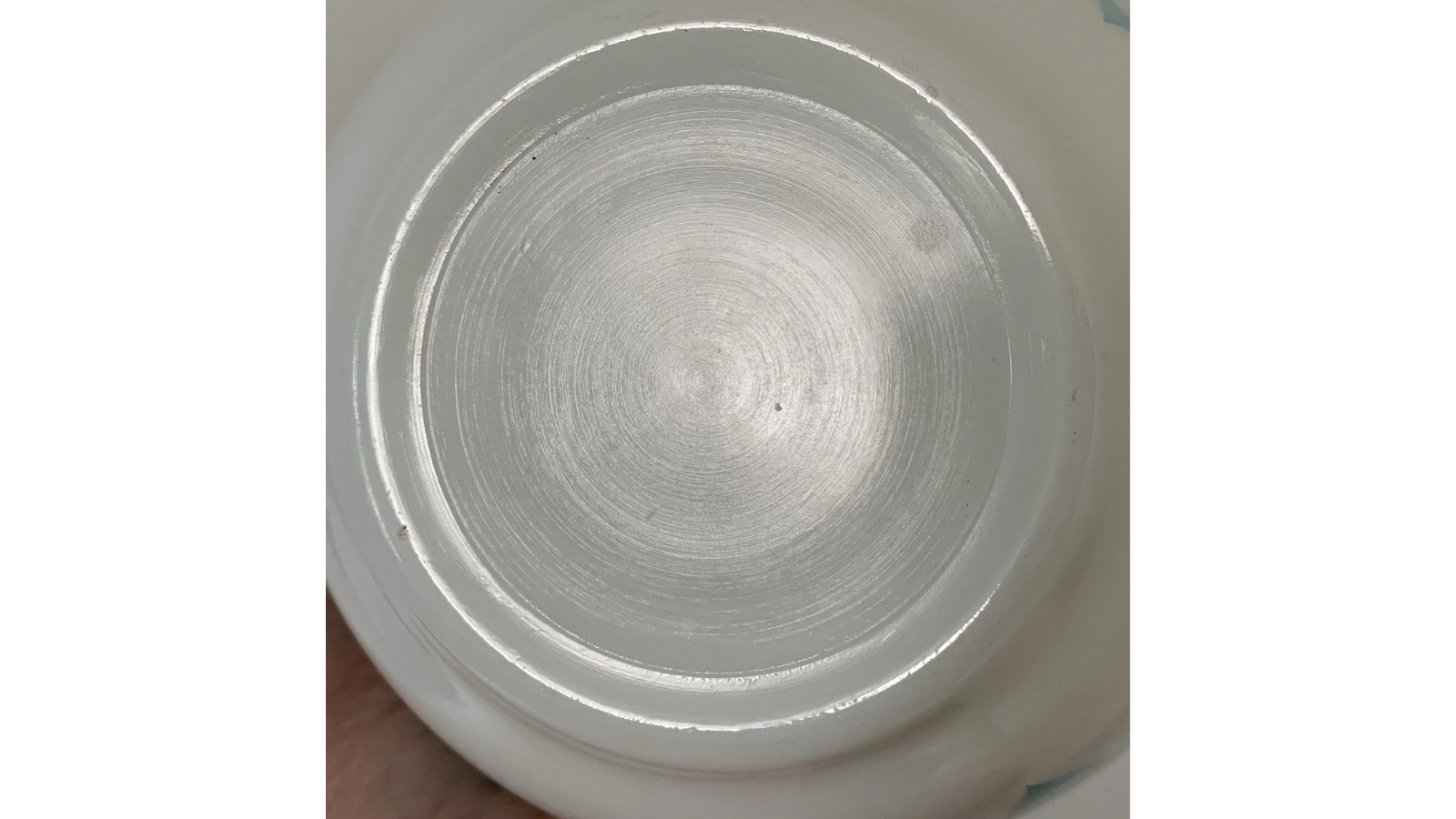
Here’s something I’d want any fellow thrifter to know: some genuine Eyes bowls have the familiar Pyrex base stamp and others don’t. An absent stamp isn’t, by itself, a reason to dismiss one. That’s especially useful to remember when you’re used to turning every vintage Pyrex bowl upside down to look for the name.
Of course, no stamp doesn’t prove that a bowl is genuine, either. Compare the exact turquoise shapes, white glass, round bowl profile, and size with documented examples. Several matching details tell you much more than one clue underneath.
Eyes isn’t the same set as Balloons

These early turquoise Pyrex promotions can look similar in photographs. But Balloons was a separate chip-and-dip design released in 1958, with white hot-air balloons and other whimsical images on a turquoise background. It used a 444 Cinderella bowl and a smaller 441 Cinderella bowl, both with flared handles.
Eyes has turquoise motifs on white, and the bowls are the round 403 and 401. The brackets differ, too. A metal support that fits Balloons isn’t necessarily the right one for Hot ‘N’ Cold. I wouldn’t treat them as interchangeable just because both are vintage chip-and-dip sets.
Check the decoration and rims before you buy
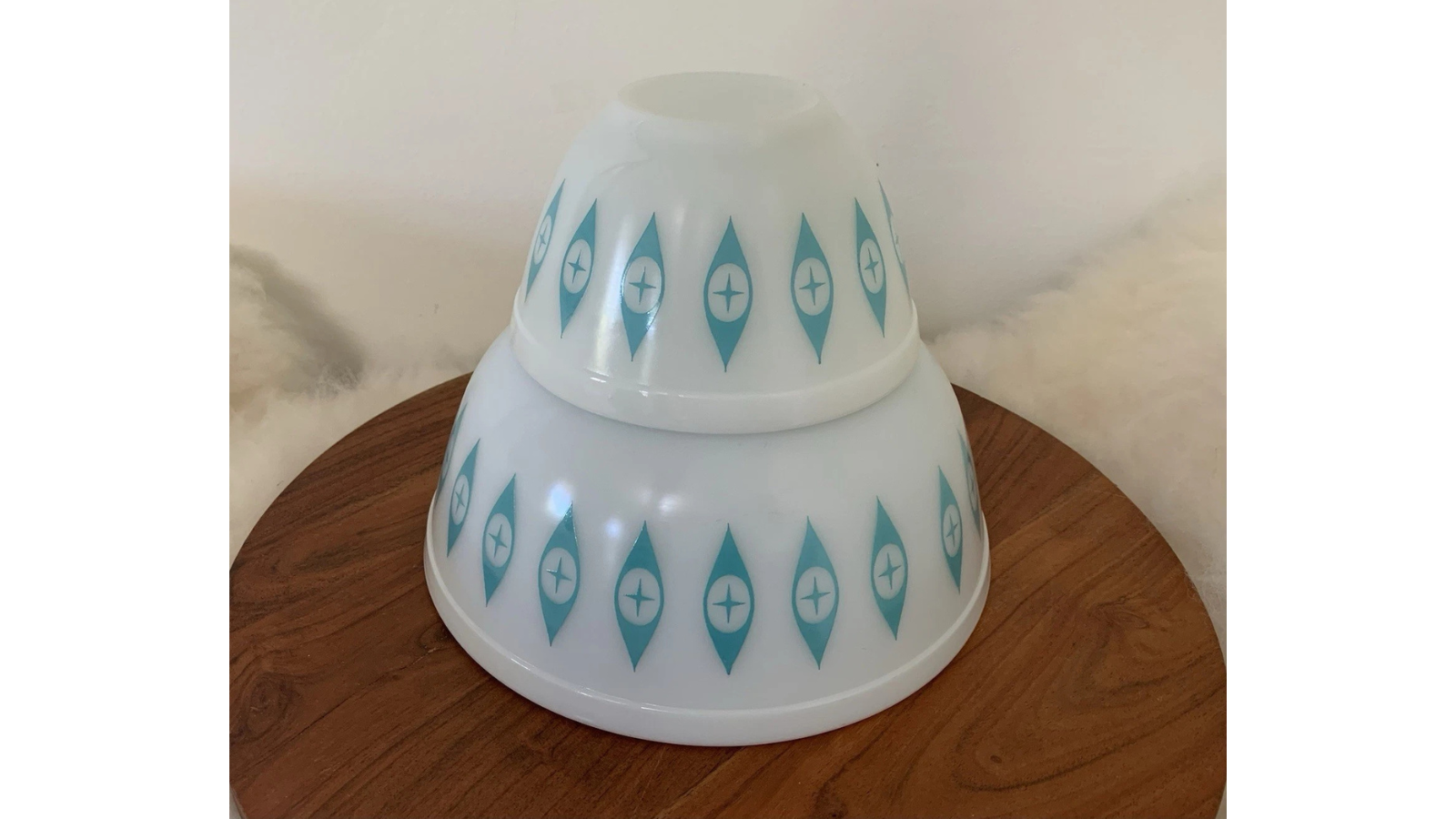
With patterned glass, I always start by turning each bowl slowly under good light. Check the rims for small chips, then look at the bases for hairline cracks and rough spots. Inspect the turquoise print for fading, scratches, or missing patches. The tidy rhythm of the repeated eyes is so much of the appeal that damaged decoration is particularly noticeable.
Don’t forget the inside for utensil wear. Ordinary signs of use wouldn’t bother me on an otherwise sound bowl, but I’d keep anything cracked strictly for display, if at all. If you’re considering a purported complete set, make sure the little bowl is actually supported safely rather than balanced precariously above the larger one.
Give this old Pyrex a gentle life
I’d hand-wash decorated vintage Pyrex gently with mild dish soap, warm water, and a soft sponge. Keep abrasive pads and strong cleaners away from the turquoise pattern. A dishwasher is an unnecessary gamble when the original decoration is a large part of why you’ve collected it.
These bowls are lovely for displaying or serving snacks. I wouldn’t assume the name Hot ‘N’ Cold means decades-old decorated bowls should go straight from a refrigerator into a hot oven. Avoid abrupt temperature changes and don’t use damaged glass for food.
A complete Eyes set with its proper bracket would be a wonderful thrift-store find. But even a single bowl has that unmistakable 1950s character, and there’s something satisfying about recognizing it for what it really is.
You might also like…
The CorningWare Pattern Collectors Dream Of Finding At A Thrift Store
The Blue-And-White Pyrex Pattern Collectors Dream Of Finding At A Thrift Store
The Pink Pyrex Pattern Collectors Dream of Finding at a Thrift Store

