
Affiliate disclosure: This post may contain affiliate links. Please see full disclosure. AI-assisted.
I look at the lids and stands almost as closely as I look at the pattern when I find unfamiliar CorningWare. A white ceramic knob, a glass lid with a pebbled underside, or a separate heater can change what you’re looking at. Four of these designs started out as limited-edition gifts. The other two are short-run patterns with clues of their own. All six are worth knowing if most of what you see secondhand is Blue Cornflower.
Platinum Filigree, introduced in 1966
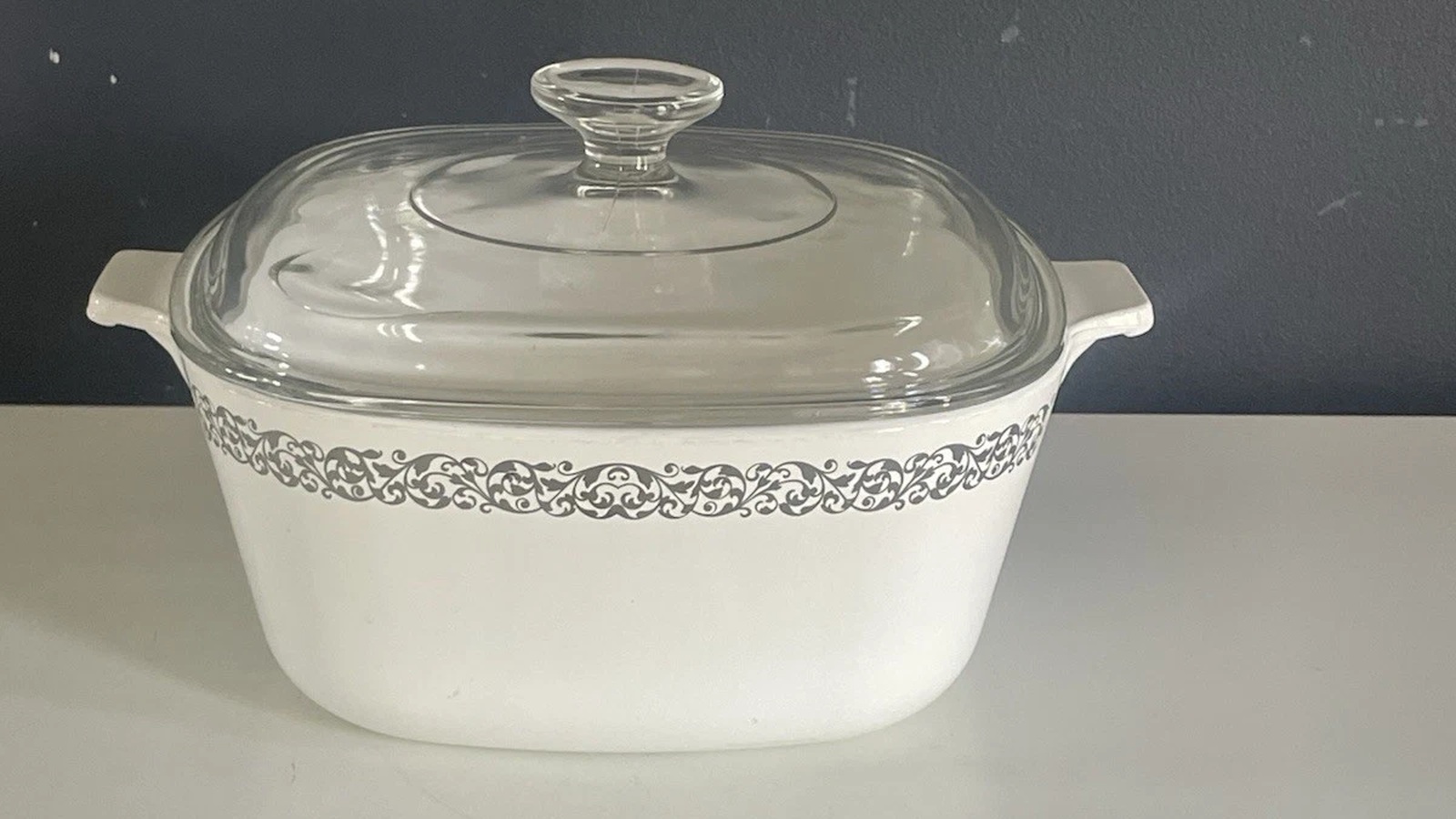
Look for a thin band of silver-colored scrolls near the top of the white body. The first Limited Edition Gift Line included 1¾- and 2½-quart saucepans, sold as the Party Buffet and Royal Buffet with glass lids and black-and-chrome candle warmers. There were also 6- and 10-cup Electromatic percolators and a 4-quart Electromatic saucepot with a separate heater. The percolators stayed available into 1969.
I’d turn the piece toward a light to check for breaks in the scrolls. For a buffet set, check that the pan sits level in the cradle and that the candle holder is still there. If you find the 4-quart saucepot, look for its flat-ground bottom and matching electric base. The silver band is delicate enough that I’d ask for a close-up of the side that faced the back of the cupboard. A complete scroll on that side can show you what the worn side originally looked like.
First-edition Floral Bouquet, introduced fall 1969
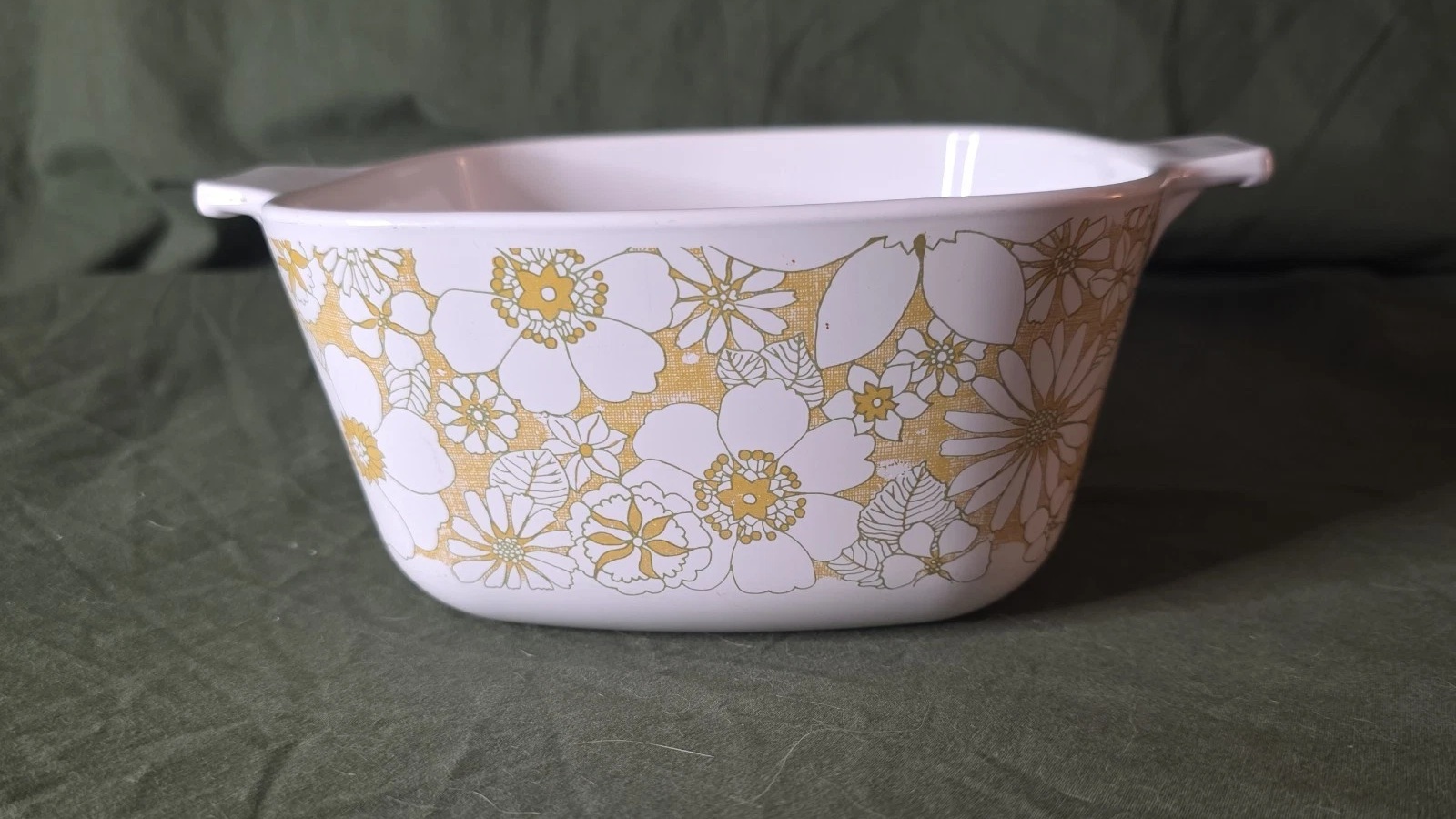
The early pattern has white flowers picked out against pale green outlines and a gold background that looks like woven linen. The fall 1969 launch included 1¾- and 2½-quart candle-warmer buffet sets and a 9-cup P-119 stovetop percolator. In early 1970 Corning added a 1½-quart saucepan with a woodgrain-look plastic trivet and offered the 1¾-quart pan with a trivet too. Later Floral Bouquet is easier to find and includes a version with a solid yellow background. Some early examples also turn up on an Electromatic skillet and percolator, but their exact introduction dates are unclear. I’d use the three launch pieces as the reference point for a 1969 set.
On the early floral saucepans, I look for a white ceramic knob that screws onto the glass cover. Check it for chips or looseness. I’d also look at the background between the blossoms. That little woven texture is easy to miss in a bright listing photo.
Renaissance, 1970

Look for a gray engraving-style view of Stockholm, with ships, buildings, and a triumphal arch. The 1970 gift line included 1¾- and 2½-quart saucepans, a 4-quart saucepot, a Broil and Bake tray, and a 9-cup stovetop percolator. Different shapes show different portions of the scene. The tray gives you a wider view, while the percolator shows the cathedral.
Turn the saucepan lids over and look for a pebbled texture underneath. The smaller pans came with chrome candle-warmer cradles and the 4-quart pot had a wood-handled cradle. I’d check the print around the corners as well as across the front, where the scene is easiest to see.
Nature’s Bounty, 1971
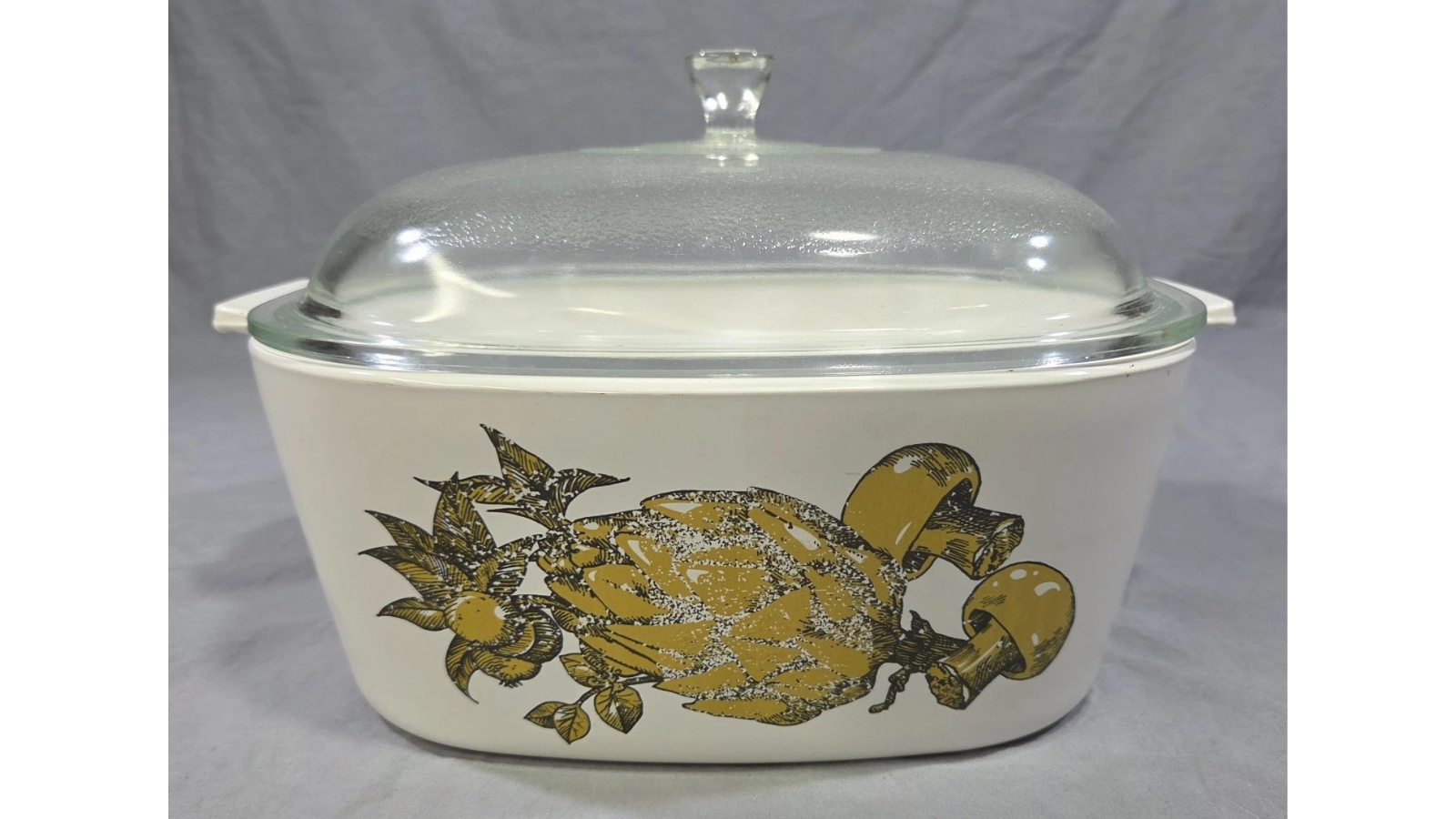
The harvest motifs are mustard-colored and olive, and some pieces show very different pictures when you turn them around. The documented 1971 pieces include 1¾- and 2½-quart saucepans, a 4-quart saucepot, a 10-inch skillet, an 8-cup Brew ’N Serve, and a bread pan. Look for pebbled glass covers on the saucepans and skillet and a gold-colored plastic lid on the bread pan.
I’d ask for a photo of each side. The decoration can flake, and a good-looking front tells you very little about the back. Look for sharp gaps in the print or lifting edges, especially around the fine leaves and stems.
Black Starburst, around 1961
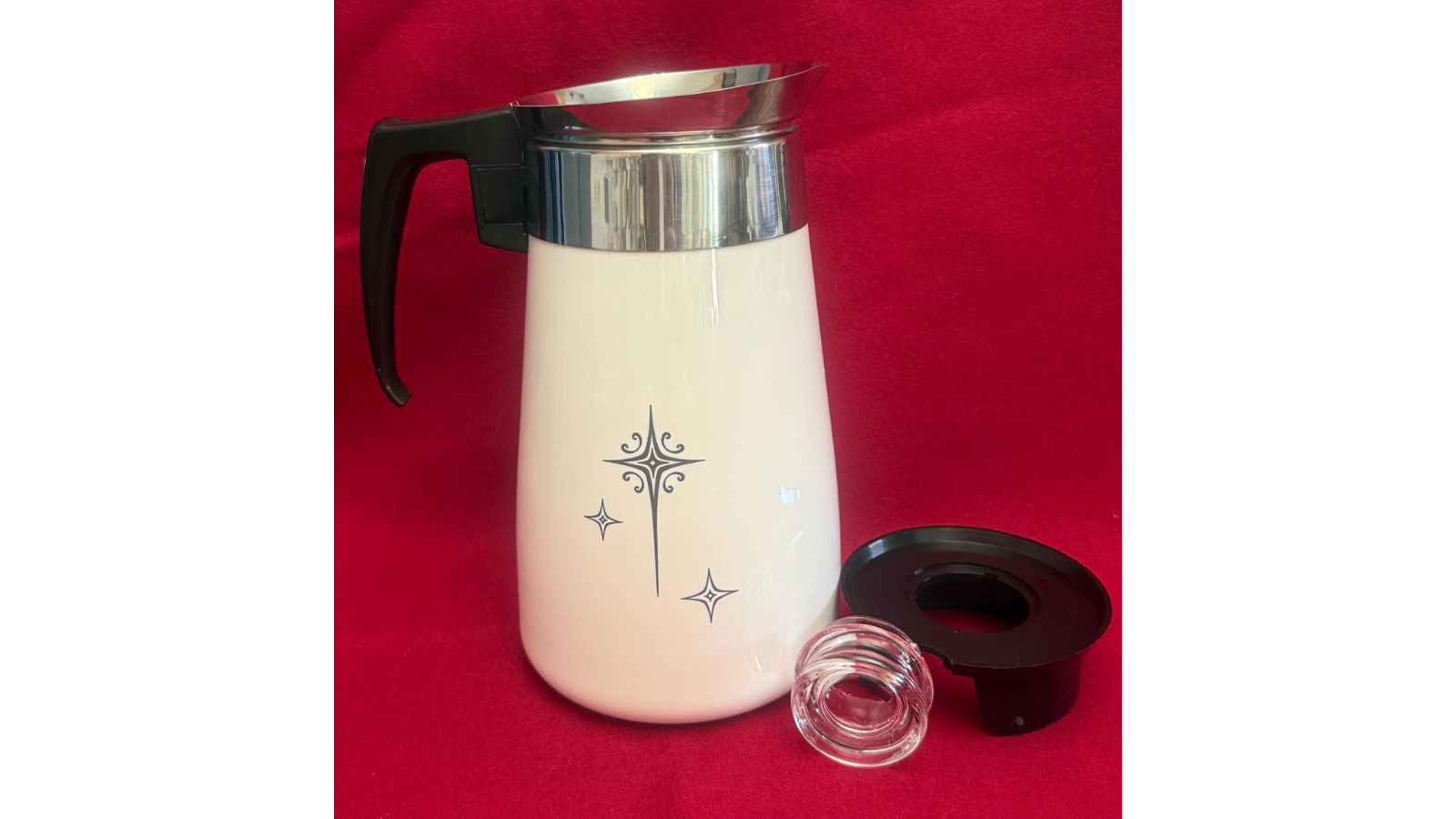
Look for a tall white stovetop coffee pot with a large, curling black star and smaller ones around it. The early-1960s Black Starburst is documented on P-108, P-116, and P-119 percolators. Listings can muddle it with the older silvery Platinum Starburst or the Black Star cookware pattern. I’d check the color of the motif and the model number together.
For completeness, ask to see the lid, basket, and stem. I’d keep the pot for display. Corning’s 1979 percolator recall warned that the handle and metal band on affected pots could separate without warning, even when the outside looked sound.
Country Festival, introduced in 1975
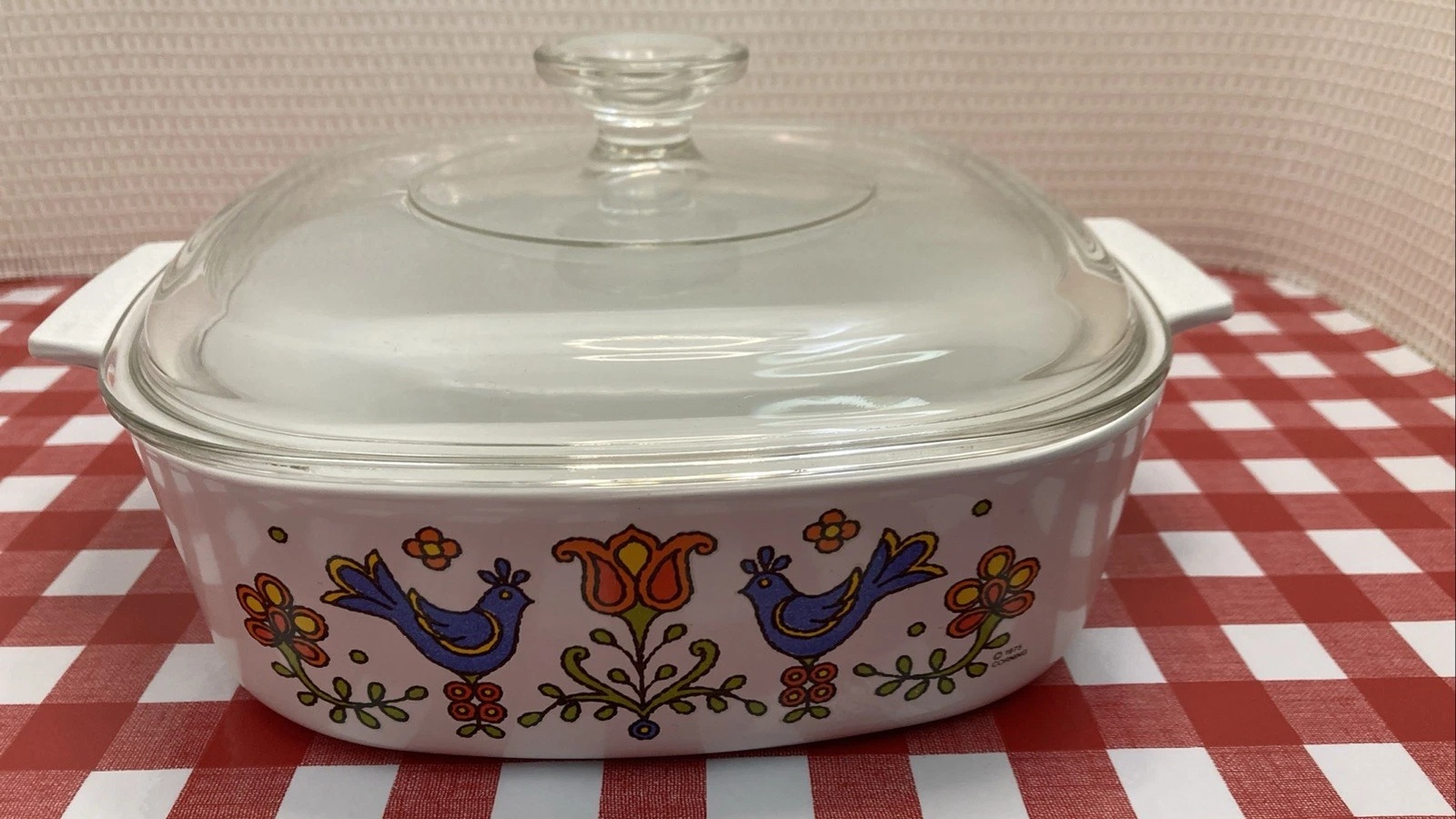
Two bright blue birds face each other around an orange flower. Look down at the lower right of the design for the tiny 1975 copyright. It dates the artwork. The pattern is usually listed as 1975–76, though some pieces are documented into 1977. The range includes A-series saucepans, skillets, a Dutch oven and roaster, plus smaller dishes, loaf pans, and beverage pieces.
I look for crisp black outlines around the birds and flowers, then read the model on the base before trying a lid. If you’re just starting to collect the range, a small saucepan with a clear print and a sound cover is a lovely find on its own. The cookware model matters here. Two pans with the same birds can take different covers, and it’s easier to search for a missing lid once you know the model.
You might also like…
The CorningWare Pattern Collectors Dream Of Finding At A Thrift Store
The Blue-And-White Pyrex Pattern Collectors Dream Of Finding At A Thrift Store
The Pink Pyrex Pattern Collectors Dream of Finding at a Thrift Store

