

Affiliate disclosure: This post may contain affiliate links. Please see full disclosure.
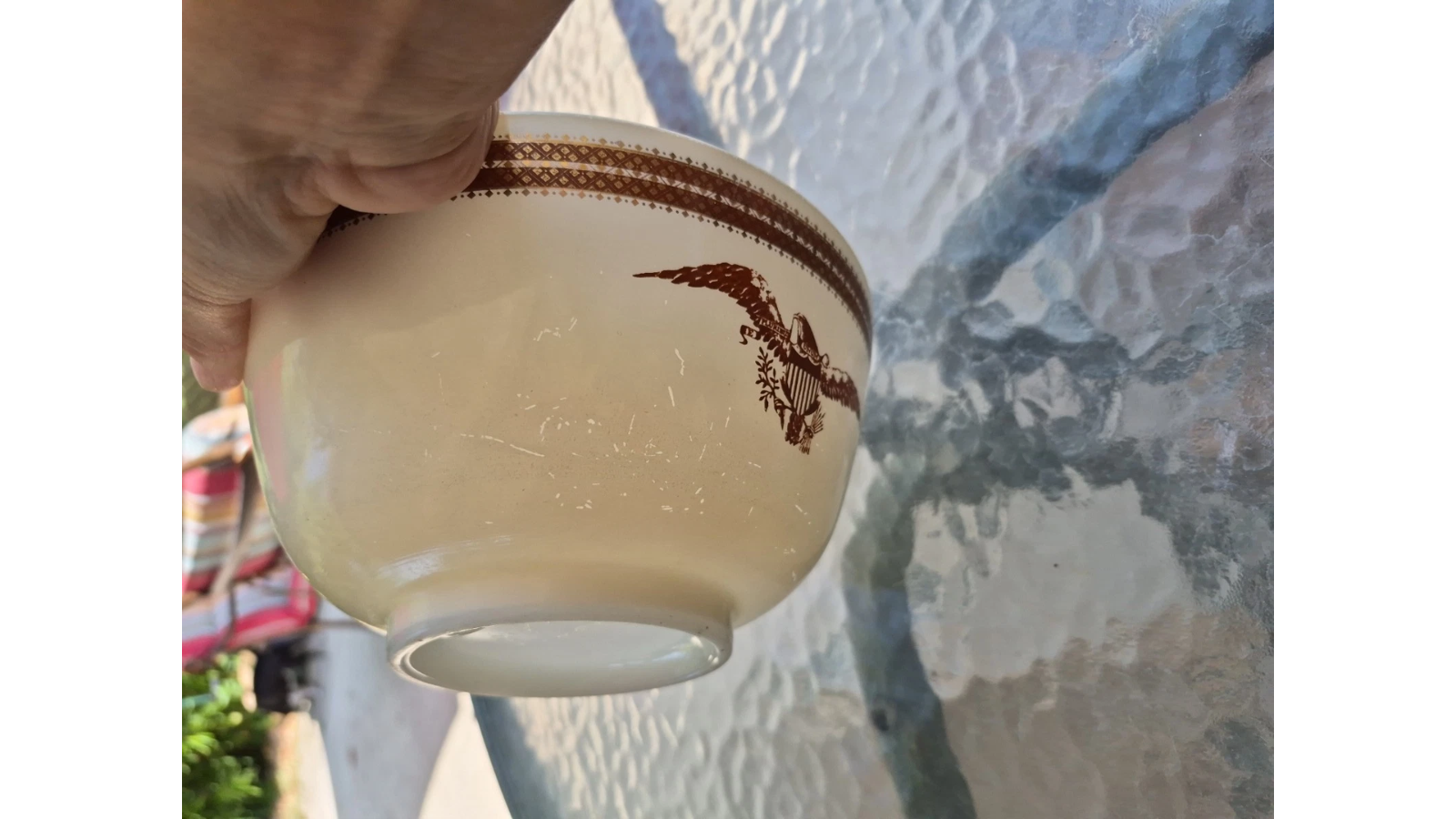
Federal Eagle gives vintage Pyrex a rather grand look: a spread-winged eagle, a shield, and brown-and-gold decoration on creamy ivory glass. But this 1967–68 design belonged to a surprisingly small range. There were two mixing-bowl sizes and a mug shape in two finishes, not a kitchen’s worth of matching casseroles and storage dishes.
That limited choice is part of its appeal to me as a thrifter and collector. You can learn exactly what belongs to the range, then enjoy looking for those particular pieces. The trick is recognizing the shape as well as the eagle, because other Pyrex carried patriotic decoration, too.
Federal Eagle belonged to the short-lived Hearth Group
Corning introduced Federal Eagle alongside Brittany Blue in the Hearth Group in 1967. Both disappeared when that line ended in 1968. So despite the patriotic subject, this wasn’t a design launched for the 1976 Bicentennial.
The two patterns shared a collection, but they didn’t share an identical selection of pieces. Brittany Blue had covered Bake-N-Serve dishes as well as bowls and mugs. Federal Eagle had the narrower offering. I wouldn’t use a photograph of the whole Hearth Group as a shopping checklist for Federal Eagle. That is an easy way to start hunting for a dish that never came in the pattern.
The bowls came in just two sizes
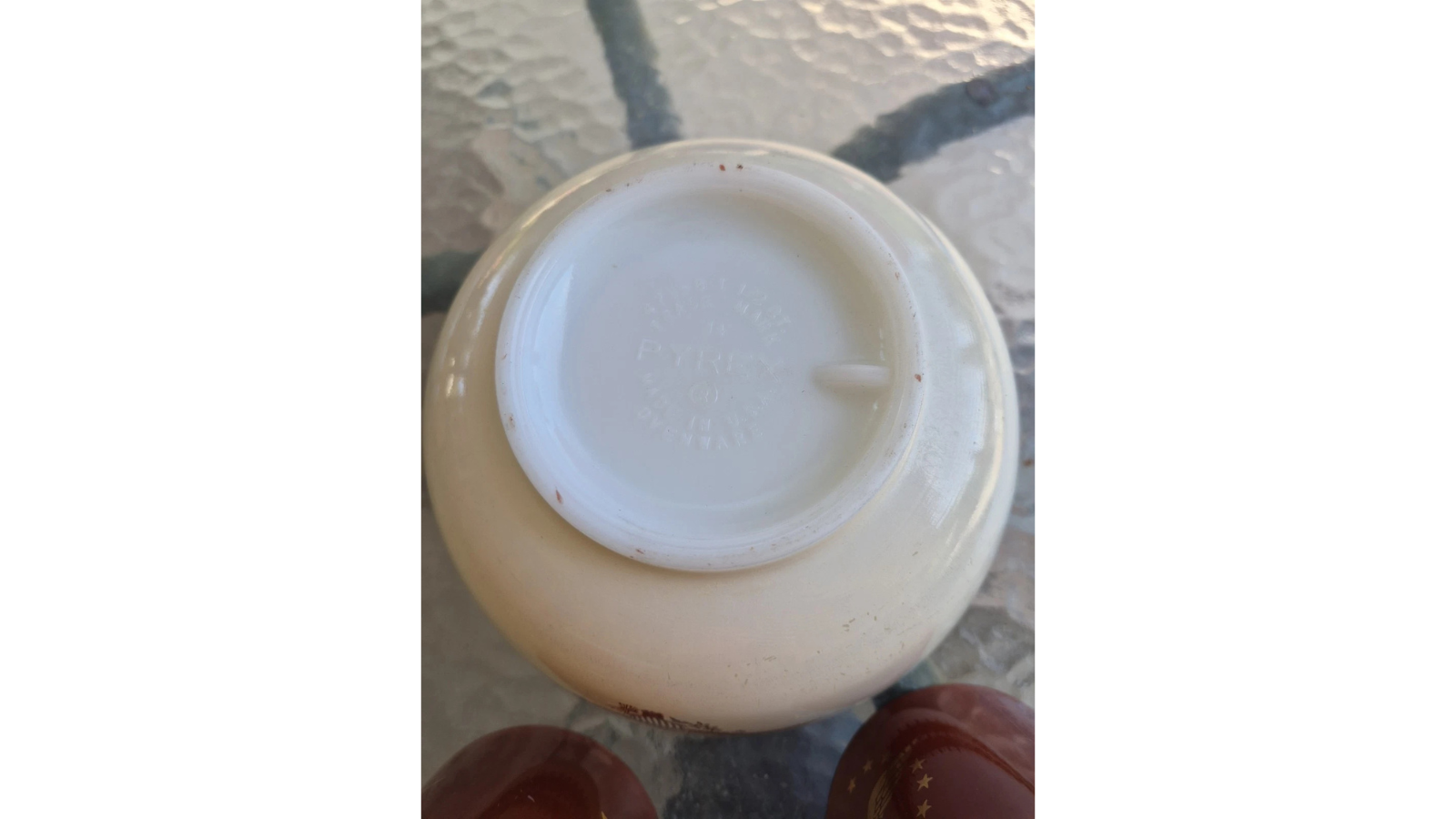
The Federal Eagle mixing bowls are model 478, holding 1½ quarts, and model 479, holding 3 quarts. Both have a cream-to-ivory exterior with the eagle decoration and a brown-and-gold band. Their interiors are white.
Look at the silhouette before turning one over. These are round, footed bowls with sides that flare outward, rather than the familiar handled Cinderella shape. The raised foot gives them a more formal, serving-bowl appearance, which I think suits the large emblem rather well.
The bowls were offered individually, so one bowl on its own isn’t necessarily the lonely survivor of a boxed nesting set. There isn’t a third or fourth size you need to find to finish the run.
If you’re comparing a bowl with old packaging or advertising, there’s another useful distinction. The sales catalog used 1700 for the smaller bowl and 1705 for the larger one. Those aren’t the same numbers as the 478 and 479 model references used to identify the bowl shapes. I recommend matching the capacity and decoration as well as the number, especially when a listing mixes the two numbering systems.
The plain brown mug belongs, too
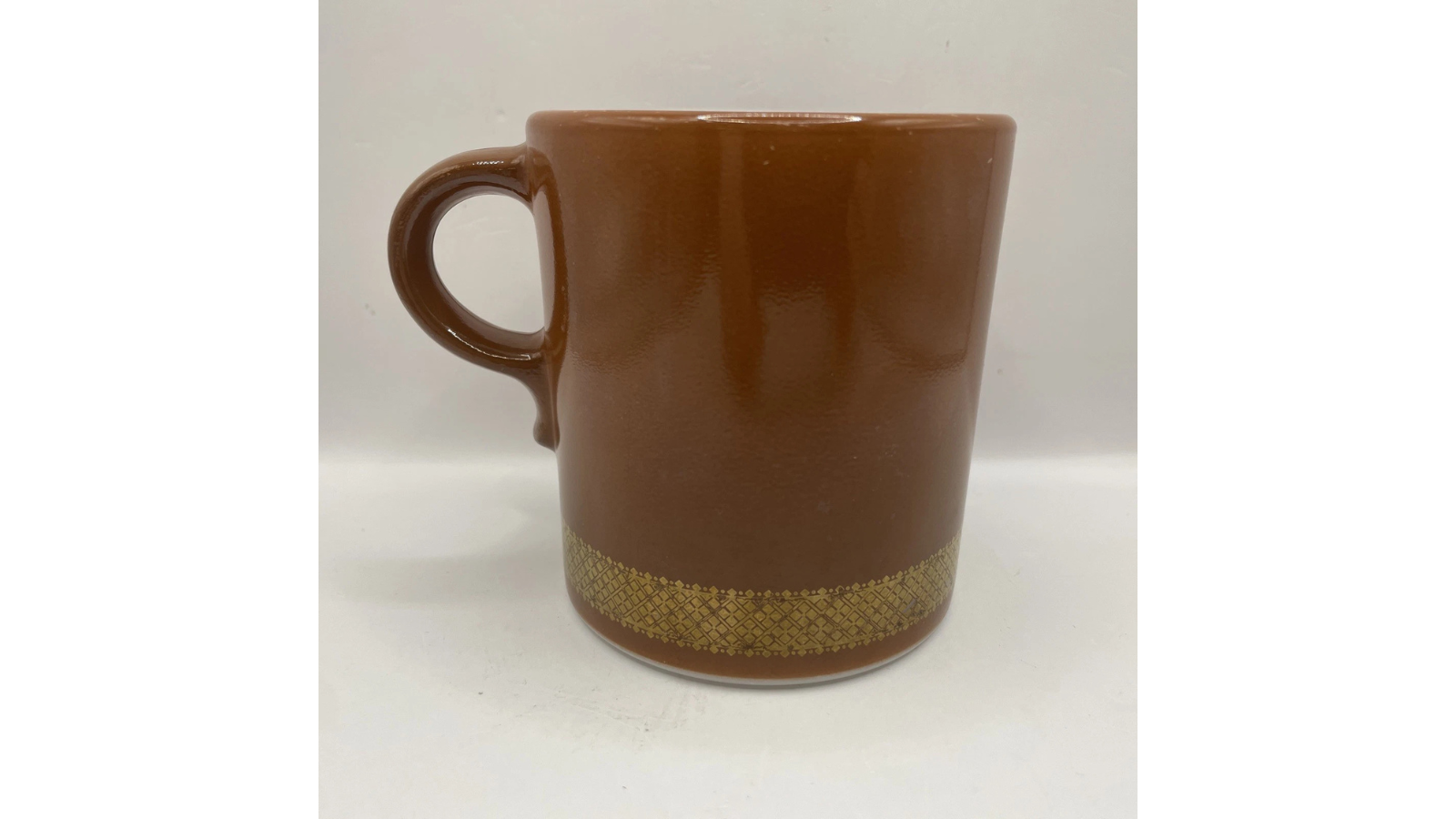
The matching 489 mug has a conspicuously rounded loop handle. One version carries the eagle on a creamy background, with brown-and-gold banding near the bottom. The other is dark brown with a gold band and no eagle.
That plain mug is easy to overlook if you’re scanning shelves only for the bird. It belongs with the collection even though the defining motif is missing. The round handle, shape, base marking, and band are more useful together than color alone.
I like the quieter brown version as a companion to the decorated bowls. Too many large motifs crowded together can look rather busy, and the plain mug gives your eye somewhere to rest. But a brown mug with a gold stripe isn’t enough to establish an identification. Check that it is the right Pyrex form before deciding you’ve found the matching piece.
Don’t confuse it with Early American eagle pieces
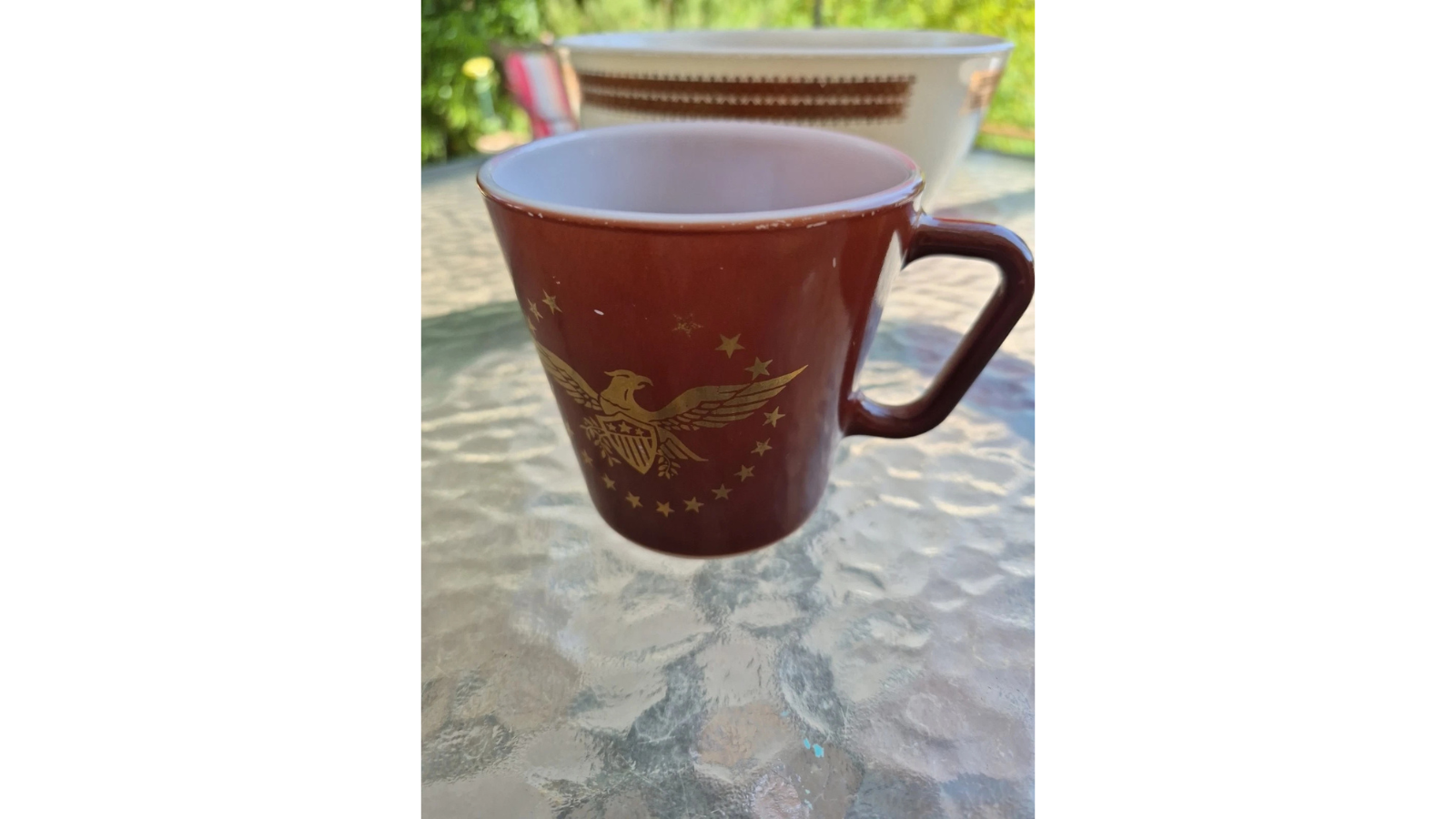
Early American Pyrex also used eagles, along with old-fashioned household motifs, and had a much broader selection of dishes. A brown-and-gold casserole with an eagle doesn’t automatically belong to Federal Eagle.
The mugs cause particular confusion. Brown mugs showing a gold eagle surrounded by stars, with angled D-shaped handles, accompanied an Early American beverage-serving set. They are different from the round-handled Hearth Group mugs. You may still see them described as Federal Eagle, so treat that name on a label as something to check.
For collecting the 1967–68 Hearth Group release, the practical checklist is therefore two bowl sizes and the two mug finishes. Don’t add a matching refrigerator set, oval casserole, or four-piece Cinderella bowl set to it. If you want an eagle-themed display combining several Pyrex lines, that’s perfectly reasonable. Just keep the identities separate.
Look closely at the gold before buying
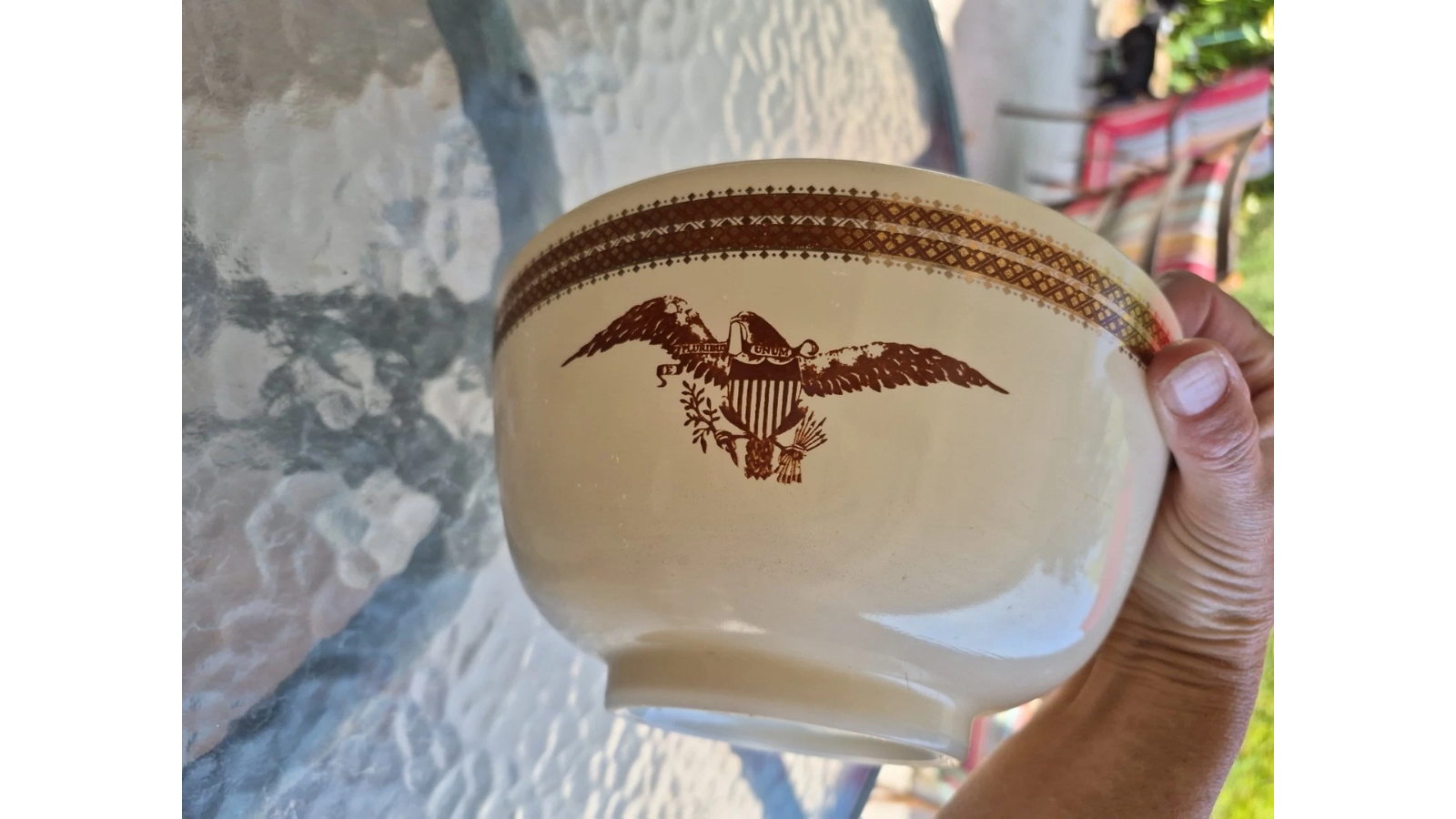
With this design, I’d pay particular attention to the decorative band. Turn the piece so the light catches it all the way around, and look for rubbed sections, scratches, and missing detail. On a mug, inspect the handle joins and drinking rim; on a bowl, check the rim and foot as carefully as the eagle.
I don’t expect old kitchenware to be untouched, but I wouldn’t buy a badly worn example on the assumption that polishing will restore it. Damage from over-cleaning cannot simply be repaired. A clear, attractive emblem matters more to me than owning every variation immediately.
At home, use dish soap, warm water, and a soft cloth, keeping these decorated pieces out of the dishwasher and away from abrasive pads. Keep them out of the microwave, too: metallic gold trim can cause arcing. If your main pleasure is the design, give one bowl enough space on a shelf for its eagle and footed shape to be seen.
You might also like…
The CorningWare Pattern Collectors Dream Of Finding At A Thrift Store
The Blue-And-White Pyrex Pattern Collectors Dream Of Finding At A Thrift Store
The Pink Pyrex Pattern Collectors Dream of Finding at a Thrift Store

