
Affiliate disclosure: This post may contain affiliate links. Please see full disclosure.
Some vintage Pyrex patterns are difficult to find because collectors got there first. Lucky in Love is different. There simply do not appear to have been many of these dishes in circulation to begin with. The pattern dates to 1959 and was most likely either a test piece or a very limited release, which goes a long way toward explaining why a collector can spend years looking without ever seeing one in person.
The design appeared primarily on a white 1-quart round casserole, model 473. Around the bottom is a band of green grass broken up by four-leaf clovers. Surviving examples generally have small pink hearts scattered above the greenery, so despite the predominantly green-and-white appearance, genuine Lucky in Love isn’t strictly a two-color pattern. There is an important exception, though. The prototype preserved in the museum collection has the green grass and clovers but no hearts at all.
That dish helps remove some of the mystery surrounding the pattern. Its surviving factory label identifies it as “Lucky in Love,” gives the item number as 473, and dates it September 2, 1959. So this isn’t a collector nickname attached decades later to an unidentified piece. We know Corning Glass Works was actually experimenting with the design. What remains murkier is how far that experiment went. The surviving records don’t establish a normal production run, and the pattern disappeared almost as quickly as it appeared.
Look for clovers, grass, and tiny pink hearts
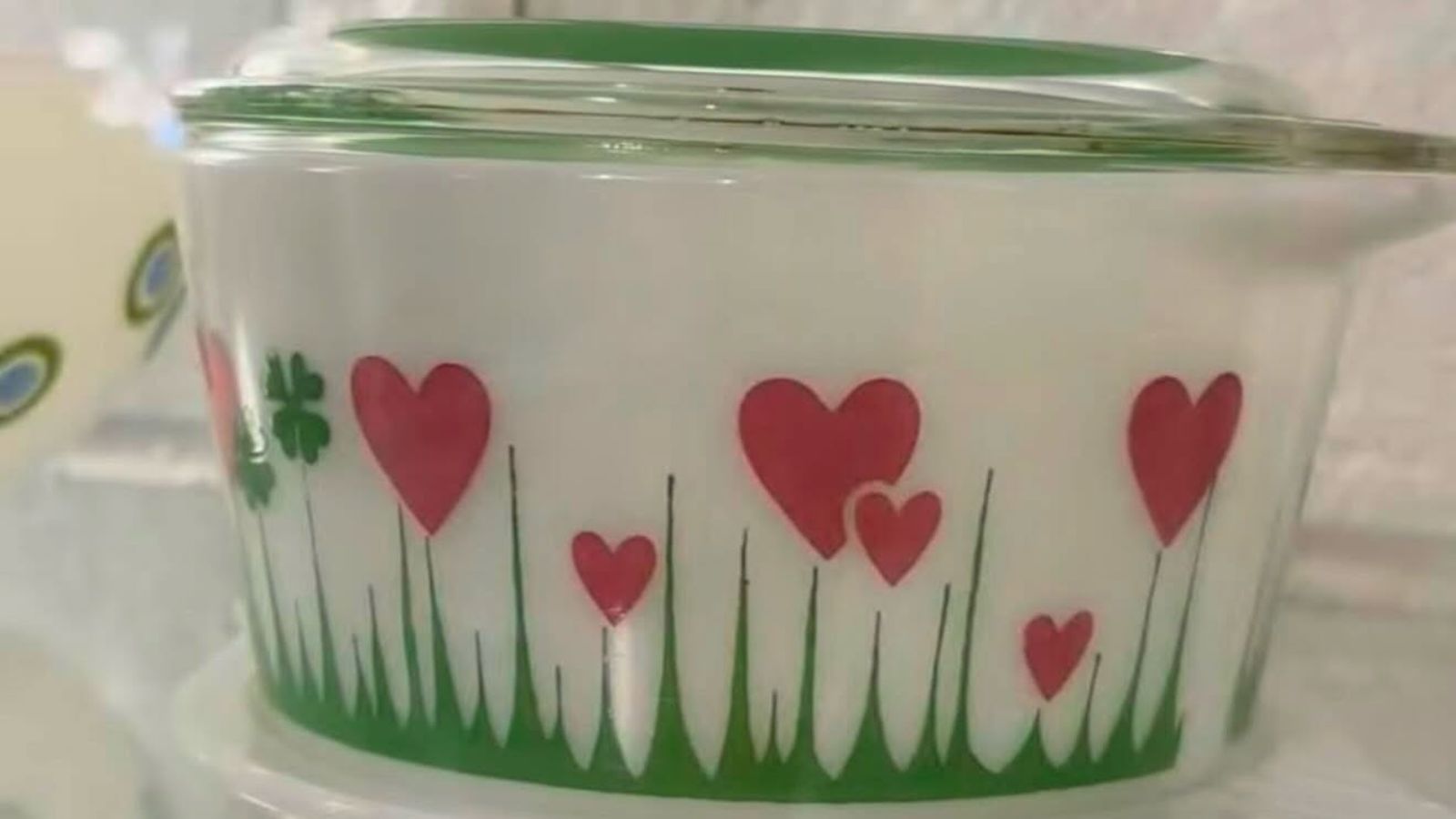
Lucky in Love looks remarkably simple for something that has become so difficult to encounter. There are no elaborate florals or bold geometric shapes to memorize. On the classic version, you’re looking for opaque white Pyrex decorated with a low border of fine green grass, several four-leaf clovers, and pink hearts floating above them. It has the cheerful, slightly odd look of late-1950s kitchenware without resembling many of Pyrex’s better-known patterns.
The shape matters just as much as the decoration. The best-documented Lucky in Love piece is the 473 1-quart round casserole, which has two small handles and a relatively shallow, rounded body. It was paired with an opaque white lid rather than the clear glass lid you might expect on plenty of other Pyrex casseroles. At least one larger 475 casserole with the pattern has also been documented, but the 473 is the piece most closely associated with Lucky in Love.
And this is where knowing the pattern rather than simply looking for “green Pyrex” matters. Pyrex used green on plenty of other designs, and a plain white casserole can look thoroughly uninteresting when it’s wedged behind a stack of mismatched baking dishes. Lucky in Love is subtle enough that it would be easy to pass without noticing the clovers. If you’re already familiar with other rare vintage Pyrex patterns collectors hunt for, this is another design where a few seconds spent examining the decoration and shape properly makes all the difference.
Its strange history is part of what collectors love about it
Rarity alone doesn’t make an old kitchen dish interesting. Lucky in Love has the better story. Corning was producing plenty of promotional Pyrex during this period, using existing shapes for short-lived designs and gift sets rather than committing every pattern to years of regular production. Lucky in Love appears to have been caught somewhere in that experimental process. The museum describes it as one of the most elusive Pyrex designs Corning Glass Works ever created, and there is still no clear record showing that it received anything resembling a conventional nationwide release.
There are also small differences between known pieces, which makes the pattern even more intriguing. The museum’s prototype has no pink hearts, while other documented examples combine the hearts with the green clover design. A surviving factory label on the prototype identifies its green decoration and Lucky in Love name, giving collectors an unusually direct little piece of the development process rather than just a finished consumer product.
That’s really why finding one would be such a remarkable moment for someone who collects vintage Pyrex. Butterprint, Gooseberry, and other beloved patterns can turn up often enough that you might slowly build a set over time. Lucky in Love doesn’t work like that. You can know exactly what you’re searching for and still never encounter an original. The appeal isn’t what somebody else might pay for it. It’s the chance, however slim, of finding one of those peculiar little pieces of Pyrex history that barely escaped the factory at all.
You might also like…
The CorningWare Pattern Collectors Dream Of Finding At A Thrift Store
The Blue-And-White Pyrex Pattern Collectors Dream Of Finding At A Thrift Store
The Pink Pyrex Pattern Collectors Dream of Finding at a Thrift Store

