
Affiliate disclosure: This post may contain affiliate links. Please see full disclosure. AI-assisted.
Turn over a Hall China Autumn Leaf utility jug and you may find a grocery company’s seal of approval on the bottom. The jug in Berea College’s Appalachian Artifacts Teaching Collection bears the words “Tested and Approved by Mary Dunbar,” followed by the Jewel Homemaker’s Institute name. I’d pick it up for the orange flowers and the gold around the lip. I’d turn it over for the story of how a company that delivered coffee persuaded people to bring its china into their kitchens, too.
The floral jug to look for
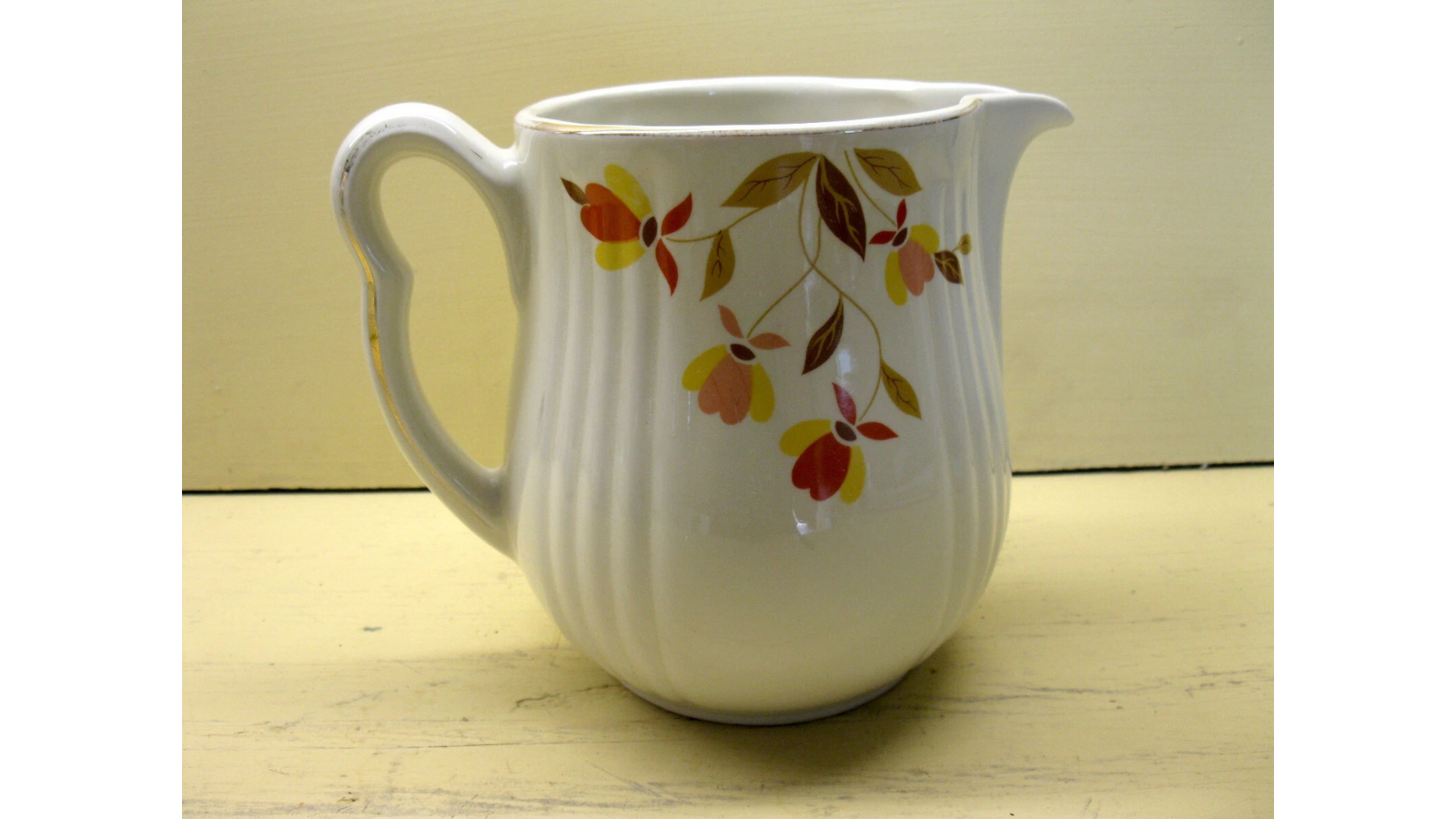
The Berea jug is cream with flowers and leaves on both sides, in shades of yellow, orange, and brown. Gold edges the mouth and the sides of the curved handle. Look at that handle from the side and you’ll see it curve inward partway up before sweeping back out to meet the body. It’s a detail you can use even when rubbing has taken some of the shine off the gold.
If you’re searching online, try “Hall Autumn Leaf rayed utility jug” as well as “Jewel Tea pitcher.” The 40-ounce rayed utility jug is listed at about 5½ inches tall. Hall also made a much larger 80-ounce ball jug with an ice lip in Autumn Leaf. A photograph that shows only the flowers can make the two seem more alike than they are. I’d ask for a full side view with a ruler in the frame if the description is vague.
The utility jug is an open pitcher. A covered Autumn Leaf jug can be a different design altogether, such as the lidded Norris water jug. When you see a lid in a listing, check the pitcher’s silhouette before assuming the seller has the same shape as the Berea piece.
What the Mary Dunbar stamp actually says

On the base of the Berea jug, Hall identifies it as “Hall’s Superior Quality Kitchenware.” The approval wording names Mary Dunbar and the Jewel Homemaker’s Institute. That gives you two names to read on one mark. Hall was the potter that made the jug in Ohio. Jewel was the company that offered the Autumn Leaf line through its home-shopping routes.
Mary Dunbar was the name used by the director of Jewel’s institute. It came from Mary Hartson, the first director, whose maiden name was Dunbar. When Leone Carroll took over in 1926, she continued to use it. Customers could see the same familiar name even after the person running the institute had changed.
The institute was Jewel’s own product-testing division. Its remit covered groceries and household goods, with tests concerned with things like purity, durability, and how well an item did its job. Read the wording on the base as Jewel’s promise about the goods it offered. For dating the piece, the Berea example carries a catalog range of 1937 to 1976. The signature-style name is a clue to its ties to Jewel. An exact year would take more evidence.
The same name turned up in Jewel’s cookbooks

Jewel’s route salesmen handed customers free Mary Dunbar cookbooks starting in 1927. The booklets put recipes, household advice, and product promotions together. One recipe called for Jewel’s own coffee in a custard. A later booklet was titled 476 Tested Recipes. That word “tested” did the same work there as it did on the jug. It gave customers a reason to trust the advice and the things Jewel sold to go with it.
When Hall made its first Autumn Leaf bowl as a Jewel premium in 1933, the company already had a familiar voice to introduce its kitchen goods. The route brought customers coffee and a way to acquire dishes over time. Look at the bottom of the jug and you can see the partnership in miniature. Hall put its name on the china, and Jewel put its own kitchen authority behind it.
Jewel shoppers could save coupons from grocery purchases toward premiums, and the Autumn Leaf line could also be bought from the route salesperson. The approval message worked either way. The dish you finally brought home came with a recommendation from the same company that had been supplying the ingredients.
Check the mouth, the handle, and the underside
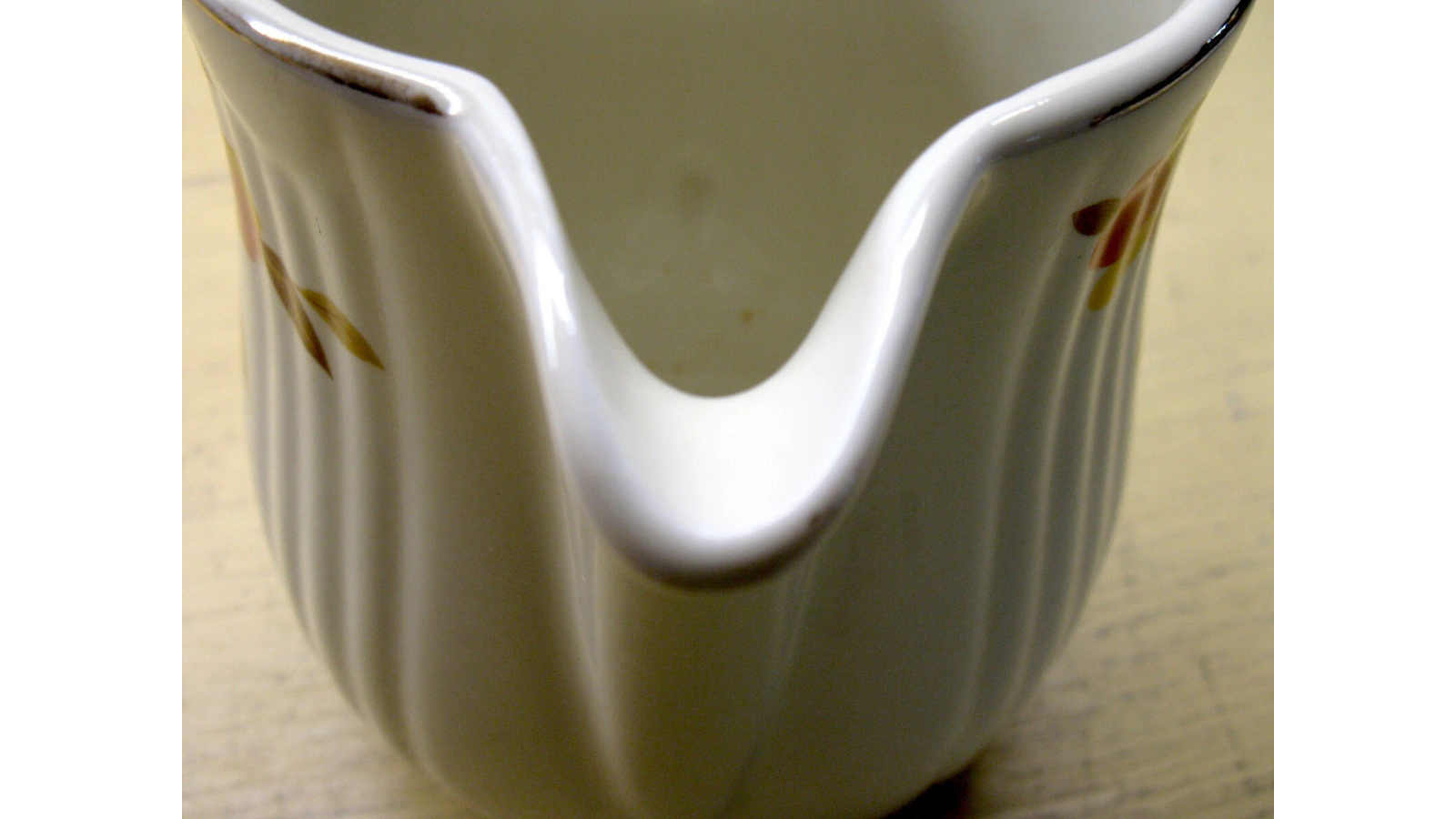
When I’m thrifting vintage dishware, I look first at the spots that had to do the work. On a jug, that means the tip of the spout and both points where the handle joins the body. Turn those areas toward the light. A fine crack at the handle can hide in the curve, and a rim chip can be easier to see from inside the mouth. I’d take a bit of rubbed gold over a damaged handle every time.
If you’re buying online, ask for a photo of the whole underside taken straight on. That lets you read the words and get a look at the foot at the same time. For a collector interested in the Jewel connection, I’d wait for a sound example with enough of the mark to read. The flowers are lovely on the shelf. Picking up the jug and finding Mary Dunbar tucked away underneath is what makes this particular find so satisfying.
You might also like…
The CorningWare Pattern Collectors Dream Of Finding At A Thrift Store
The Blue-And-White Pyrex Pattern Collectors Dream Of Finding At A Thrift Store
The Pink Pyrex Pattern Collectors Dream of Finding at a Thrift Store

