

Affiliate disclosure: This post may contain affiliate links. Please see full disclosure.
Black Tulip is one of those vintage Pyrex finds that deserves a second look. Made in 1956–57, this white oval casserole has a dramatic charcoal-black floral pattern and originally came with a little brass-tone serving cradle. It’s lovely in its own right, but its place in Pyrex history makes it more interesting.
I’m an avid thrifter and collector, and the pieces that catch my attention have an identifiable story. Black Tulip belongs to the small group of early printed promotional casseroles that helped turn practical ovenware into something people wanted to give as a gift and put straight on the table.
The unmistakable Black Tulip design
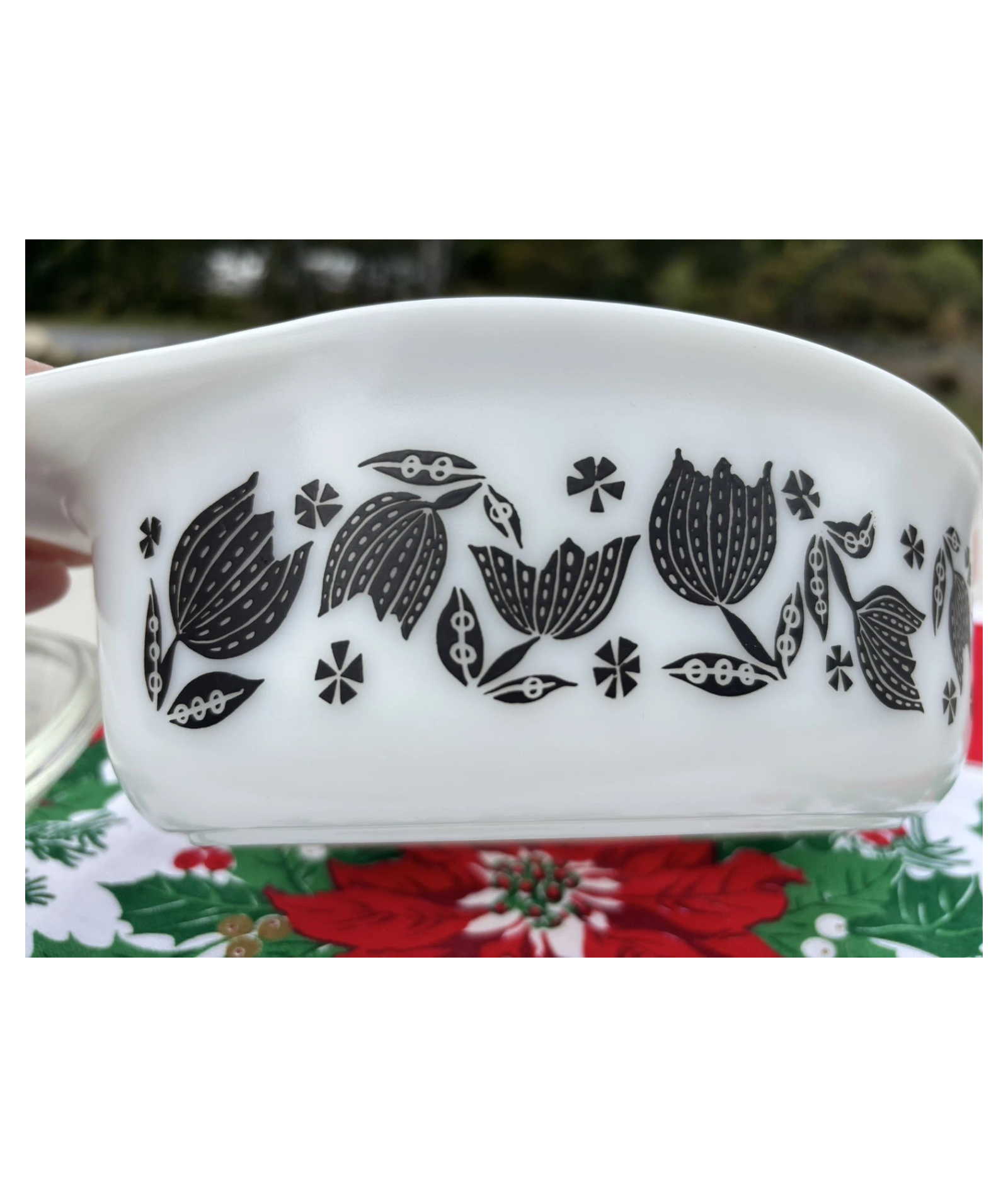
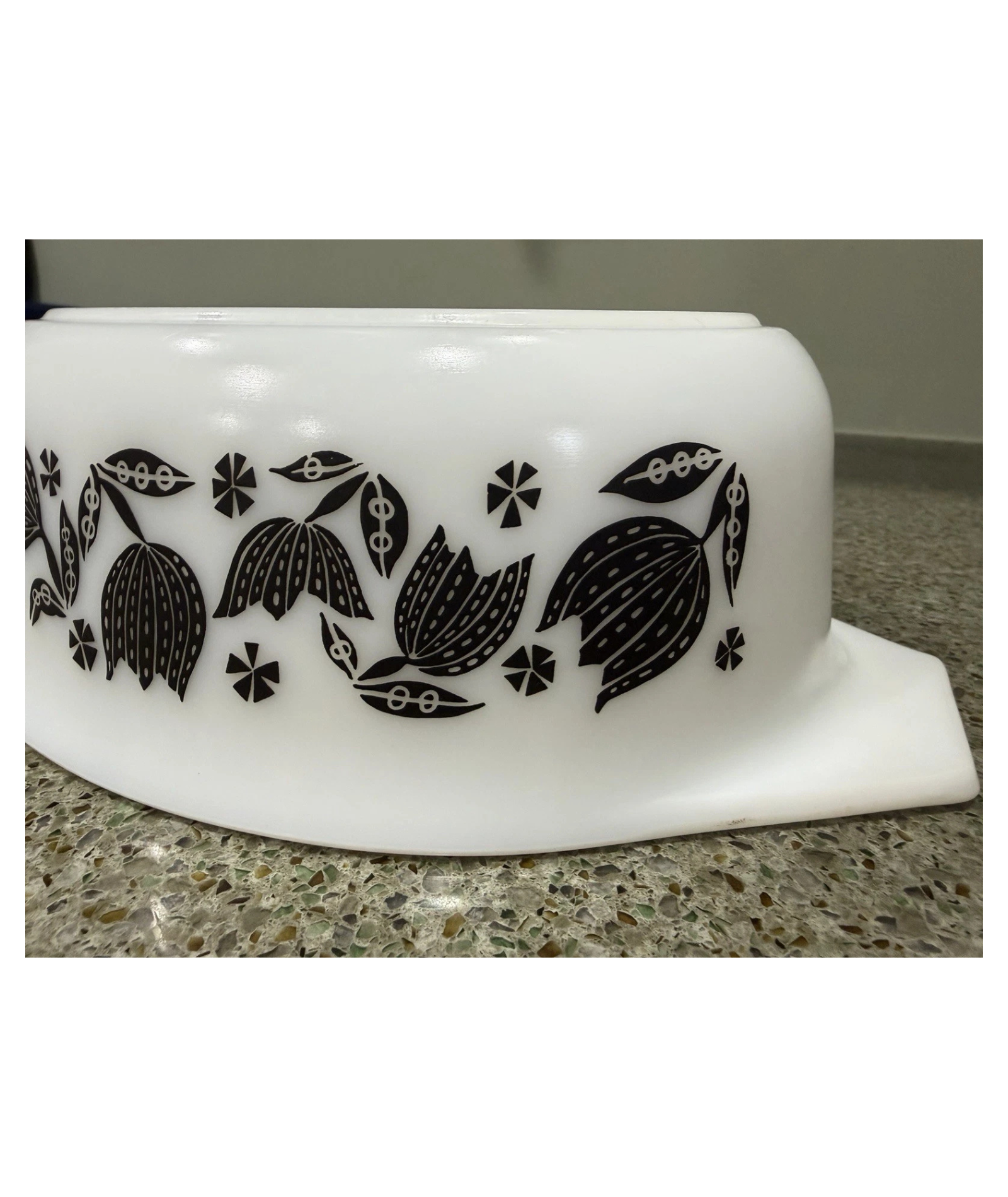
The flowers aren’t dainty little bouquets. They’re bold, dark tulips with striped, pointed petals, twisting stems and long leaves, interspersed with tiny four-pointed, pinwheel-like flowers. The pattern runs around an opaque white dish, so the contrast is striking even from across a crowded shelf.
The official design was never called Black Tulip. Corning sold it as a Decorator Casserole; collectors supplied the more memorable name. The Corning Museum ozf Glass pattern record identifies it as the 1½-quart, model 043 oval casserole. That matters, because you’re looking for a particular shape and size, not a family of Black Tulip mixing bowls, refrigerator dishes and casseroles.
Look for the shallow oval body with handles at either end, rather than a deep round bowl. The clear glass lid belongs with the covered casserole. The decoration can look almost like printed fabric from a distance, with its repeating flowers and geometric details.
Why this was such an important early Pyrex pattern
Earlier Pyrex promotional dishes were mostly plain white or solid colors. By the mid-1950s, Corning was experimenting with decoration that made everyday ovenware look more like tableware. Black Tulip was among the first promotional casseroles to carry a printed design on the sides, alongside White Lace, Pressed Flowers and Black Needlepoint.
There is one dating wrinkle worth knowing. The museum records Black Tulip as introduced in 1956 and manufactured through 1957, while the specialist Pyrex Collector reference lists its release as 1957. So 1956–57 is a sensible date range, rather than claiming every surviving example was bought in 1956.
It also isn’t quite right to call this the first patterned Pyrex of any kind. Corning had an earlier patterned Heinz promotional baking dish in 1953, while printed standard patterns including Pink Daisy and Snowflake appeared in 1956. Black Tulip’s distinction is its place in that first wave of printed promotional casserole gift sets, not a claim that no decorated Pyrex existed before it.
The original cradle makes the set special

The casserole is attractive on its own, but a complete Black Tulip set is especially satisfying. It originally came with a low, brass-tone metal cradle that held the oval dish above the tabletop. The cradle was part of the presentation, not a decorative extra somebody added decades later.
A period advertisement shows the casserole in a simple, low-profile brass-plated frame, with handles extending at either end. It also shows a clear glass lid. The combination made sense: dinner could go to the table in a stand smart enough for company, without transferring it into another serving bowl.
If you find the dish alone, don’t dismiss it. Lids and stands often get separated from their original partners over years of use, moves and donations. But if a cradle is included, compare its profile and fit with documented examples rather than assuming any gold-colored stand must be original.
What to check when you find one

Start with the decoration. You want recognizable dark tulips and foliage on a plain white base, not the single gold flower of the later Golden Tulip pattern. Check the underside for the molded 043 model number where visible, then examine the shape and size together. A model number identifies the dish shape, but doesn’t prove the decoration on its own.
I always pay more attention to condition than to how impressive a pattern looks in a photograph. Tilt the dish into the light and check whether the black printing is sharp or rubbed thin. Look along the rim, handles and lid edges for chips, and inspect the bottom for damage. Ordinary signs of age are one thing; significant missing decoration is another.
If the stand is present, check for bent metal, corrosion and a secure fit. A badly distorted cradle may look fine on a shelf but won’t display the casserole properly. And don’t force a mismatched lid into place just to make a set look complete.
How I’d care for a Black Tulip casserole

With an early printed Pyrex piece, I’d prioritize keeping the decoration intact over making it look brand-new. Gentle handwashing with mild dish soap, warm water and a soft cloth is better than abrasive scrubbers or a dishwasher. Repeated harsh cleaning can leave vintage Pyrex decoration dull or worn, and that damage isn’t something you can simply polish away.
Wash the glass and metal parts separately, dry the cradle thoroughly and avoid stacking anything heavy against the printed sides. The Pyrex Collector’s damage guide is useful for distinguishing normal manufacturing marks from scratches, chips and dishwasher damage.
Although Pyrex casseroles were made as functional ovenware, I wouldn’t treat an unknown, nearly 70-year-old thrift-store find as though it had just come out of a modern box. If you don’t know its history or condition, displaying it or using it for cool, dry serving is the more cautious choice. Keep the metal cradle out of the oven.
Black Tulip doesn’t need a matching kitchen to look good. Its black-and-white design is easy to display with other vintage dishes, whether you collect Pink Gooseberry Pyrex or prefer understated glassware. And if you find the casserole with its original lid and cradle still together, that’s a particularly pleasing piece of mid-century kitchen history to bring home.
You might also like…
The CorningWare Pattern Collectors Dream Of Finding At A Thrift Store
The Blue-And-White Pyrex Pattern Collectors Dream Of Finding At A Thrift Store
The Pink Pyrex Pattern Collectors Dream of Finding at a Thrift Store

