
Affiliate disclosure: This post may contain affiliate links. Please see full disclosure.
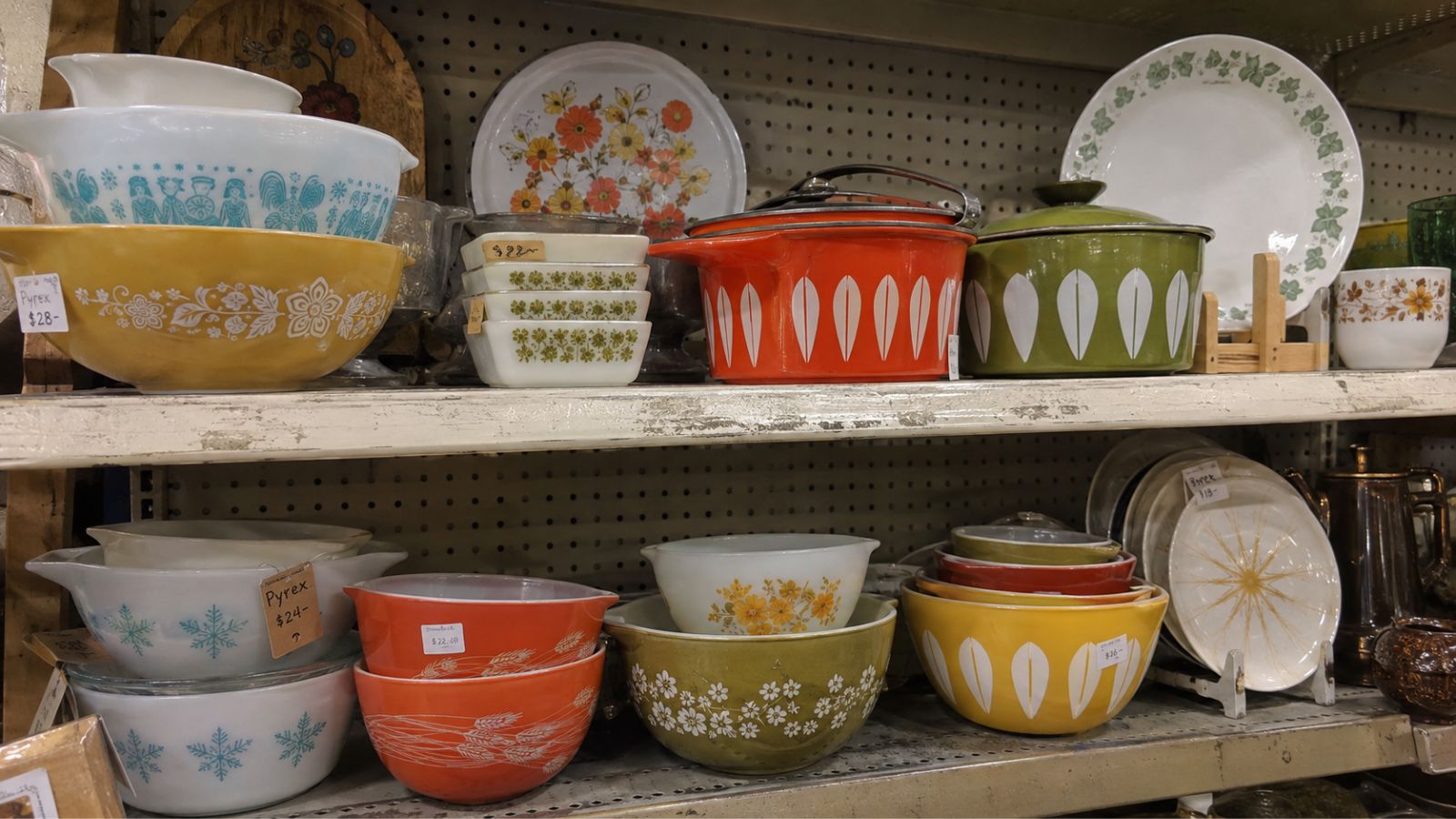
I have a real weakness for vintage kitchenware, especially the brightly colored pieces from the 1950s and ’60s. But I’ve learned that not every old enamel saucepan or mixing bowl is worth bringing home. One pattern I always keep an eye out for, though, is Cathrineholm Lotus. It’s one of the most recognizable mid-century kitchenware designs, with its bold colors and distinctive repeating leaf pattern. And some pieces are particularly difficult to find, especially in excellent condition.
Cathrineholm was a Norwegian manufacturer based in Halden, and its Lotus collection became a huge success during the 1960s. The design is fairly simple, consisting of long, pointed lotus leaves arranged around the outside of bowls, casseroles, and other kitchenware. Most pieces have white leaves against a colored background, or colored leaves against white. You’ll find them in cheerful shades of orange, yellow, blue, and red, as well as more subdued greens, browns, and black.
Interestingly, the pattern and the dishes themselves were designed by two different people. Grete Prytz Kittelsen, a well-known Norwegian enamel artist, created the shapes and colors of the kitchenware, while Arne Clausen designed the Lotus motif. Kittelsen apparently wasn’t particularly fond of the pattern, preferring her original plain-colored designs. Consumers, however, loved it. Today, original Cathrineholm Lotus pieces are sought after by collectors of Scandinavian design and vintage kitchenware. Even a single bowl can make a lovely addition to a collection.
The Cathrineholm Lotus pieces worth looking for

The most familiar pieces are probably the mixing and serving bowls. These were produced in six graduated sizes, ranging from approximately 4 inches to 11 inches across. Some have large lotus leaves stretching almost the full height of the bowl, while others feature a narrower band of smaller leaves around the rim. A complete nesting set in matching colors is a particularly nice find, but individual bowls are collectible, too. Some of the less-common colors, particularly pink and certain shades of blue and green, are especially desirable.
Cathrineholm also made a surprisingly large range of cookware. There are lidded casseroles and Dutch ovens in several sizes, saucepans, frying pans, and even a rectangular lasagna dish. The cookware often has polished metal handles and contrasting colored lids. You might also come across coffee pots, kettles, percolators, and fondue sets. If you’re lucky enough to find a complete fondue set with its original burner and stand, it’s certainly worth a closer look.
Some of the smaller accessories are particularly interesting. Cathrineholm produced salt and pepper shakers, spice containers, and kitchen canisters decorated with the Lotus pattern. Unlike the enamel cookware, some of the canisters and spice jars were manufactured in Japan using aluminum. They’re less common than the familiar mixing bowls, and finding a matching set with all its original lids is a real treat. Personally, I’d be delighted to come across one of the little spice racks, particularly with the original containers still intact.
How to recognize genuine Cathrineholm Lotus enamelware

SouthShoreVintageNY via eBay
The first thing I do when examining a piece of vintage kitchenware is turn it over and look for the manufacturer’s mark. With Cathrineholm Lotus, you might find “Cathrineholm of Norway” or simply “Made in Norway” stamped on the base. On some cookware, you’ll also find markings beneath the lid handle or knob. However, not all genuine pieces have permanent markings. Some originally had paper labels, which have understandably disappeared after decades of use and washing.
The pattern itself can help you identify an original. Authentic Lotus leaves are generally wider near the top and taper toward a narrow point at the bottom. Some lookalikes have a more rounded, bean-shaped motif. You’ll also want to check the material. Original Norwegian Lotus bowls and cookware were made from enamel-coated metal, whereas some modern, licensed versions are ceramic. They’re attractive in their own right, but they’re not the same as the vintage enamelware.
Condition is another thing I always check when thrifting vintage enamelware. Small chips around the rim are fairly common, but look carefully for rust, deep scratches, and places where the enamel has started to flake away. Check the inside of bowls and casseroles, too, as damage isn’t always obvious from the outside. If there’s a lid, make sure it fits properly and matches the piece. I wouldn’t necessarily leave a lovely Lotus bowl behind just because it had a few chips, particularly if it was an unusual color or one of the less-common shapes. After all, these pieces are over 50 years old, and finding one that’s completely unblemished isn’t always realistic. But I’d definitely inspect it carefully before putting it in my basket, especially if I intended to use it rather than simply display it.
You might also like…
The CorningWare Pattern Collectors Dream Of Finding At A Thrift Store
The Blue-And-White Pyrex Pattern Collectors Dream Of Finding At A Thrift Store
The Pink Pyrex Pattern Collectors Dream of Finding at a Thrift Store

