
Affiliate disclosure: This post may contain affiliate links. Please see full disclosure.
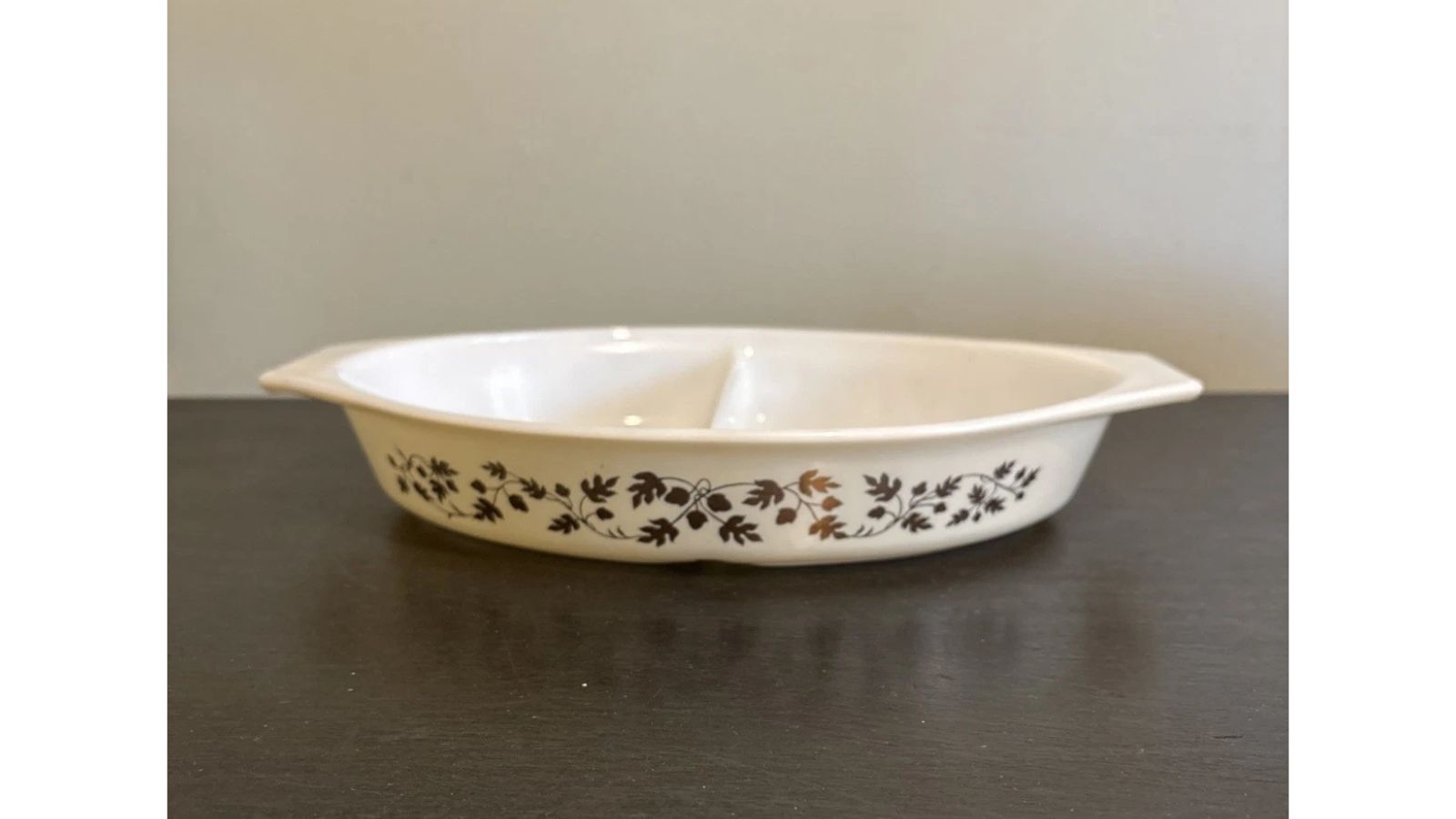
I’ve spent enough time rummaging through thrift stores and secondhand kitchenware to know that some of the nicest vintage pieces are also the easiest to overlook. Pyrex Golden Acorn is a good example. At first glance, it’s a fairly ordinary ivory-colored baking dish. But look closer, and you’ll see a lovely gold pattern of acorns, oak leaves, and delicate trailing branches running around the outside. It’s a much more understated design than the brightly colored Pyrex patterns that tend to get all the attention, and that’s part of its charm.
Golden Acorn was produced between 1960 and 1963, although it was advertised to dealers as early as November 1959. You’ll sometimes see it referred to as Gold Acorn on Ivory or Golden Touch, names that appeared in the original advertising. The warm cream background and metallic gold decoration were quite a departure from the bold colors and cheerful prints we often associate with mid-century Pyrex.
Unlike some of the better-known Pyrex patterns, Golden Acorn wasn’t produced in a huge range of kitchenware. You won’t find the usual nesting mixing bowl sets or matching refrigerator dishes. Instead, the pattern was used on a small selection of casseroles and baking dishes, designed to go straight from the oven to the dinner table. And, while Golden Acorn isn’t the rarest Pyrex pattern, some of its less-common pieces are genuinely difficult to track down. For anyone who enjoys collecting vintage kitchenware, they’re well worth keeping an eye out for.
The different Golden Acorn pieces to look for
Cathys funfinds via eBay
The standard Golden Acorn range included six different baking dishes, with two sizes of oval casserole being among the most recognizable. The smaller 043 holds 1½ quarts, while the larger 045 holds 2½ quarts. Both have the familiar oval shape and extended handles, with the gold acorn pattern running around their sides. There’s also the 053 oval open baker, which holds 1½ quarts, and the 063 divided dish, also originally described as holding 1½ quarts. The latter has two separate compartments, making it particularly handy for serving vegetables or side dishes.
Then there are the rectangular Space-Saver casseroles. These are quite different from the oval dishes, with straight sides and a flatter, more compact shape. They came in two sizes: the 1¼-quart 548 and the 2-quart 575. The idea was that they took up less room in the refrigerator or freezer, while still being suitable for baking and serving.
What’s particularly interesting about the Space-Savers is that they were available individually or as a set. The individual dishes came with clear glass lids, but the set included one glass lid and two metal lids. Those metal lids were intended to be sealed with freezer tape for airtight storage. Finding the original pieces together is a nice bonus, especially as lids have a habit of getting separated from their dishes over the decades. I always think it’s worth checking the shelf around a vintage casserole for a matching lid before leaving it behind.
The rare Golden Acorn pieces and how to recognize a good find

The pieces I’d be particularly pleased to discover are the unusual round Golden Acorn casseroles. These were never part of the standard retail range, and may have been produced for market testing. There are three known sizes: the 1-quart 473, the 1½-quart 474, and the 2½-quart 475. They have the same gold acorn and leaf decoration as the regular pieces, but on round Cinderella-style casserole dishes rather than the more familiar oval and rectangular shapes. Because they weren’t standard production items, they’re considerably less common.
If you come across a Golden Acorn dish, start by checking its condition, particularly the gold decoration. Vintage Pyrex with metallic gold designs can show considerable wear, and dishwasher damage can leave the decoration faded, patchy, or missing altogether. Look closely at the pattern, especially around the handles and areas where the dish might have been frequently gripped or rubbed. Check the glass for chips, cracks, and rough edges, too.
It’s also worth turning the dish over to check the Pyrex markings and model number. These help identify the shape and size, particularly if you’re trying to establish whether you’ve found one of the unusual round casseroles. And don’t forget the lid, if there is one. Check that it fits properly and doesn’t have any chips around the rim.
If you do bring a Golden Acorn piece home, I’d stick to gentle handwashing with mild dish soap and a soft sponge. Avoid abrasive cleaners and the dishwasher, which can damage the decorative finish. You should also keep it out of the microwave, as the metallic gold decoration isn’t microwave-compatible. Personally, I’d be inclined to keep a particularly good example for display rather than subjecting it to the wear and tear of everyday cooking.
You might also like…
The CorningWare Pattern Collectors Dream Of Finding At A Thrift Store
The Blue-And-White Pyrex Pattern Collectors Dream Of Finding At A Thrift Store
The Pink Pyrex Pattern Collectors Dream of Finding at a Thrift Store

