
Affiliate disclosure: This post may contain affiliate links. Please see full disclosure.
If a brown Pyrex bowl covered in tiny gold eagles and old-fashioned kitchen tools turns up among the usual thrift-store casserole dishes, take a closer look. That decoration isn’t simply gold-colored paint. Introduced in 1962, Early American was the first Pyrex pattern printed using 22-karat gold, giving a fairly ordinary piece of kitchenware a slightly ridiculous, and rather wonderful, touch of actual precious metal.
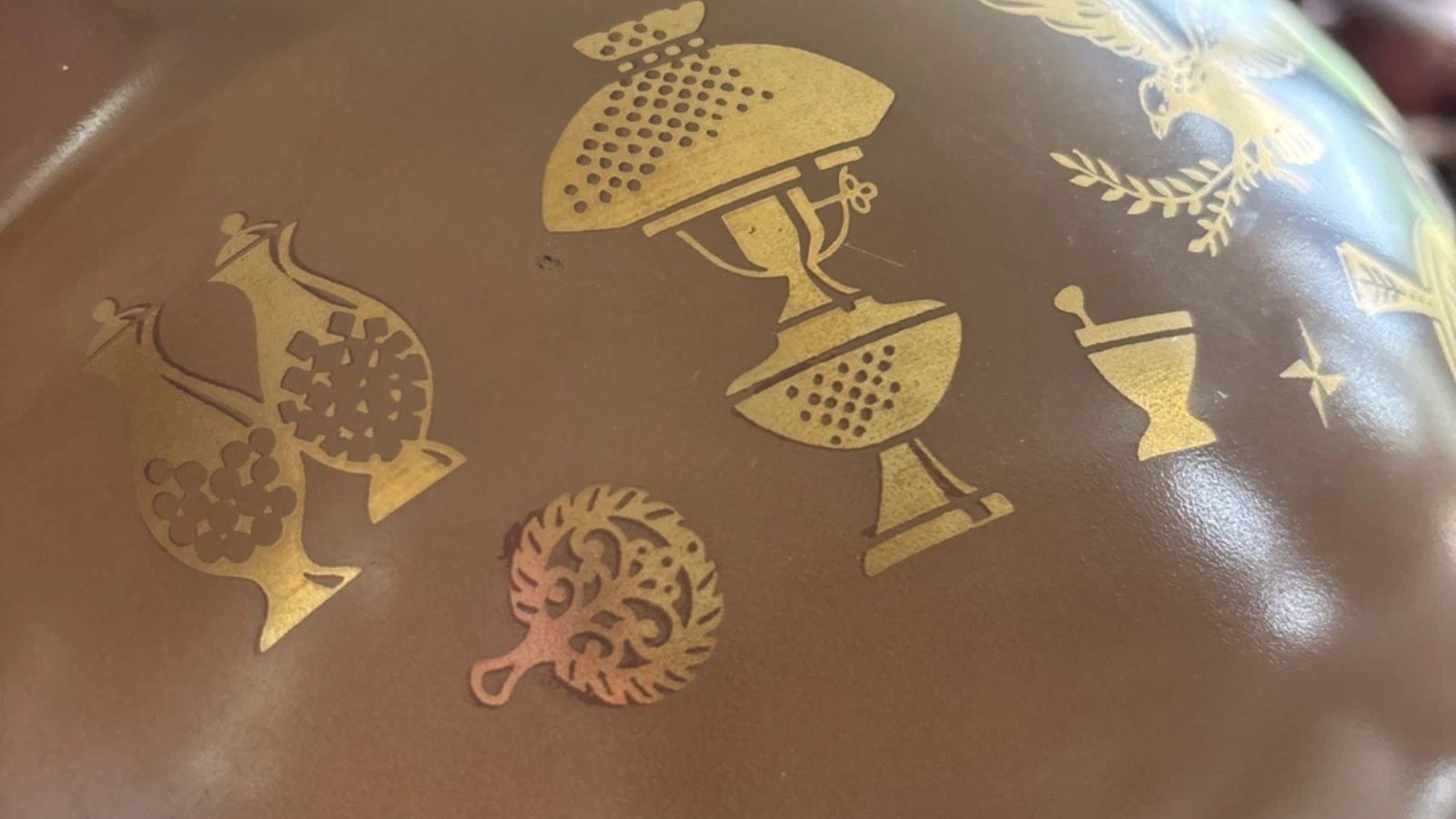
The pattern was very much a product of its time. Corning advertised Early American as the “theme of the decade,” covering the dishes with nostalgic Colonial-style images such as eagles, weathervanes, roosters, lanterns, hand bellows, meat grinders, and mortars and pestles. The best-known gold version has these motifs printed over a deep milk-chocolate brown background. Early American also came in brown decoration on white Pyrex, so spotting the pattern doesn’t automatically mean you’ve found one of the gold pieces.
Early American wasn’t a short-lived promotional experiment, either. It remained in production from 1962 until 1971, making it one of Pyrex’s longer-running patterns. Gold had appeared on earlier promotional Pyrex pieces, but Early American was the point where it became part of a regular standard pattern collection rather than something largely reserved for special releases. Real gold on everyday mixing bowls still feels gloriously excessive, which is probably part of why these pieces have held collectors’ attention for so long.
Here’s how to recognize gold-on-brown Early American Pyrex
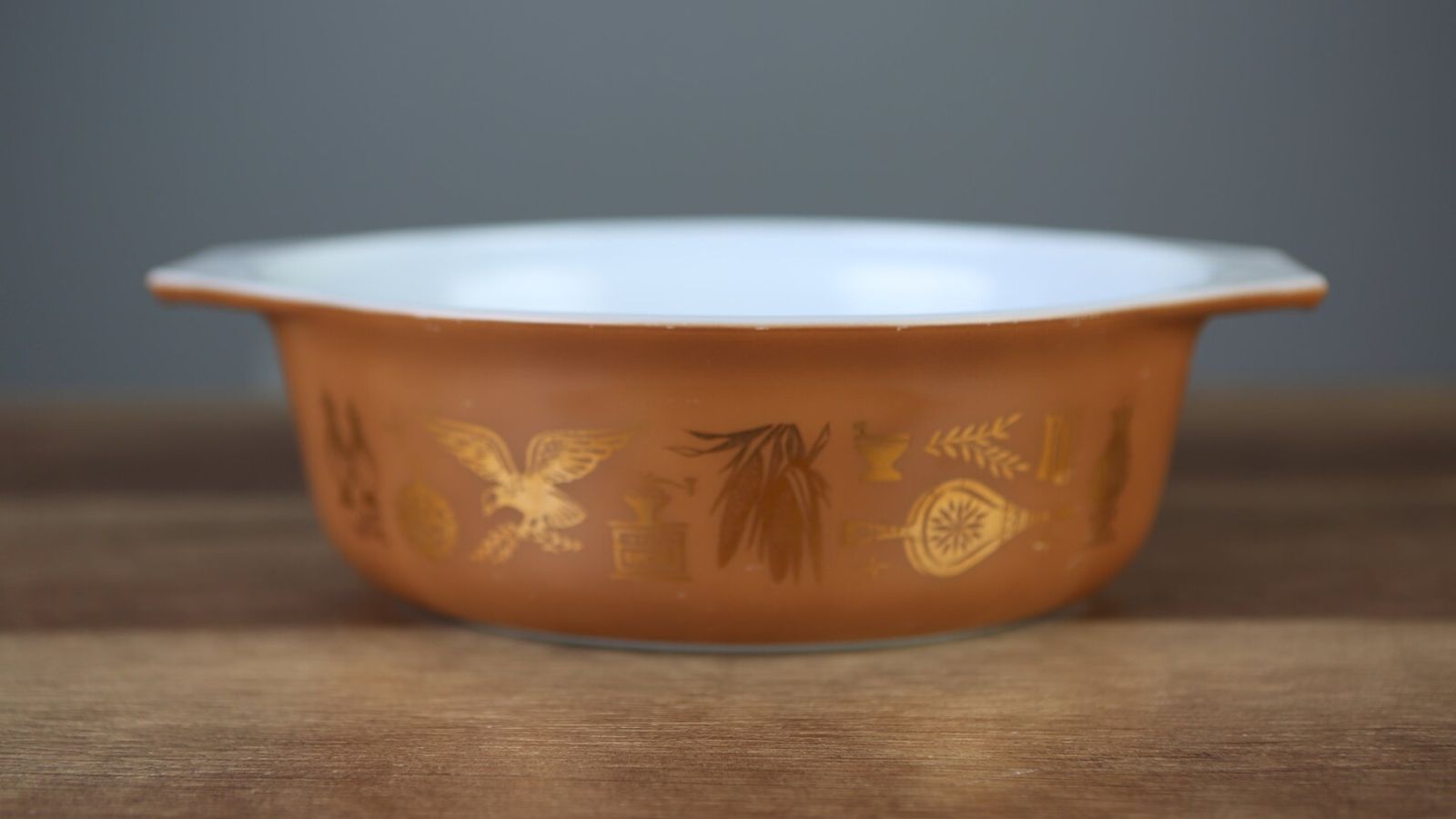
Color is the quickest clue. Look for a rich dark brown exterior with a metallic gold design running around the dish. The illustrations aren’t delicate or abstract. They’re chunky little bits of early Americana: an eagle, farm and kitchen equipment, lamps, roosters, and other deliberately old-fashioned objects. Once you’ve seen the design a few times, it’s difficult to confuse with Pyrex’s florals, snowflakes, or later geometric patterns.
Don’t expect every piece in an Early American set to match exactly, though. Pyrex deliberately mixed the gold-on-brown pieces with brown-on-white ones. In the four-piece Cinderella bowl set, for example, the 442 and 444 bowls carried gold decoration over brown, while the 441 and 443 were brown on white. Gold-on-brown also appeared on several round and oval casseroles and on the pattern’s Chip & Dip set. The collection eventually stretched well beyond bowls to include refrigerator storage, casseroles, serving pieces, and even a carafe and mugs with a candle warmer.
Condition deserves an especially careful look with these. Scratching and years of dishwasher use can leave vintage colorware faded, rough, or hazy, and decorative finishes can be lost altogether. A gold-on-brown Early American piece that still has a glossy brown surface and clear, bright decoration is therefore particularly satisfying to find. And if you spot a brown Early American piece with white rather than gold decoration, don’t dismiss it as the wrong version. Some white-on-brown Early American pieces are considerably less commonly encountered than the familiar color combinations.
The real gold is only part of the collector appeal
cathscorner via eBay
Early American isn’t appealing because every piece is impossibly rare. It isn’t. The pattern was successful enough to stay in production for nearly a decade, and plenty of examples survived. What makes it such a good thrift-store find is the combination of unmistakable midcentury design, an enormous coordinated collection, and that genuinely unusual 22-karat gold decoration. You can find one casserole and stop there, or slowly end up with mixing bowls, refrigerator dishes, and serving pieces until an entire shelf has somehow turned brown and gold. That is generally how collecting goes.
There are stranger Early American pieces out there, too. Experimental versions are known with gold decoration over red, turquoise, and deep yellow or orange backgrounds. Those weren’t part of the familiar regular color scheme and appear to have been test-market or prototype pieces. For most collectors, though, the classic gold-on-brown version is the one realistically worth learning to recognize in the wild.
One practical warning comes with all that gold. The decoration is metallic, and vintage Pyrex references note that it isn’t compatible with microwave use. Gold decoration largely disappeared from Pyrex around 1970 as microwave ovens became increasingly popular. That doesn’t make Early American any less appealing as a piece of vintage kitchenware. Quite the opposite. The gold is a little snapshot of a period when Pyrex could take a sturdy brown casserole, cover it in tiny Colonial kitchen tools, print the whole thing in 22-karat gold, and apparently decide that this was perfectly reasonable everyday cookware.
You might also like…
The Pink Pyrex Pattern Collectors Dream of Finding at a Thrift Store
The Old Cast-Iron Skillet Collectors Are Always on the Hunt For
The Blue-And-White Pyrex Pattern Collectors Dream Of Finding At A Thrift Store

