

Affiliate disclosure: This post may contain affiliate links. Please see full disclosure.
A vintage teapot doesn’t have to be covered in flowers or edged in gold to deserve a closer look. In fact, one of the most interesting American designs looks almost like a piece of modern sculpture. It’s round, wonderfully chunky, and has a hole through its middle. You could easily walk past it in a thrift store without realizing that its unusual shape is deliberate.
I’d stop and pick it up. There are plenty of pretty old teapots around, but a genuinely unusual silhouette is much more interesting to me than another ordinary floral pot. And this one has a particularly good story behind it.
The unusual Hall China teapot with a hole in the middle
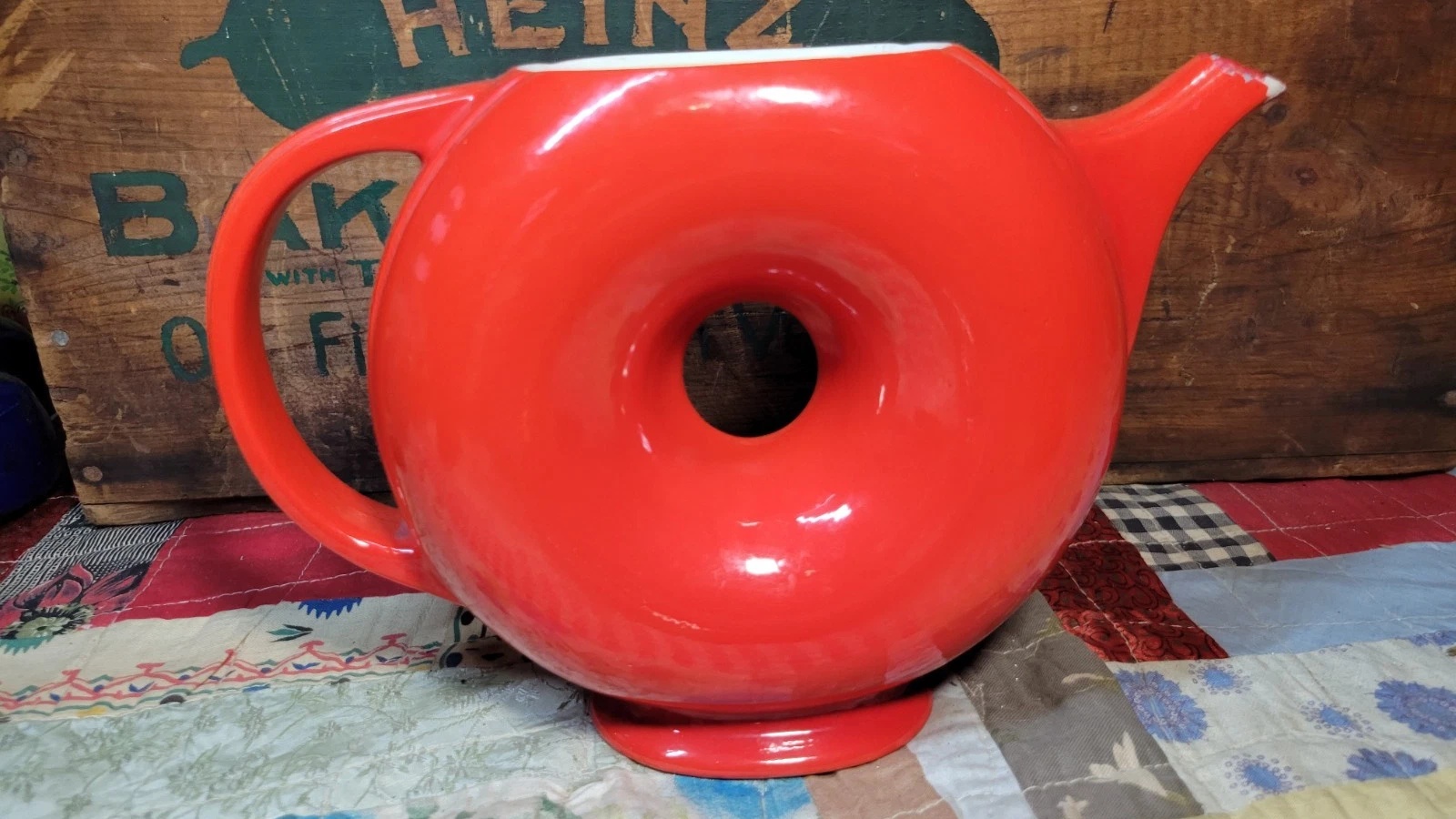
The design is the Hall China Doughnut teapot, introduced in 1938 by the Hall China Company of East Liverpool, Ohio. Instead of the conventional rounded body, it has a doughnut-like central form. Its bold curves fit beautifully with the playful, streamlined designs of the late 1930s.
The original teapot cost $1.50 when it appeared. It was a practical household purchase, albeit one with an adventurous design. That’s part of its charm. Someone could have bought this remarkable-looking piece simply because they needed a new teapot.
The Doughnut was introduced in 1938 and included in Hall’s Superior Quality Kitchenware range from 1939 to 1941. Importantly, Hall also made later reproductions in the 1970s, 1980s, and 1990s. So finding this exact shape doesn’t automatically mean you’ve found a 1930s original.
The colors and decorations worth looking for

Part of the pleasure of collecting Hall pottery is the color. A solid-colored teapot can look completely different from the same shape with a printed decoration, and the Doughnut was produced in multiple finishes.
One particularly striking example is Chinese red, a rich, warm glaze that works beautifully with the rounded shape. A Chinese red Doughnut from the original Superior Quality Kitchenware range is documented in the Museum of Ceramics collection. It’s the sort of piece I’d happily give shelf space to, even if I never used it for tea.
The Doughnut also appeared with decorated surfaces rather than plain glaze. Hall adapted it for its Orange Poppy pattern, for instance, putting a floral design onto that distinctly modern body. That contrast between a traditional flower motif and an unconventional teapot shape is rather lovely.
Turn it over and look for the Hall mark

The underside is where I’d look next. Hall used several different maker’s marks over the decades, so the stamp can help you narrow down when a teapot was produced.
A circular mark containing the name Hall is commonly associated with collectible pottery made from the early 1930s into the later twentieth century. Pieces of the Superior Quality Kitchenware range may instead carry a rectangular mark with that wording and Made in U.S.A. Hall also used other marks for later production.
There’s a catch, though. A mark that broadly fits the 1930s isn’t proof of an exact production year. Nor is every Hall-marked Doughnut an original from 1938 to 1941. The company officially reissued the design decades later, with identifying marks that distinguish those pieces from earlier production.
For that reason, I’d compare the full stamp, not just the word Hall, with documented examples. Take a clear picture of it, then check the glaze, shape, and any additional lettering together. A later reproduction can still be a beautiful collectible teapot. It just shouldn’t be mistaken for an earlier example.
What makes a complete example more appealing

The first thing I check on an old teapot is its lid. A missing lid can be surprisingly difficult to replace, especially on a distinctive shape that hasn’t been made continuously. Even one that looks close may not sit properly or match the glaze.
Lift the lid carefully and check the seat around the opening for chips. Run your eyes over the spout, its tip, the handle, and the junctions where these meet the body. These projecting parts usually have a harder life than the rounded sides of a pot.
Next, inspect the glaze under good light. Hall became known for durable, colorful glazed pottery, but that doesn’t make an individual old piece immune to chips, cracks, or damage from decades of use. I don’t mind a little wear on a display piece. A hairline crack extending through the body is a different matter.
If I were choosing between a brightly colored teapot with a badly damaged spout and a quieter example in excellent condition, I’d usually take the sound one. The whole point of a design like this is its shape. Once the spout or lid is broken, a good deal of its appeal disappears.
Display it or use it carefully
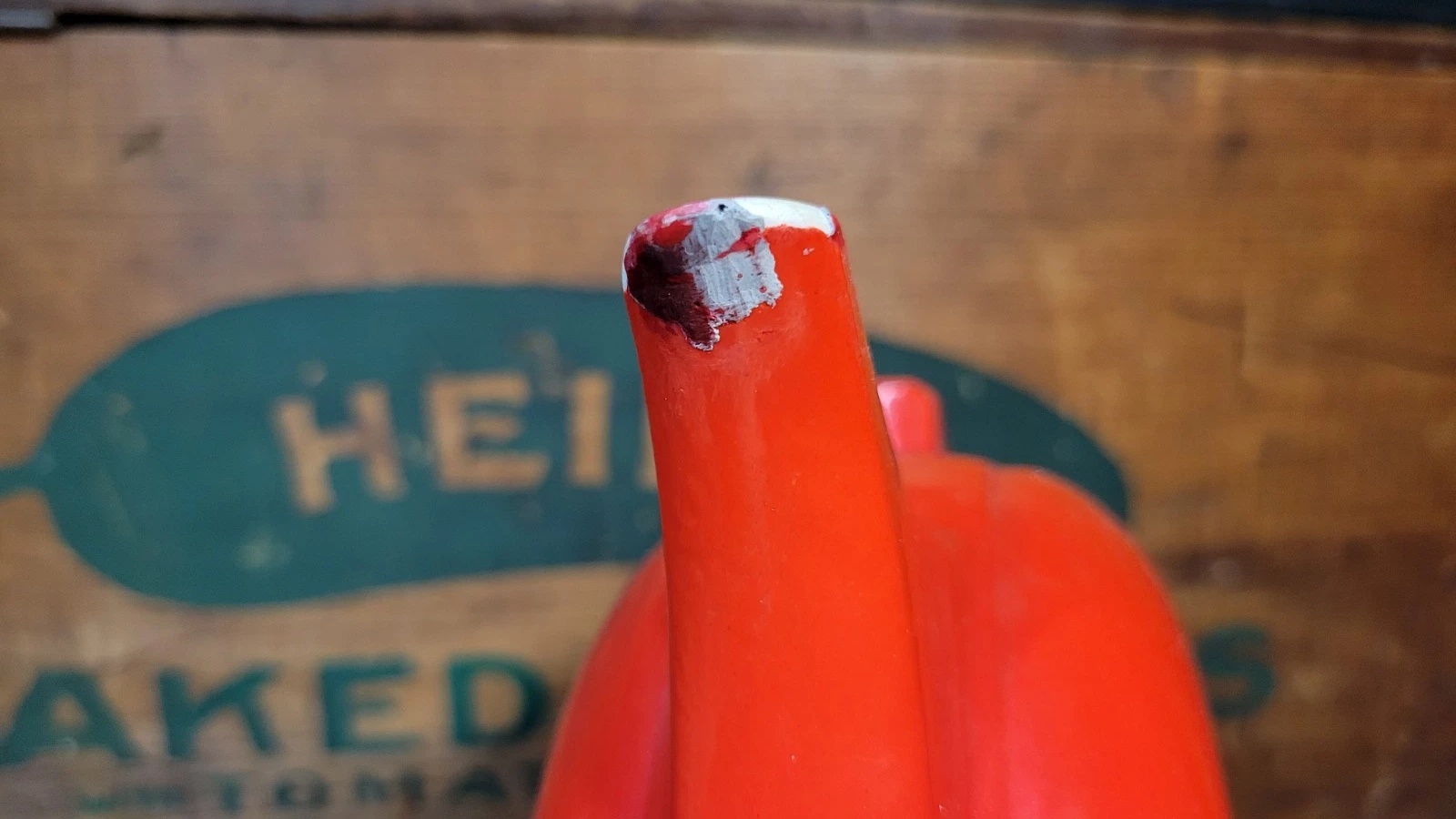
For everyday use, be more cautious. An old teapot may have repairs, internal wear, or a glaze whose food-contact safety you haven’t established. I recommend keeping an uncertain example for display rather than assuming it meets modern standards. Never put it directly on a stove burner, and don’t shock old ceramic ware with sudden temperature changes.
Clean it gently by hand, without abrasive pads or a dishwasher cycle, and support the base rather than lifting it by its handle alone. These pieces have already survived a great many years. There’s no sense taking unnecessary risks with them now.
The real joy of finding a Hall Doughnut teapot isn’t whether somebody else would pay more for it. It’s recognizing a clever piece of American pottery design sitting among the everyday dishes, then discovering that a shape which looks startlingly modern actually goes back to the 1930s. That’s exactly the sort of thrift-store surprise I love.

