
Affiliate disclosure: This post may contain affiliate links. Please see full disclosure.
Franciscan Desert Rose is one of those thrift-store patterns you can recognize from halfway down the dinnerware aisle. The plates are creamy ivory, with soft pink roses, yellow centers, leafy green stems, and a slightly uneven, scalloped edge. The flowers aren’t simply a flat printed design, either. You can see and feel their shape in the pottery.
I’m an avid thrifter and vintage collector, and I love hunting recognizable old dinnerware. Desert Rose is particularly satisfying because you can start with a single plate or cup and build a collection gradually, without needing to hunt down an entire dinner service in one go.
The roses are part of the pottery itself
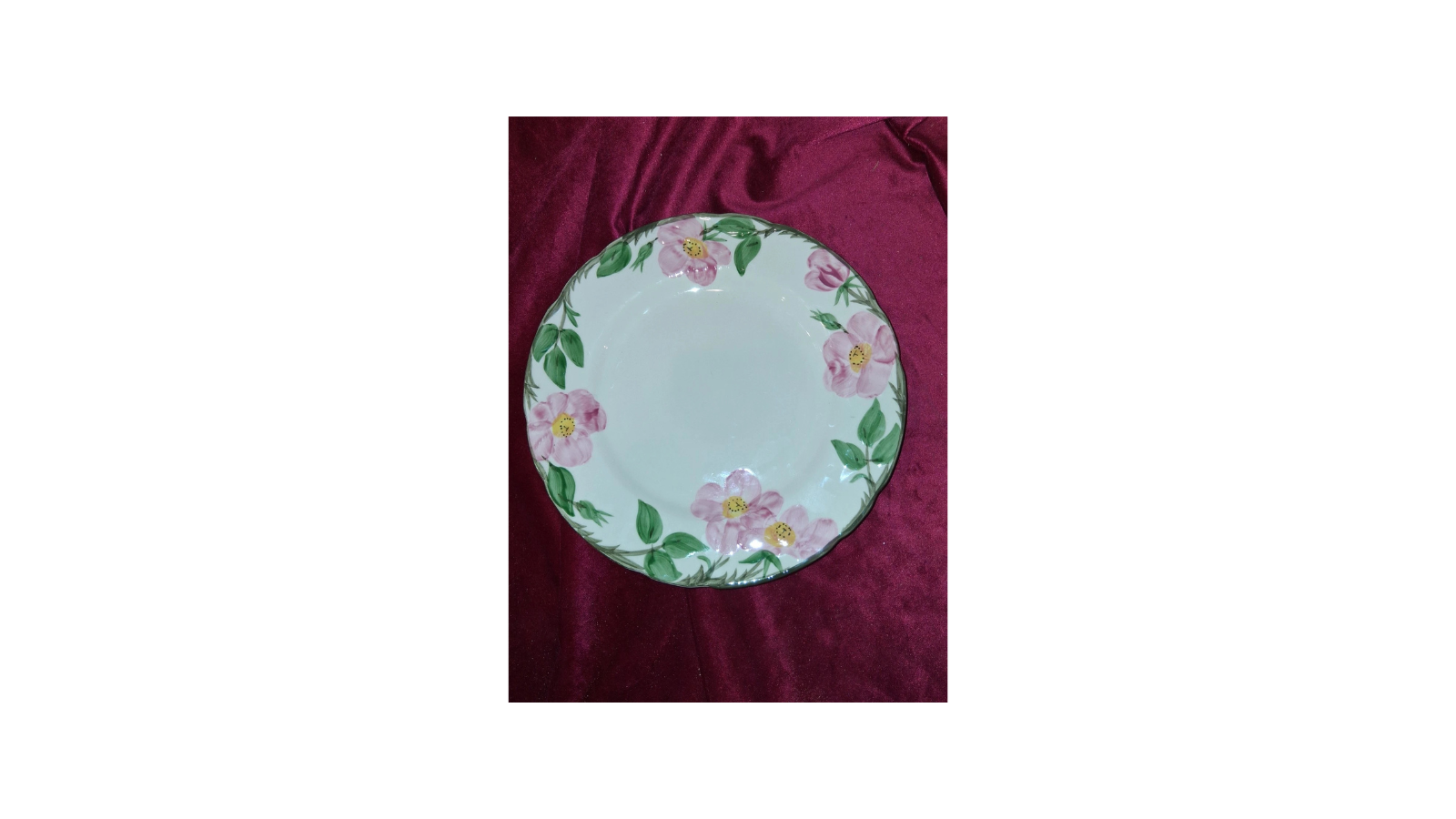
The original Desert Rose was introduced in 1941 by California pottery company Gladding, McBean & Co. Its floral design came from artist Annette Honeywell. What separates it from an ordinary floral plate is the combination of sculpted relief and hand-applied color.
Look closely at a flower. The petals and leaves are raised from the surrounding surface, while pink paint settles across the details in slightly different shades. The stems and thorny-looking border frame the rim, leaving plenty of plain cream space in the middle.
The hand-decorated finish means you may see subtle differences in the depth of the pink or the placement of the brushwork. I regard that as part of the charm, provided the glaze and decoration are sound. A flat floral decal doesn’t have the same raised relief, however pretty its roses might be.
Turn it over before deciding how old it is

A California-made Desert Rose piece might have a Franciscan mark, a Gladding, McBean name, or a simpler Made in U.S.A. stamp, depending on when it was made and the size of the item. The marks changed many times. Some even include decorator or year numbers, so the exact wording and layout are worth checking rather than relying on the flower pattern alone.
The original American production ran until 1984, but that wasn’t the end of Desert Rose. Production continued in England from the mid-1980s, with some complementary pieces made in Portugal, and later examples made in China. A Made in England backstamp is not a fake. It simply belongs to a different period of the pattern’s history.
I’d pay particular attention to a sound older California-made piece, but I wouldn’t reject a later one if I loved the shape. The collectors’ mark guide is much more reliable for dating than sweeping claims about one shade of pink being older than another. A U.S. mark doesn’t mean a plate necessarily dates from the 1940s.
The serving pieces are where collecting gets interesting
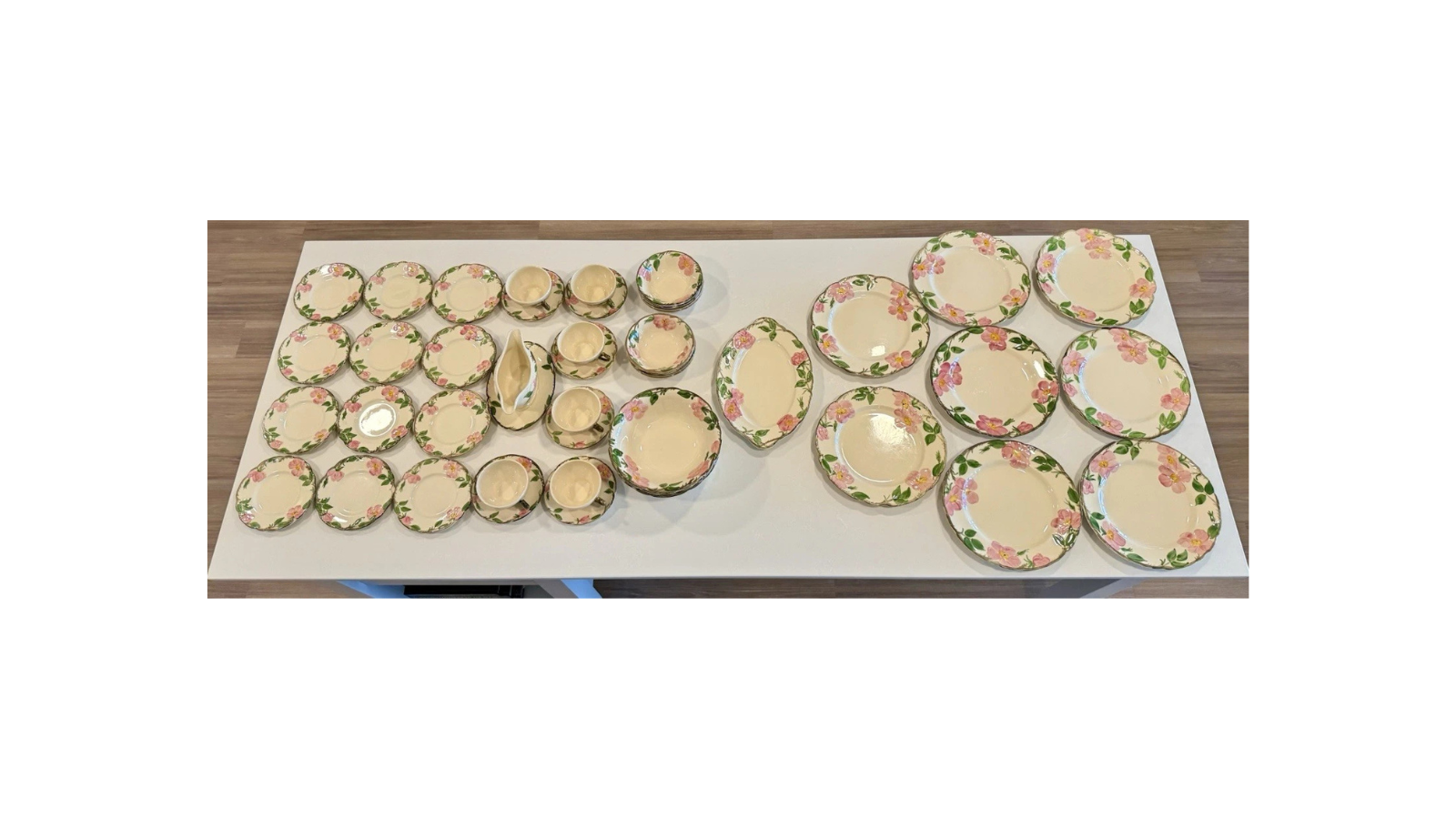
Dinner plates, bread-and-butter plates, cereal bowls, and cups make a lovely starting point, especially if you’re trying to fill gaps in an inherited set. But I always look a little longer at the oddly shaped pieces. Desert Rose eventually included far more than place settings, and some of those extras make wonderful individual finds.
A teapot with its rosebud lid, a sugar bowl with a matching cover, or a creamer with a branch-like handle has a lot more of the pattern’s character on show than a flat plate. A covered butter dish, gravy boat with its underplate, or divided vegetable dish is worth inspecting too. They’re also the pieces most likely to be missing a lid or companion part, so check before assuming you’ve found a complete item.
For a proper collector’s curiosity, there was even a special Desert Rose breakfast set offered in 1951. It included a covered toast dish and miniature coffee service. The toast cover, demi coffee pot, demi sugar, and demi creamer were singled out as especially difficult finds in an early collectors’ newsletter. The demi sugar never had a lid, so don’t mistake it for an incomplete piece.
The selection changed over time as well. A 1990 English range included a smaller restyled cookie jar, a spoon rest, picture frames, and a cake plate with server. I’d rather collect shapes I genuinely enjoy than insist that every piece have an identical backstamp.
Check the glaze as carefully as the flowers

Pick up each piece and angle it toward the light. I’m looking for chips along the scalloped rim, cracks at the roots of handles, and damage to rosebud knobs. Run a fingertip carefully around the edge, too. A tiny rough spot can be hard to see among all those molded leaves and petals.
Fine crackle lines in the glaze are called crazing. They aren’t the same thing as a crack through the pottery, but I still examine them closely, especially if there’s brown staining in the lines. On cups, jugs, and teapots, check the inside as well as the outside. And if you’re buying a matching replacement, measure the plate or bowl first. Similar-looking Desert Rose pieces were made in different sizes and shapes.
My advice is to buy for condition first, then worry about how perfectly the brushwork matches another piece. A teapot with a beautiful painted rose but a badly repaired spout is less satisfying than a modest plate you can display without wondering when it will break. Wash sound pieces gently by hand and avoid abrasive cleaners or sudden temperature changes.
Enjoy the flowers without assuming every old plate is food-safe

Desert Rose was originally made as dinnerware, but age and condition matter when deciding what to do with a thrifted example. Older or damaged glazed pottery deserves extra care because some glazes can release lead into food. That doesn’t prove a particular Desert Rose piece contains leachable lead. It means you shouldn’t assume a decades-old plate is suitable for everyday serving just because it carries a familiar factory mark.
If you can’t establish that a piece is suitable for food use, display it instead. A single Desert Rose plate on a stand, a little vase among the houseplants, or a group of different serving pieces on a shelf lets you enjoy that cheerful pink-and-green pattern without taking unnecessary risks. That’s the point of collecting for me: finding something with a history that I actually like living with.
You might also like…
The CorningWare Pattern Collectors Dream Of Finding At A Thrift Store
The Blue-And-White Pyrex Pattern Collectors Dream Of Finding At A Thrift Store
The Pink Pyrex Pattern Collectors Dream of Finding at a Thrift Store

