
Affiliate disclosure: This post may contain affiliate links. Please see full disclosure.
Strawberry plants that look perfectly healthy but won’t produce fruit are almost always suffering from one of a few specific, fixable problems. Some are about what you’re doing, some are about what the weather is doing, and a few are about what’s living in your soil. Work through this list and you’ll find your culprit. I love strawberries – picking them fresh from the garden, and eating them right there, still warm from the sun is one of the greatest joys of my summer garden. The flavor is unmatched and it’s just such an incredible sensory experience. But it’s super-frustrating if you’re trying desperately to grow your own produce, and your strawberries decide they don’t want to produce fruit.
1. You have June-bearers and you’re expecting fruit all summer
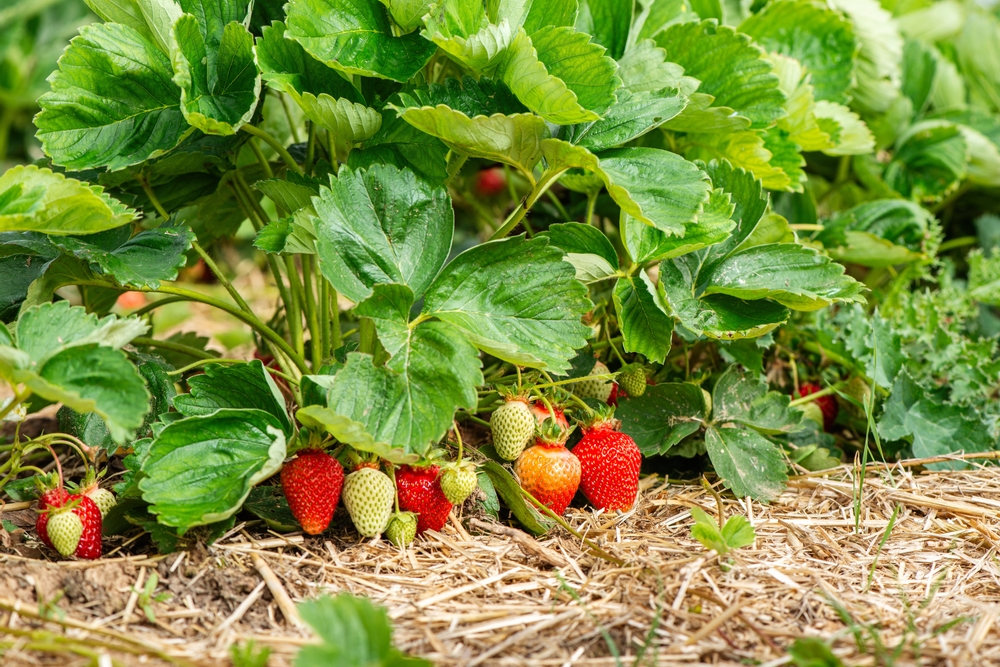
June-bearing strawberries produce exactly one crop per year, typically over a 2-4 week window in late May through June depending on your zone. That’s it. One flush of berries, then nothing until next year. If you planted June-bearers expecting continuous summer production, the plants are performing exactly as they should.
The fix is variety selection. Day-neutral varieties like ‘Albion,’ ‘Seascape,’ and ‘Tristar’ produce fruit steadily from late spring right through to the first hard frost. Everbearing types like ‘Ozark Beauty’ give you two main flushes, one in early summer and one in fall. Check what you’re currently growing and swap in day-neutrals if you want ongoing production. I grow both: June-bearers for a big preserving batch in early summer, day-neutrals for fresh eating from June onward. Knowing the difference between them changed how I planned my whole strawberry bed.
RELATED: The complete guide to growing strawberries (including variety selection)
2. You didn’t pinch first-year flowers, or you pinched them too late

In a strawberry plant’s first year in the ground, energy needs to go into root and crown development. Let first-year plants set fruit and they’ll divert that energy into berries instead of building the root system that supports years of heavy production. The result is a small, disappointing harvest year one and underwhelming performance for the life of the plant.
The rule is to remove every flower that appears in the first year for June-bearers, with no exceptions. For day-neutrals and everbearers, pinch all flowers for the first 6 weeks after planting, then let the plants fruit from midsummer onward. If you’ve already missed the window and let your first-year plants set heavily, the best fix is to feed them well with a balanced, natural fertilizer in fall, mulch them properly over winter, and give them the strongest possible start next spring. They may never reach full potential, but a well-fed plant recovers better than a neglected one.
3. Your plants aren’t getting enough direct sun
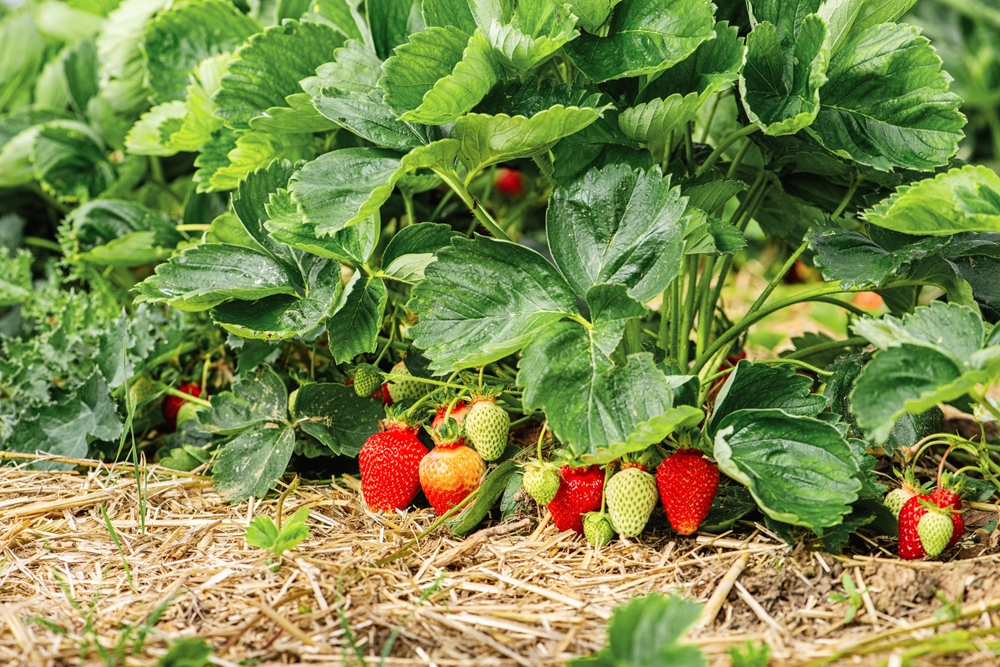
Strawberries need a minimum of 6-8 hours of direct sunlight per day to fruit reliably. Below that, they’ll survive and look reasonably healthy, and they may even flower, but fruit set will be poor and any berries that do develop will be small and slow to ripen. Partial shade produces exactly the kind of “lots of leaves, almost no fruit” situation that confuses a lot of gardeners.
If your plants are in a spot with fewer than 6 hours of full sun, that’s your problem and there’s no workaround. The fix for established plants is to move them in late summer or early fall once they’ve finished for the season. If the shading comes from a nearby shrub, fence, or tree, assess whether any pruning is practical. No amount of extra feeding or careful watering will compensate for inadequate light.
4. You’ve been overfeeding with a high-nitrogen fertilizer

Dark green, lush, vigorous strawberry plants with almost no fruit are a textbook sign of nitrogen excess. Nitrogen drives leafy, vegetative growth. When plants get too much of it, they put energy into producing foliage and almost none into flowers and fruit. It looks like a healthy plant. It isn’t performing like one.
If you’ve been using a general-purpose vegetable fertilizer or any lawn feed near your strawberry bed, that’s almost certainly the cause. Stop the nitrogen feed immediately and switch to a high-potassium, low-nitrogen fertilizer like an organic tomato feed. Potassium supports flowering and fruit development. Apply a tomato fertilizer every 10-14 days from when plants are in active spring growth onward, and hold all nitrogen-heavy feeds until after fruiting finishes. Don’t worry if the new growth looks slightly less lush than before. That’s what you’re aiming for.
RELATED: Best organic fertilizers for strawberries
5. The crown is planted at the wrong depth

The crown is the central nub where roots meet leaves, and it needs to sit right at soil level. Bury it too deep and it rots. Plant it too shallow and it dries out and the plant struggles to establish properly. Both result in plants that survive but never thrive, and poor fruiting is usually one of the first signs something is wrong at the base.
To check, gently brush soil away from the base of the plant until you can see where the roots meet the crown. It should be sitting exactly at soil level, not below it, not perched above it. If it’s buried, carefully lift the plant and replant it at the correct depth. If it’s sitting too high, mound a little soil around the roots without covering the crown itself. This is easiest to fix when plants are young. On older established plants, if the crown has been too deep for a full season, check item 13 on this list for signs of crown rot before deciding whether to replant.
6. A late frost killed the flowers before you noticed

This one catches gardeners every single year. The plants come through winter fine, throw up a flush of flowers, a surprise late frost hits overnight, and the fruit never sets. The plants still look okay, and the flowers might even look okay from a distance, but frost kills the reproductive parts of a strawberry blossom even when the petals survive perfectly intact.
The test is simple: look at the center of an open flower. A healthy flower has a bright yellow-green center. A frost-damaged flower has a center that’s turned black or dark brown. If you’re seeing blackened centers across your plants after a cold night, those flowers are dead and won’t recover. Remove them. The fix for next season is to keep row cover or garden fleece on hand throughout the flowering period, which typically runs April through May across most of the US. Cover plants whenever the forecast drops below 32°F (0°C), even for a single night.
RELATED: How to protect your plants from frost
7. The flowers aren’t getting properly pollinated

Strawberries need insects to move pollen during the flowering window. Cold, wet, or windy weather during bloom keeps bees grounded for days at a time, and if that coincides with peak flowering, you’ll end up with very few berries or a lot of misshapen, knobby, partially developed fruit. A garden with poor habitat for pollinators has the same problem even in good weather.
The short-term fix is hand pollination. Take a soft paintbrush or even just a fingertip and move gently from flower to flower, transferring pollen the way a bee would. It takes a few minutes and it works reliably. For the longer term, plant pollinator-friendly flowers near the strawberry bed. Phacelia, borage, and sweet alyssum all attract bees dependably and bloom around the same time as strawberries in most zones. If you’re using row cover to protect from frost or extend the season, remove it during the day whenever temperatures are above 50°F (10°C) so pollinators can reach the flowers.
RELATED: Best companion plants for strawberries
8. Runners are draining the mother plant during fruiting season

Strawberry runners are the long horizontal stems the plant sends out to produce new plants, and the mother invests significant energy in every one. Let runners proliferate unchecked during the flowering and fruiting period and that energy comes directly at the expense of fruit production. You end up with a lot of healthy new baby plants and a disappointing harvest from the mothers.
Cut runners off as soon as they appear throughout the fruiting season. Once harvest is finished, you can let selected runners root into pots or prepared ground to produce your replacement plants for next year. Aim to keep no more than 2-3 runners per mother plant if you’re propagating, and remove the rest entirely. By late summer, your new plants should be rooted and established, and the mother plants, kept runner-free all season, will go into winter in much better condition.
9. Your plants are past their productive prime

Strawberry plants produce best in years 2 and 3. By year 4, most varieties have declined noticeably, and by year 5 or 6, you’re getting a fraction of what younger plants would give you. Gardeners who don’t rotate their beds often assume their struggling plants are sick or being managed wrong, when really they’ve just reached the end of their productive life.
If your plants are 4 years old or more and production has been dropping gradually over the past couple of seasons without any other obvious cause, age is almost certainly the answer. The fix is to refresh the bed with new plants grown from runners taken off your best-performing mothers before they get too old. I keep a rolling rotation so I always have plants in years 1, 2, and 3 in the ground. It means potting up runners each summer, but it’s far easier than starting from scratch and keeps production consistent year after year.
10. Heat stress is causing flowers to drop before they’re pollinated

Strawberry blossoms are more heat-sensitive than most gardeners expect. When daytime temperatures consistently exceed 85°F (30°C) during the flowering period, blossoms drop before they can be fully pollinated and fruit never sets. The plant looks completely fine and keeps growing, but the fruit simply doesn’t appear. This is a particular problem in warmer zones or during unusually hot springs.
Mulch heavily around the base of the plants with straw to keep soil temperature down and reduce heat stress on the roots. Water deeply and consistently during hot spells, since drought stress compounds the problem. If heat during flowering is a recurring issue in your climate, look at day-neutral varieties with documented heat tolerance like ‘Albion’ or ‘San Andreas,’ and consider a spot in the garden that gets some afternoon shade to take the edge off the hottest part of the day.
11. Blossom weevils are clipping the flower stalks

The strawberry blossom weevil is a small brown beetle roughly 2-3mm long whose larvae develop inside flower buds. The adult female lays a single egg inside a developing bud, then partially severs the flower stalk so it droops and dies before it can open. Once you know what you’re looking for, the damage is unmistakable: flower buds hanging at an angle from a half-severed stalk, wilting and browning without ever opening. It’s active from April onward and common across much of the US.
The fix requires early action, because by the time you see drooping buds, the eggs are already laid and the damage is done for that bud. Knock affected buds off into a bucket of soapy water and dispose of them. For organic control, pyrethrin-based sprays applied in the evening reduce adult populations without harming daytime pollinators. Avoiding growing strawberries in the same spot year after year also helps break the lifecycle, since adults overwinter in the soil and leaf litter nearby. If you grow raspberries alongside strawberries, note that the weevil attacks both crops.
12. Botrytis gray mold is killing your flowers and developing fruit

Botrytis cinerea thrives in cool, damp, still air, which makes a wet spring during the strawberry flowering window ideal conditions for it. The fungus attacks flowers first, turning them brown and mushy before they can set fruit. If wet weather continues, it moves on to small developing berries, coating them in the characteristic grayish fuzzy growth. In the right conditions, it spreads through a bed quickly.
Prevention is more effective than treatment once it takes hold. Space plants at least 12-18 inches apart so air can move freely between them. Remove dead leaves and old plant material, which harbor the spores over winter. Water at the base of the plants rather than overhead, and try to water in the morning so any splash on the foliage dries before evening. If you’re seeing active infection, remove and bin affected flowers and fruit immediately. Don’t compost them. Copper-based fungicides and sulfur sprays provide some organic preventative control when applied before symptoms appear, but they’re far less effective once the disease is established.
13. Crown rot or root rot is collapsing the plant from the base

Crown rot and root rot are most commonly caused by water molds in the Phytophthora family and tend to strike in beds with poor drainage or after a stretch of wet weather. Plants start to look stunted and off-color, new leaves come in small and yellowish, and the whole plant looks like it’s slowly failing without any obvious surface-level reason. Pull a plant and check the roots: healthy roots are white and firm. Roots affected by rot are brown, soft, and often smell unpleasant. The crown base itself may be brown and mushy rather than firm and pale.
Once crown rot is well established in an individual plant, it can’t usually be saved. Remove and destroy affected plants, and don’t compost them. The fix for the rest of the bed is improved drainage. If the bed sits in a low spot or the soil is heavy clay, that needs to be addressed before you replant anything. Raise the bed, work in grit and compost to open up the structure, and let the soil dry out before putting new plants in. Avoid planting strawberries in the same ground where crown rot has appeared for at least 3-4 years. Several modern varieties have improved resistance if this is a recurring problem in your garden.
14. Verticillium wilt is causing slow decline and poor fruit set

Verticillium wilt is a soil-borne fungal disease that causes gradual, often puzzling decline in strawberry plants. Older leaves develop reddish or yellowish coloring and start to collapse at the edges. Plants look progressively smaller and more exhausted each season, and fruit set drops off even though there’s no obvious single cause. Unlike crown rot, which tends to strike suddenly, verticillium wilt is slow and easy to mistake for old age or poor care.
The pattern is the key to diagnosis. If plants are declining despite correct feeding, watering, and no visible pest damage, especially if you’ve grown tomatoes, potatoes, peppers, or eggplant in the same ground in recent years, verticillium wilt is a strong possibility. There’s no chemical treatment for it once it’s in the soil. The only workable fix is to remove affected plants, avoid growing strawberries, tomatoes, peppers, or potatoes in that ground for at least 4-5 years, and choose resistant varieties like ‘Albion,’ ‘Seascape,’ or ‘Chandler’ for your new bed. Building good soil biology with plenty of compost and organic matter helps suppress soil-borne pathogens over time, so it’s worth investing in the soil before replanting.
15. Spider mites or aphids are stressing the plant during fruit set

Spider mites and aphids both peak during warm, dry spells, which unfortunately overlaps with the critical fruiting window for strawberries. Spider mites cause a distinctive stippling or bronzing on the upper leaf surface, and at higher populations you’ll see fine webbing under the leaves. Aphids cluster on new growth and flower stems, and in large numbers they distort leaves and cause growing tips to curl. Both weaken plants by feeding on sap, and both can cause flower drop and poor fruit development if pressure is high during the short window between flowering and fruit set.
Early identification is the most important fix, because both pests are much easier to manage when populations are small. Check the undersides of leaves regularly from mid-spring onward. For aphids, a strong jet of water knocks them off effectively as a first measure. If that’s not keeping up with them, insecticidal soap spray works well without leaving residues on developing fruit. For spider mites, insecticidal soap or neem oil are the most reliable organic options. Apply any spray in the evening to protect pollinators. For longer-term control, companion planting with yarrow, phacelia, or marigolds near the strawberry bed attracts predatory insects like lacewings and hoverflies that keep both pests in check naturally.
RELATED: How to control aphids naturally
A quick note on where to start
If you’ve worked through this list and you’re still not sure which problem applies to you, start with the basics before assuming something more serious is going on. Most strawberry fruiting failures come down to variety mismatch, sun, feeding, or age. Check those four things first. If the plants are healthy and the conditions are right and you’re still not getting fruit, that’s when it’s worth digging deeper into pollination, pests, and disease.
You might also like…
How to grow strawberries from scraps
Easy DIY ways to grow strawberries for big harvests in small spaces
Why are my strawberry leaves curling?