
Affiliate disclosure: This post may contain affiliate links. Please see full disclosure.

Disclosure: This post contains affiliate links. Click here to read my affiliate policy.
When pepper leaves turn yellow, you know something’s wrong. If you spot yellowing pepper leaves early, you can usually fix the problem and still get a nice, healthy harvest. But if you leave it too long, you’ll end up with dead plants or a meagre harvest. Pepper plant leaves turn yellow for many reasons, from too much or too little fertilizer to disease and pest infestation.
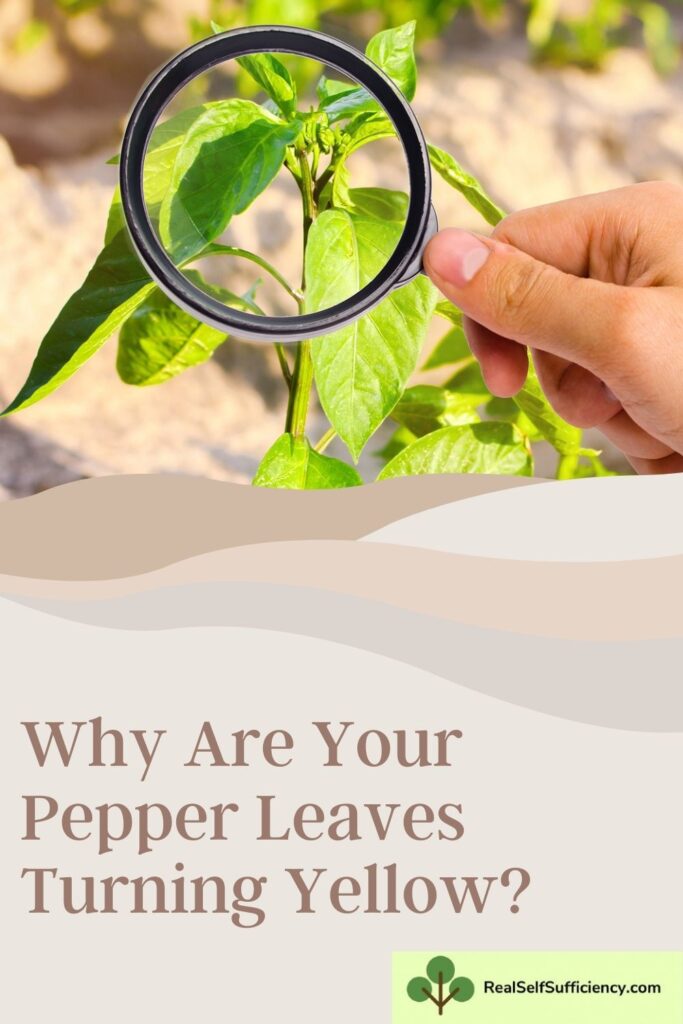
If your pepper plants have yellow leaves, first check the basics. How’s your watering schedule? Are you giving the peppers too much water? Not enough? And how’s your soil health? Are you fertilizing the pepper plants correctly? Is disease the problem? What about signs of pest infestation?
Find out why your pepper leaves are turning yellow and what you can do about it.
1. Water Stress
A common misconception is that yellowing leaves on a pepper plant immediately signals a lack of watering.
In fact, while water stress is a common reason for yellow pepper leaves, it’s most often caused by too much water.
Peppers like fairly dry conditions and can tolerate moderate periods of drought. Under-watering is easy to spot as the leaves start to droop and wilt, and with a quick drink of water, they perk back up in a few hours.
Inconsistent watering and overwatering can be fatal for peppers, resulting in stunted growth and reduced or completely absent pepper production. Letting them dry out for a week and then saturating the soil with water is not healthy for the plants and leaves them open to disease and pest attacks.
Get yourself on a regular watering schedule to avoid causing water stress, but make sure not to oversaturate the soil. It should be moist, not soaking.
Consistency is extra important if you’re growing peppers in containers. In which case, make sure there are plenty of drainage holes in the bottom of the container, and only lightly water as the pepper roots will rot or become diseased if they’re persistently wet.
How Do You Fix Water Stress in Peppers?
Fixing water stress in peppers is simple: Check the plants every day to see if they need water.
Test the soil close to the pepper plants by sticking your finger about two inches in. If the soil is pretty damp that far down, don’t water. If it’s dry, you know it’s time to water your peppers. But do it conservatively, don’t drown them.
Put your finger into the soil to determine its moisture content. If the soil is moist two inches down, don’t water that day, and if it’s not moist, it’s time to water!

2. Lack of Nitrogen
One of the key nutrients all plants need is nitrogen, and peppers are no exception. If your soil lacks nitrogen, one of the early warning signs is yellowing plant leaves. Without nitrogen, your peppers may still grow, but they’ll be small, weedy, and not very productive.
If you know you’re managing your soil health well and practicing crop rotation, replenishing nutrients and organic matter every year, and generally working toward building good soil health, a lack of nitrogen may not be the issue. But, however careful you are, it’s still worth checking if lack of nitrogen is causing yellow pepper leaves.
The easiest way for many people is to get a soil testing kit like this one. It’s cheap and pretty accurate and can tell you what nutrients your soil is lacking in or has too much of.
But there’s another way.
Look at your peppers. Is the leaf yellowing happening at the bottom of the plant? If so, it could well be a nitrogen deficiency. Nitrogen is a mobile nutrient, so it travels slowly from one part of the plant to another. If your pepper plant isn’t getting enough nitrogen, it’ll move what little it has got to the top of the plant where it’s trying to produce new leaves.
How Can You Fix a Nitrogen Deficiency in Pepper Plants?
Once you’re certain you’re dealing with a nitrogen deficiency, it’s time to fertilize your peppers to stop any more leaves turning yellow.
But fixing the problem won’t turn the yellow leaves green again. Those are a lost cause, but you can prevent the other leaves on your plant from turning yellow as well.
If you haven’t done a soil test and you’re not sure exactly what nutrients your soil is missing but you suspect a lack of nitrogen, add organic, natural fertilizer like manure tea, which has a nice balance of nitrogen (0.6%), phosphorus (0.1%), and potassium (0.5%).
If you don’t want to make your own fertilizer, you can still get a natural fertilizer to supplement nitrogen like this blood meal from Down To Earth. You can also use chicken manure if you have your own chickens, or chicken manure pellets like these great value ones from Flosage Npkure.
Remember, this won’t turn yellow leaves green again, but it should help to fuel foliage growth and stop any more leaves turning yellow.
3. Other Nutrient Deficiencies That Turn Pepper Leaves Yellow
Nitrogen, potassium, and phosphorus aren’t the only nutrients your plants need. And a lack of some nutrients, like calcium and magnesium, also cause pepper leaves to turn yellow.
We know that nitrogen is necessary, but your plant needs more than that to survive. Yellowing leaves could indicate a lack of an array of nutrients. Two other key elements needed for plant growth are magnesium and calcium, and a lack of either of these can cause pepper leaves to turn yellow.
Yellow Pepper Leaves Due to Calcium Deficiency
Calcium plays a leading role in cell wall development and fruit setting. It’s also vital to the absorption of other nutrients and root growth, so a lack of calcium is a significant problem.
If your peppers lack calcium, you’ll see yellowing, curled leaves and some will likely have brown spots. If you have fruit setting, you’ll likely see blossom end rot, too.
How to Fix Calcium Deficiency in Pepper Plants
Add calcium to the soil! You can crush up egg shells into powder and bury at the roots of your pepper plants. You can also use a readily absorbable natural calcium powder or make or buy a calcium spray. Alternatively, you can use a bone meal fertilizer like Burpee Organic Bone Meal that provides calcium and phosphorus.
Yellowing Pepper Leaves Due to Magnesium Deficiency
While it’s an even rarer deficiency than calcium, a lack of magnesium can occur, especially if you haven’t been replenishing nutrients and organic matter between growing cycles and generally promoting good soil health.
Your peppers need magnesium for growth, just like nitrogen. And, just like with a nitrogen deficiency, a lack of magnesium presents as yellowed leaves starting at the bottom of the plant and slowly creeping upwards.
How can you tell the difference between a nitrogen deficiency and a magnesium deficiency in pepper plants?
Easy! With a nitrogen deficiency the whole pepper leaf turns yellow. With a magnesium deficiency, the leaf turns yellow but the veins stay green. This is called chlorosis.
How to Fix Magnesium Deficiency in Pepper Plants
Add dolomitic lime around the base of your pepper plants if you spot signs of chlorosis. Go for a high-quality dolomitic lime like this one and be sure to follow the directions on the package for the best results.
If you’re concerned that you’re missing both calcium and magnesium, use Bloom City’s Cal-Mag Fertilizer.
This has calcium, magnesium, iron, and many other micronutrients. It’s safe and natural and bioactivated for maximum nutrient absorption.
A lack of iron, nitrogen, and copper can make white spots appear on your pepper plant leaves.
4. Common Pepper Plant Diseases That Cause Yellow Leaves
There are many diseases that cause pepper plants to have yellow leaves. In fact, we’ve got a whole post dedicated to common pepper diseases. Some, if caught early enough, are treatable, so looking for early signs of disease is critical to keeping your pepper plants healthy.
Here’s a summary of the diseases most likely to turn your pepper leaves yellow.
Phytophthora Blight

Phytophthora blight is a soil-borne pathogen that infects plants when water splashes up onto the leaves from heavy rain and from bad overhead watering practices. This disease causes yellow-to-brown spots on the leaves of your pepper plants. There’s really not much you can do about this disease once it sets in, aside from removing the infected plants. Don’t just remove the affected leaves, as the plant is already infected and will soon die. It’s best to prevent the disease in the first place with good watering practices, planting peppers in raised beds, watering at the base, not overhead, and making sure you don’t over-water as standing water causes the mold spores to multiply and spread.
If you know you have this disease in your soil, either don’t plant any susceptible plants there, like peppers, tomatoes, potatoes, squashes, and beans, or take more drastic action and sterilize your soil.
Bacterial leaf spot

Bacterial leaf spot affects an array of plants and, because it’s a bacteria, you can inadvertently spread it from plant to plant by touch. This disease can also be spread via water carrying the pathogen from splashing up onto the plants. It causes yellow and green spots on the pepper plant leaves in the early stages, then progresses to brown spots and leaf decay and drop.
If you see green and yellow spots on the leaves of your pepper plants (particularly the lower leaves), take action, because you can actually save your plants. Firstly, remove the infected leaves then apply some nitrogen-rich fertilizer. With enough nitrogen and other nutrients, pepper plants can actually fight off bacterial leaf spot.
Mosaic Virus

Mosaic virus is unfortunately common on peppers and the damage is irreversible. It’s such a problem because this virus is soil-borne but can also be spread by aphids and other sap-sucking pests, as well as plant-to-plant contact and plant-human-plant contact. If your pepper plant has a mosaic virus, you’ll see green and yellow mottling on leaves, stunted growth, and reduced fruit yield. And the fruit will be small, bumpy, and unappetizing. There’s nothing you can do to remedy mosaic virus other than remove and burn the affected plants. Also note that, while the fruits are safe to eat, you should not save the seeds as the virus can infect the seeds and lay dormant until the next growing season.
Verticillium Wilt on Peppers

Verticillium wilt is a common problem on peppers and all kinds of edible and ornamental plants across the world. This bacterial disease spreads rapidly if left unchecked and can ruin your whole crop in days. The bacteria gets inside the pepper plant and blocks the vascular tissue so that water and nutrients can’t travel around.
You’ll notice yellowing leaves, often starting on one side of the plant first, then the inner tissues of the stems turning brown (this is called vascular discoloration). Verticillium wilt spreads across pepper plants rapidly and there is no cure. If you spot this disease, pull up the affected plants and wash your hands before you touch any other plants! Don’t put the infected plant in your compost bin – the bacteria will stay in the compost and infect anything you plant in it. So, to be safe, burn the dying plants instead.
5. Pests Infestations That Turn Pepper Plants Yellow
Like most other plants, peppers are prone to pest infestations, particularly if they’re not healthy, if your soil isn’t healthy, and you aren’t nurturing a diverse micro ecosystem in your growing area. Pepper plant pests that turn plants yellow include flea beetles, aphids, white flies, and psyllids.
Aphids

Aphids are soft-bodied little fiends that use their piercing, sucking mouth parts to eat the fluids of your peppers, depriving them of water and nutrients. Aphids reproduce rapidly because there are no males and no eggs. Instead, each aphid is female and gives birth to around 100 nymphs that mature quickly and give birth to their own nymphs. If you have an aphid infestation, you’ll find the blighters underneath your pepper leaves and you may also notice your pepper leaves starting to turn yellow, showing stunted growth, or curling upward or downwards. And, if you have the double nightmare of ants farming aphids to milk them for their honeydew, you’ll also see ants running around your plants as they care for their aphid captives.
There’s not much you can do for aphids, chemically or otherwise, as they don’t respond to even the most deadly commercial pesticides. One of the most effective ways to control aphids naturally is to wash them off with the hose. You can also use natural predators, reflective mulch, and trap crops.
Whiteflies

Like aphids, you’ll most often find whiteflies on peppers underneath the leaves. The most common whiteflies that attack pepper plants are the silverleaf whitefly and the greenhouse whitefly. As they suck the sap from your pepper plants, you’ll see yellowing leaves, stunted or reduced growth, leaf loss, and lower fruit production.
Natural control methods that work for aphids also work for whiteflies, particularly using natural predators like ladybugs and applying neem oil spray.
Psyllids

Psyllids cause chlorosis, turning the leaf yellow but leaving the veins green. These small bugs also suck sap and produce honeydew. In the case of psyllids, their honeydew is a white powder rather than the sticky liquid of aphids and whiteflies. Sucking the sap dehydrates and starves the pepper plants, and the honeydew provides the perfect growth medium for sooty mold. An infestation of psyllids on peppers also results in either hardly any fruit production or the overproduction of small, inferior fruit.
Naturally controlling psyllids on peppers requires natural predators, neem oil, or natural insecticidal soaps. You can also try any of the other aphid control remedies linked above, as a multi-pronged approach is usually the most successful.
There are many reasons why your pepper leaves might turn yellow, ranging from you over or underwatering, to diseases, poor soil health, and pest infestations. Be proactive when trying to grow pepper plants. Get your soil right, water gently and consistently without drowning the plants, and be vigilant! Keep a close watch for pests and signs of disease to grow healthy pepper plants and harvest the biggest possible harvest at the end of the growing season.