
Affiliate disclosure: This post may contain affiliate links. Please see full disclosure.
A no-knead loaf baked in a preheated Dutch oven beats a bread machine on every point that actually matters. You get a shatter-crisp crust, a wide-open chewy crumb, deeper flavor from the long ferment, and no paddle-shaped crater in the bottom of every loaf. I gave my bread machine to my neighbor years ago and haven’t missed it once. All it takes to get there is flour, water, salt, a pinch of yeast, and about five minutes of actual hands-on work spread across a day and a half. The catch is timing, not skill, and once you build it into your week, it’s no more effort than remembering to load the machine the night before. Now admittedly, I don’t have time to make fresh bread every day. I am busy with to-do list that’s always a bajillion items long. But I do try to make time to do this from time to time because I adore homemade bread. Plus, it’s a nice skill to practice so that I know, as long as I have the basic ingredients, I can provide good, hearty bread for my family. I can make this bread without electricity if I have to. I can’t do that with a bread maker.
Why No-Knead Beats a Bread Machine on Every Front That Matters

A bread machine and a no-knead loaf use nearly the same four ingredients, but the results aren’t close. The machine bakes at a lower temperature inside a closed, nonstick pan, which gives you a pale crust that’s either soft or oddly tough, a tighter crumb, and a hole in the bottom of every loaf from the kneading paddle.
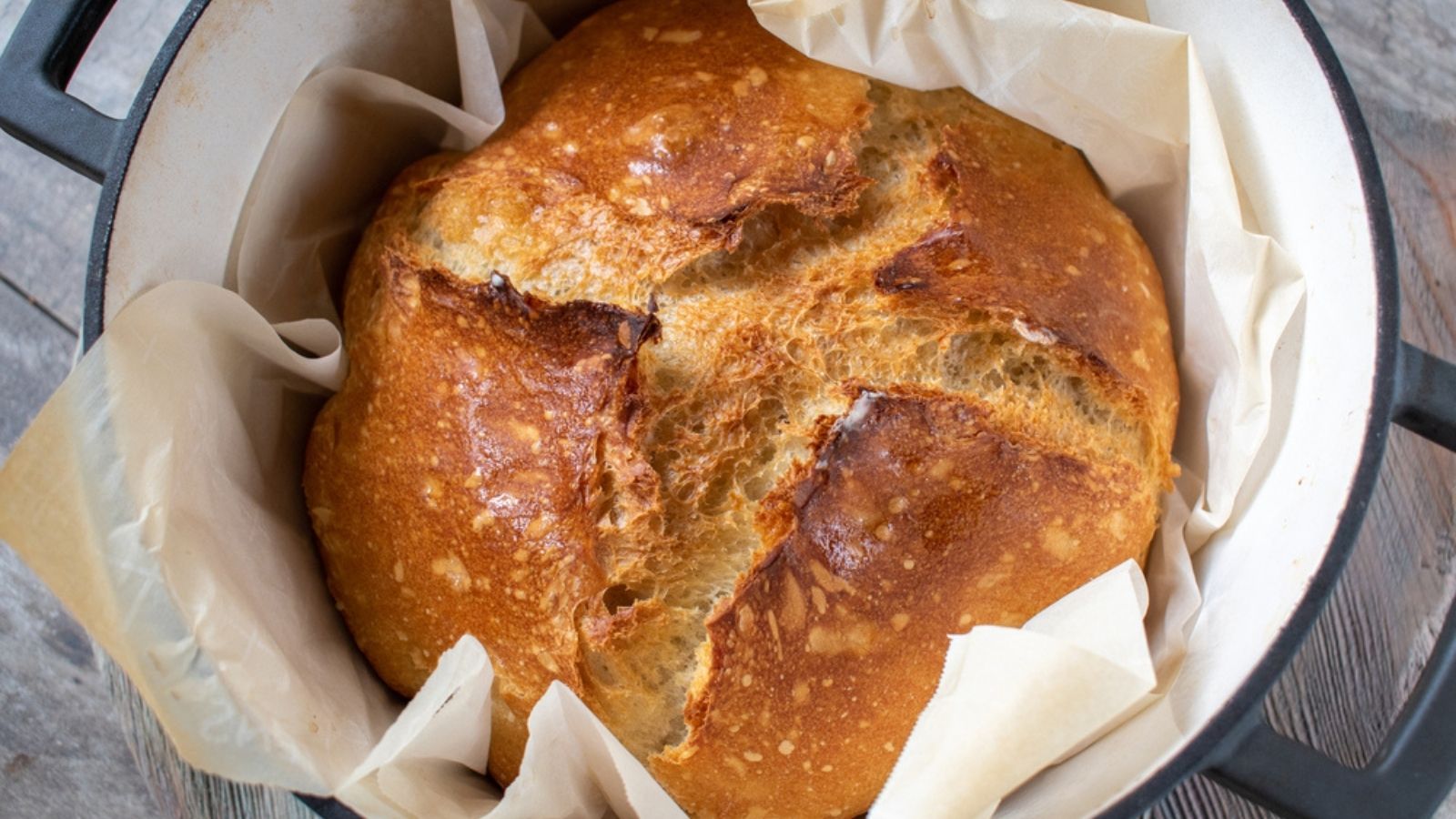
The crust difference comes down to heat and steam. A Dutch oven preheated to 450°F or hotter (230°C) traps the steam released by the wet dough during the first half of baking, and that trapped steam is what lets the crust blister, crack, and turn deep gold instead of just cooking through pale and thick. A bread machine never gets that hot, and the lid never comes off.
The crumb difference comes down to hydration and time. No-knead dough is wetter than almost any dough you’d put in a machine, and after 12 to 18 hours of slow fermentation, that extra water plus the gas the yeast produces stretches into big, irregular holes. Machine dough gets mechanically kneaded for a fixed 10 to 20 minutes on the machine’s schedule, not the dough’s, and it’s almost always a drier, more worked dough, which bakes up tighter and closer to sandwich bread.
Flavor is the difference I notice most. Over 12 to 18 hours, the yeast and the wild bacteria already present in flour produce organic acids and byproducts that build real complexity, a little sour, a little nutty, nothing like the flat taste of a loaf that rose in three hours flat. The first time I cut into a no-knead loaf and a machine loaf side by side for comparison, the machine loaf tasted like almost nothing next to it.
Then there’s the paddle hole. The metal blade at the bottom of every bread machine pan leaves a crater in the base of the finished loaf, and short of pulling the paddle out mid-cycle, there’s no real way around it. No-knead skips the problem entirely because a mechanical paddle never touches the dough. Add in that cleanup is one bowl and a spoon, not a nonstick pan and a kneading blade to scrub, and you’ve also freed up whatever counter space that appliance was taking up permanently.
What a Loaf Actually Costs You
A loaf of no-knead bread costs somewhere around 55 to 65 cents in flour, yeast, and salt at current U.S. grocery prices, which is a fraction of what a bakery loaf runs and noticeably less than most bread machine recipes once you add in the extra sugar, oil, and yeast those formulas usually call for.
Here’s where that number comes from. A loaf uses about 14 ounces of flour, and the average U.S. price for all-purpose flour is currently around 54 cents a pound, so flour alone runs about 47 cents. The yeast is a single gram, a genuine pinch, out of a jar that typically costs $4 to $8 for a full pound, which puts the yeast in one loaf at well under a nickel. Salt is a scant teaspoon and a half, essentially free.
A typical bread machine recipe uses similar flour but usually adds sugar, oil or butter, and sometimes milk powder or an egg, which pushes ingredient cost closer to $1 to $1.50 a loaf before you count the electricity for a 3 to 4 hour cycle. Compare that to a standard grocery store loaf averaging around $2.50, with a genuine bakery loaf running $6 or more, and the no-knead loaf isn’t just better bread, it’s the cheapest bread on the list by a wide margin. These figures will shift a bit with your store and region, but the gap between a homemade loaf and anything off a shelf isn’t close.
How the Long Ferment Replaces Kneading

Kneading develops gluten by physically stretching and aligning proteins in flour. A 12 to 18 hour ferment does the same job chemically, using time and a very wet dough instead of muscle.
Gluten is the stretchy protein network that forms when two proteins in flour, glutenin and gliadin, come into contact with water and get worked, and it’s what traps the gas bubbles that make bread rise instead of collapsing into a flat cake. Hydration is the ratio of water to flour by weight, and this recipe runs at about 75%, wetter than nearly any kneaded bread dough you’ve made. That sounds backwards until you realize a wetter dough lets those gluten strands slide into alignment on their own over many hours, instead of needing a mixer or your hands to force them there in minutes.
During that long, slow rise at room temperature, roughly 70°F (21°C), the small amount of yeast produces carbon dioxide gradually, and just as importantly, enzymes already present in the flour have time to break down proteins while wild bacteria produce the organic acids that both strengthen the dough’s structure and build flavor. It’s the same basic principle sourdough runs on, just with a whisper of commercial yeast instead of a wild starter doing the heavy lifting. I was skeptical the first time too, mixing up what looked like thick pancake batter and walking away from it for an entire day expecting to come back to soup.
The No-Knead Method

No-knead bread is a lot older than any recipe site will tell you. Bakers have been skipping kneading for generations, and the best-documented early example is Doris Grant’s wartime wholemeal loaf, published in her 1944 book ‘Your Daily Bread’. Grant found the technique by accident, she’d forgotten to knead a batch of dough and discovered the loaf came out fine anyway, and her version uses wholemeal flour and a single short rise of just a couple of hours, nothing like the long ferment below. We’ll cover Grant’s technique in another post.
Here, I’m sharing my version of the long-fermented, Dutch-oven-baked style Jim Lahey first shared through Mark Bittman’s New York Times column in 2006. It’s the version I reach for because the long ferment and the screaming-hot pot are what actually produce that crackly crust and wide-open crumb with a plain white flour, which stores longer than wholemeal. Flour, a pinch of yeast, salt, water, and time are still the whole story.
Ingredients You’ll Need
- 3 cups (400g) bread flour or all-purpose flour, plus extra for dusting
- ¼ teaspoon (1g) instant yeast
- 1¼ teaspoons (8g) salt
- 1⅓ cups (300ml) cool water, 55 to 65°F (13 to 18°C)
Bread flour gives slightly more structure and bigger holes thanks to its higher protein content, but all-purpose works just fine. I’ve made this loaf with whatever bag happened to be open in my pantry more times than I can count.
How to Mix, Rest, Shape, and Bake It
- Stir the flour, yeast, and salt together in a large bowl. Add the water and mix with a wooden spoon or your hand until no dry flour remains. The dough will look shaggy, wet, and a bit like thick, lumpy oatmeal. That’s correct. Don’t add extra flour to make it neater.
- Cover the bowl with plastic wrap or a plate and let it sit at room temperature, ideally around 72°F (22°C), for 12 to 18 hours. It’s ready when the surface is dotted with bubbles, the dough has more than doubled, and pulling it away from the bowl leaves long, thin strands clinging behind, a sign the gluten has fully developed.
- Turn the dough out onto a well-floured surface. Fold it over on itself once or twice, then shape it loosely into a ball. Don’t knead it, this is just enough handling to give it shape.
- Let the shaped dough rest on a floured towel or in a floured bowl, covered, for another 1 to 2 hours, until it’s visibly puffed. It’s ready when a light fingertip poke leaves a dent about ¼ inch deep that holds its shape instead of springing back.
- About 30 minutes before baking, put a covered heavy pot (4½ to 5½ quarts) in the oven and heat it to 475°F (246°C). The pot needs to be hot all the way through, not just the air around it, so don’t shortcut this step.
- Carefully lower the dough into the hot pot (a sheet of parchment paper under it makes this much easier), cover with the lid, and bake for 30 minutes.
- Remove the lid and bake another 15 to 20 minutes, until the crust is a deep amber-brown and the internal temperature reads 200 to 205°F (93 to 96°C).
- Lift the loaf onto a wire rack and let it cool for at least an hour before slicing. Cutting in too early turns the crumb gummy.
Time It Around Your Life, Not the Other Way Around
The 12 to 18 hour ferment fits neatly around a normal day if you start it before bed, since mixing takes five minutes at 9 or 10pm and the dough is ready to shape by the time you’re pouring your morning coffee.
Mix the dough Friday night, and it’s ready to shape Saturday morning. Give it its second rise while you handle chores or make breakfast, then bake it around midday, and you’ve got a fresh, crackling loaf on the counter by early afternoon without having spent more than five active minutes on it. Prefer mornings? Mix before you leave for work, let it ferment closer to 18 hours in a cooler kitchen, and bake after dinner instead. A bread machine demands you load it and stay within earshot three or four hours later. No-knead just asks you to remember it exists twice a day, once to mix, once to shape, and that’s less mental overhead once it becomes a habit. I mix mine most Friday nights without thinking about it anymore, the way some people set a coffee maker timer.
Fix the Two Most Common No-Knead Failures

Almost every no-knead failure comes down to one of two things, dough that never came together properly, or a Dutch oven that wasn’t hot enough when the dough went in.
Your Dough Won’t Come Together
A dry, crumbly dough that won’t turn shaggy and wet almost always means too little water relative to flour, usually from scooping flour straight from the bag instead of weighing it, since a packed measuring cup can hold up to 20% more flour than a recipe intends. Weigh your flour on a kitchen scale if you have one. If the dough still looks dry rather than sticky and cohesive, work in an extra tablespoon of water at a time until every bit of dry flour disappears. My first ruined loaf was measured entirely in cups, and it came out closer to a brick than bread.
Your Crust Comes Out Pale and Soft
A pale, soft crust almost always means the Dutch oven wasn’t fully preheated before the dough went in, since that first blast of high heat is what makes the crust blister and crackle instead of just cooking through. Preheat the empty, covered pot for a full 30 minutes minimum at 475°F (246°C) before the dough goes anywhere near it, and don’t shortcut this step just because your oven’s display says it’s already reached temperature. The heavy pot itself needs real time to heat all the way through, not just the air around it.
Three Variations Worth Trying Once You’ve Got the Basic Loaf Down
Once you’ve made the plain loaf two or three times, these three variations are the easiest ways to change it up without touching the basic method.
Rosemary and Sea Salt
Add 1 to 2 tablespoons of chopped fresh rosemary to the dry ingredients before mixing, then press a generous pinch of flaky sea salt into the top of the shaped loaf right before it goes into the hot pot.
30% Whole Wheat
Swap about 30% of the flour for whole wheat, roughly 1 cup (120g) out of the 400g total, and add an extra tablespoon or two of water since whole wheat absorbs more liquid. Expect a slightly denser, nuttier loaf.
Seeded Crust
Roll the shaped, still-damp loaf in a mix of sesame, poppy, and flax seeds right before it goes into the hot pot. They’ll toast into the crust as it bakes and add real crunch.
FAQs
Do you need a Dutch oven to make this bread?
No, though a heavy lidded pot gives the best crust because it traps steam so effectively. You can also use any oven-safe pot with a lid, or bake on a preheated baking sheet with a large metal bowl inverted over the dough for the first half of baking to trap steam a similar way.
Can you use active dry yeast instead of instant?
Yes. Substitute it in the same amount, or up to 25% more to make up for its slightly slower start. You don’t need to dissolve it in warm water first for a ferment this long, just mix it in with the dry ingredients as written.
How long does no-knead bread stay fresh?
About 2 to 3 days at room temperature stored in a paper bag or bread box, since wrapping it in plastic will soften the crust. After that, slice and freeze what’s left. It toasts beautifully straight from frozen.
Can you refrigerate the dough and bake it later?
Yes. You can refrigerate the dough for up to 3 days after its initial rise, which slows fermentation and actually deepens the flavor further. Let it sit out at room temperature for an hour or two before shaping and baking so it isn’t ice cold going into the pot.
Is no-knead bread healthier than bread machine bread?
Not meaningfully, since both use nearly identical base ingredients. A from-scratch loaf made with just flour, water, salt, and yeast does avoid the added sugar, oil, and dough conditioners found in many packaged bread machine mixes, which is a small point in its favor.
Why did my loaf turn out flat instead of round?
A flat loaf usually means the dough over-proofed during the first 12 to 18 hour rise, or it lost too much trapped gas from rough handling during shaping. Next time, pull it a little earlier if your kitchen runs warm, and handle the dough as gently and briefly as possible when you shape it.

