
Affiliate disclosure: This post may contain affiliate links. Please see full disclosure.
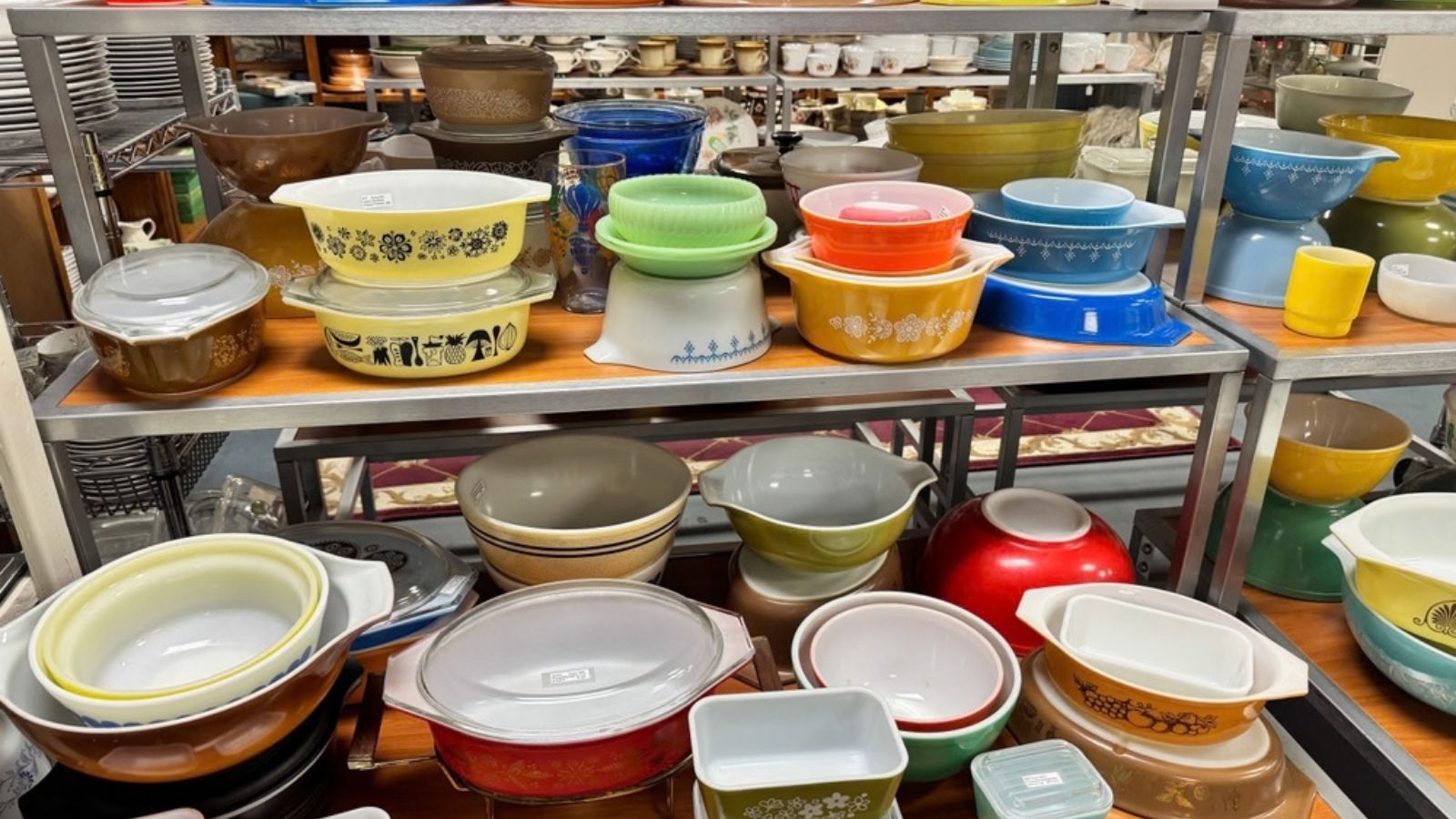
Spring Blossom Green is the avocado-green Pyrex pattern often called Crazy Daisy, and it’s one I’d always give a second look at a thrift store. Those cheerful little flowers are pure 1970s, but the bowls and casseroles themselves are useful, well-designed kitchenware. I’d much rather find a good one that can earn its keep than a supposedly rare piece I was afraid to touch.
I’ve collected and thrifted for years, and familiar patterns can be just as satisfying as unusual ones. Spring Blossom was made in several shapes and two quite different versions. Once you know what to look for, that green bowl tucked behind a stack of ordinary dishes becomes a little more interesting.
The green flowers were made for a coordinated kitchen

Spring Blossom Green was introduced in 1972 and designed by Sara Balbach. It was part of the Pyrex Compatibles range, created to coordinate with Corelle dinnerware. Avocado green was everywhere in the 1970s, from kitchen appliances to wallpaper, so a set of matching green-and-white dishes fitted right in.
What I like about Spring Blossom is that it looks cheerful rather than precious. The decoration wraps around sturdy mixing bowls, casseroles, and dishes intended for everyday cooking. It wasn’t a special-occasion pattern. People mixed cake batter in it, put food on the table in it, and washed it up afterward.
There was a surprising amount to choose from, too. The early range included covered butter dishes, creamers, sugar bowls, and salt and pepper shakers alongside the larger pieces. Even without a cabinet full of matching Pyrex, a single little butter dish can look lovely on the table.
The original 1972 design has bigger flowers
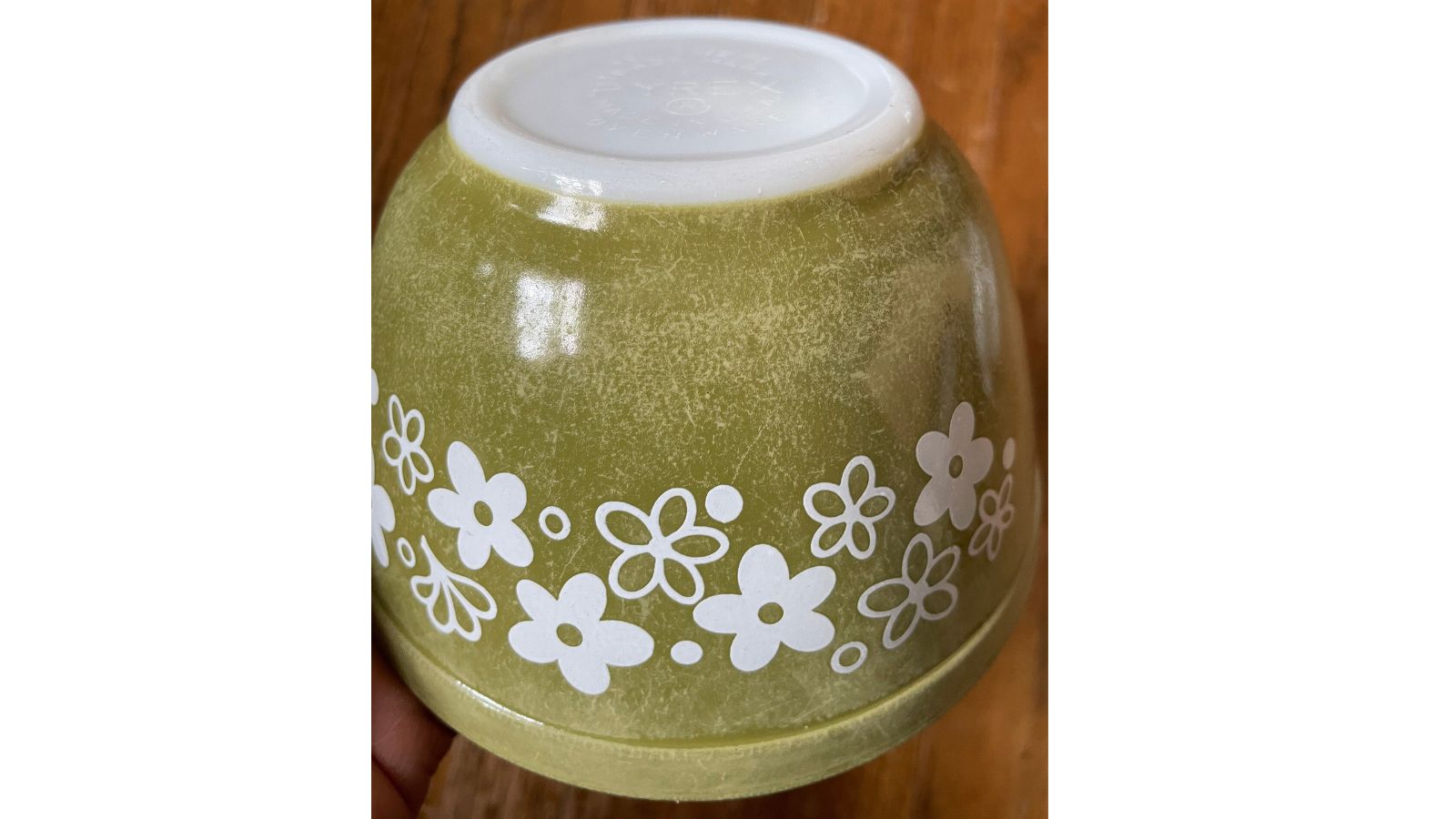
The first version ran from 1972 to 1979. Its flowers are fairly large and bold, with clusters of leaves and dots filling the gaps. You’ll see white flowers on an avocado-green background and green flowers on white glass. That’s intentional, not evidence that two unrelated bowls have been put together.
In the four-piece round mixing-bowl set, the smallest bowl, numbered 401, is green, as is the 403. The 402 and largest 404 are white with green decoration. Cinderella bowls, with their little pouring spouts and handles, have a different numbering sequence. I wouldn’t try to memorize every number, but it helps to know that the two colorways belong together.
The molded numbers on the underside tell you the size and shape, not the pattern. You still need to look at the decoration itself. That’s particularly useful when a thrift-store price sticker covers half the base, as they so often do.
The later version is lighter and a little busier
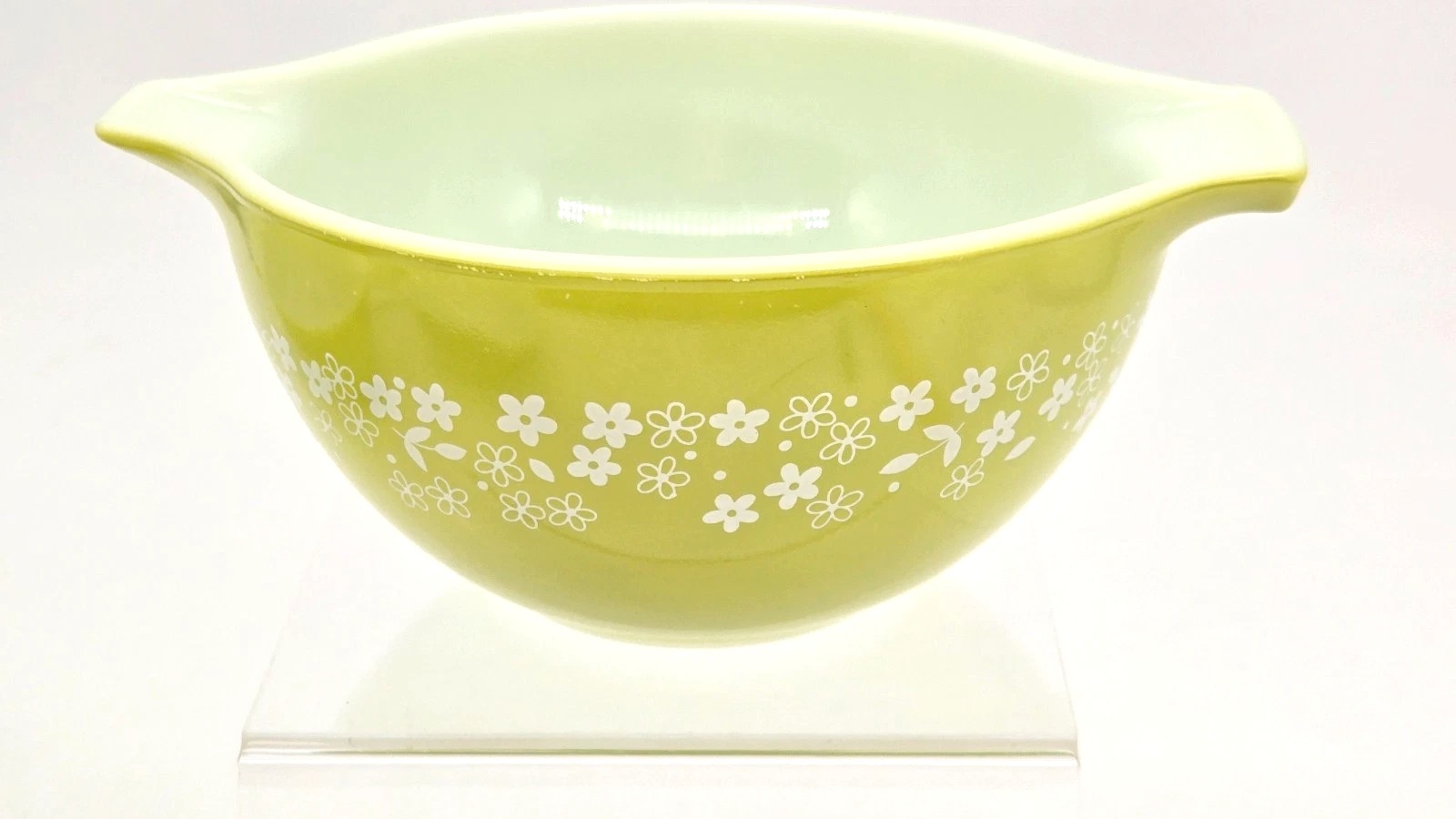
Spring Blossom was redesigned in 1979 and continued until 1981. The large flowers gave way to smaller blooms, scattered leaves, and little stems. Both background colors were green this time: the familiar dark avocado and a much brighter lime, with white decoration on each.
The lime bowls are an easy clue that you’re looking at the later version. So is the looser floral arrangement. The redesigned round mixing-bowl set had three bowls rather than four: 401 in avocado, 402 in lime, and 403 in avocado. It never had a matching 404. The later Cinderella bowls and round casseroles also mixed the two greens.
I like both versions, although they have different characters. There’s no rule that says you can’t put them together in your own kitchen. I just wouldn’t assume a mixed group was originally sold as a set.
The refrigerator dishes have a detail worth knowing
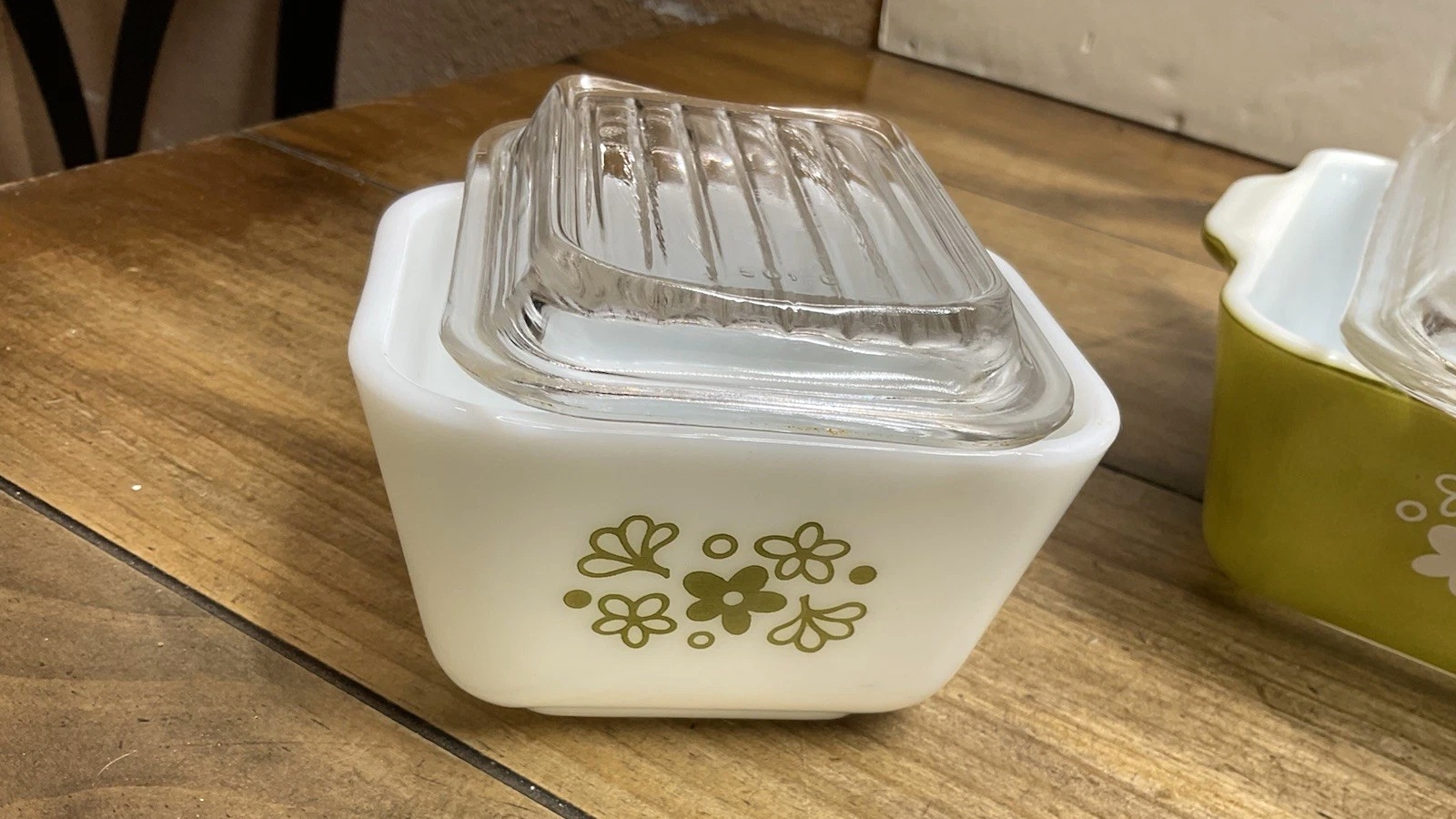
The little lidded refrigerator dishes are among my favorite vintage Pyrex shapes. They’re practical sizes for leftovers and much more appealing to look at than another plastic tub. Spring Blossom’s refrigerator set belongs to the earlier design, but even that changed slightly during production.
In 1977, the refrigerator decoration was made smaller and more symmetrical. There’s a wonderfully specific way to tell the versions apart: on the original dishes, count five dots on each decorated side, including both solid and outlined dots. Another total points to the revised refrigerator pattern. This change came before the full 1979 redesign, which had no refrigerator set at all.
It’s not something I’d expect everyone to notice while browsing, but it’s a useful detail if you enjoy knowing exactly what you’ve found. I’d be perfectly happy with either version, provided the dish and its lid were sound.
A glossy finish matters more than a perfect set
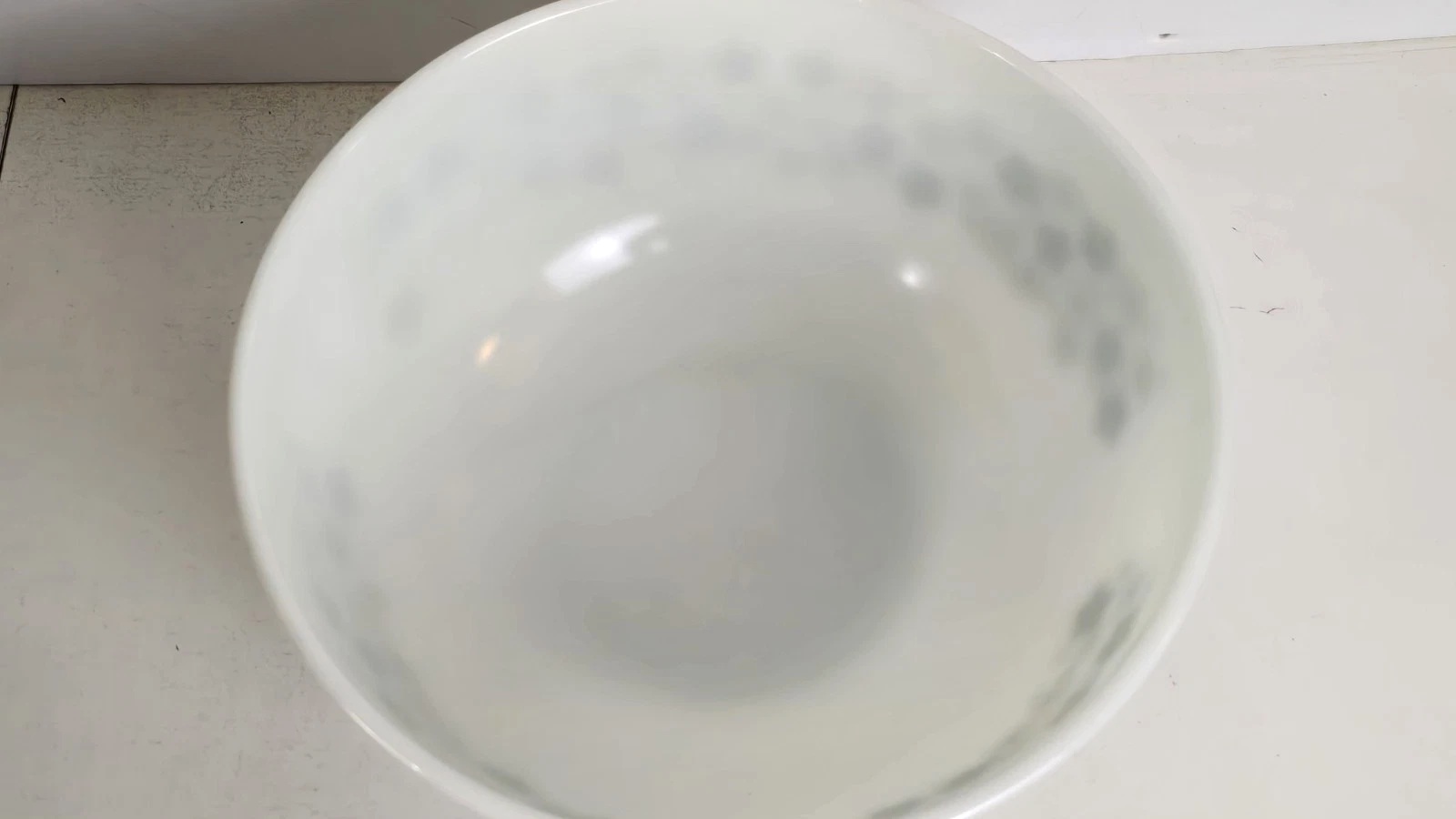
With colored Pyrex, I check the surface before anything else. Hold a bowl towards the light and look for a smooth, glossy finish. If the green looks cloudy, chalky, or faded, it may have permanent dishwasher damage. That isn’t the same as ordinary grime, and scrubbing harder won’t bring the color back.
Run your eyes carefully around the rim, foot ring, handles, and lid edges for chips. Check for cracks as well. A few utensil marks inside a mixing bowl wouldn’t put me off, but I wouldn’t use a damaged glass dish for cooking. An intact smaller bowl would appeal to me far more than a large, battered one.
If you take one home, hand-wash it with mild detergent and a soft cloth. Avoid the dishwasher and abrasive scourers, especially over the printed flowers. For an older piece you’re unsure about, mixing, cool serving, or display is a safer choice than oven use.
And don’t feel you have to hunt down every last matching piece. A good Spring Blossom bowl is useful on its own, and that’s part of the charm of collecting everyday vintage kitchenware. You get to enjoy it, rather than simply own it.
You might also like…
The CorningWare Pattern Collectors Dream Of Finding At A Thrift Store
The Blue-And-White Pyrex Pattern Collectors Dream Of Finding At A Thrift Store
The Pink Pyrex Pattern Collectors Dream of Finding at a Thrift Store

