
Affiliate disclosure: This post may contain affiliate links. Please see full disclosure.
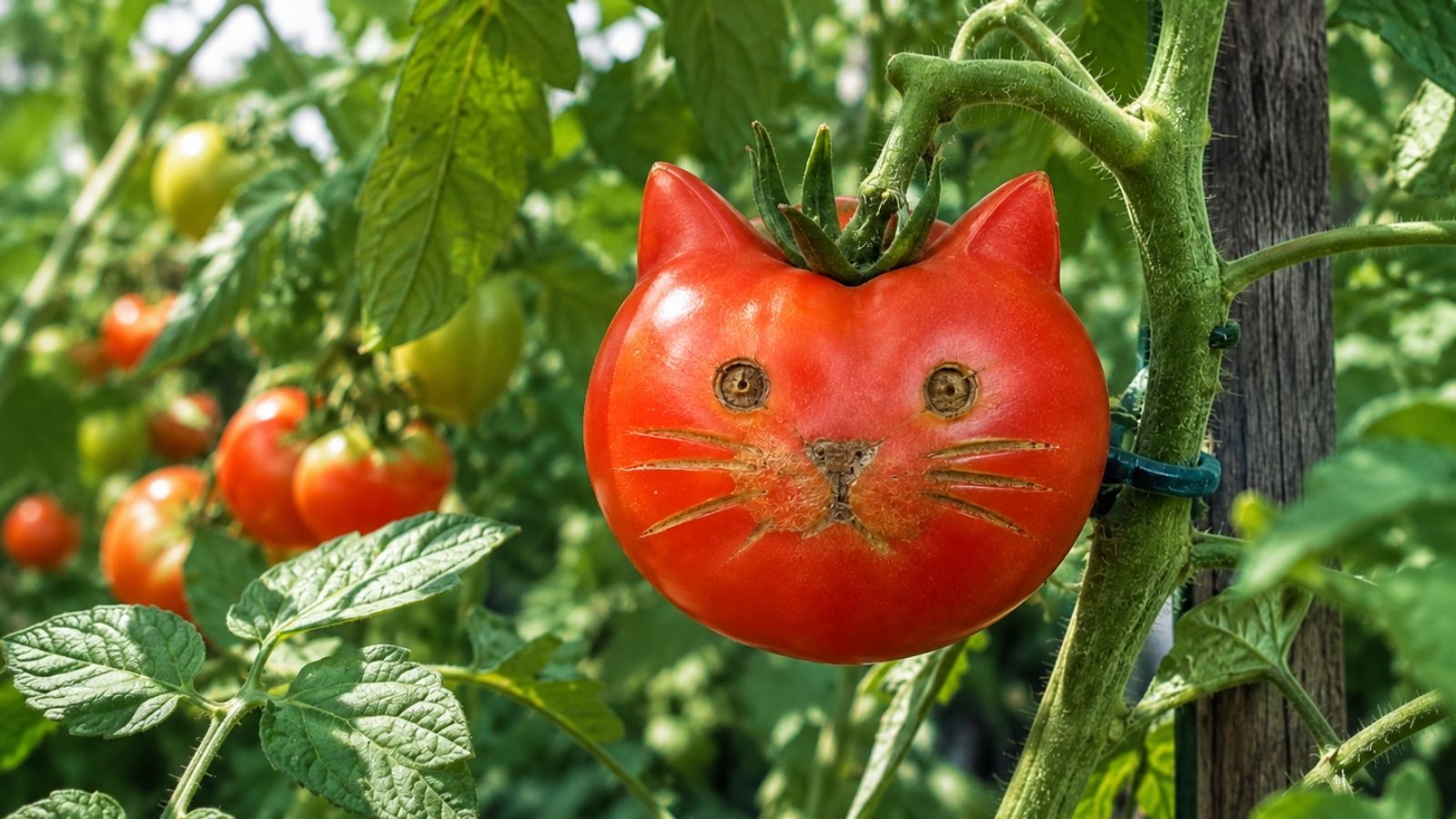
Sadly your tomatoes wont grow into cute little cat faces, but cat-facing is a real thing.
Cat-facing happens when a tomato flower gets damaged while it’s still forming, most often from a stretch of nights below 55°F (13°C), and the fruit grows around that damage instead of into a smooth, round shape. The scarring, puckering, and deep crevices at the blossom end are permanent once they set in, but the tomato underneath is almost always perfectly good to eat.
I get at least a handful of cat-faced tomatoes every June, usually on my earliest Brandywines. It’s a physiological response to stress during flowering, not a disease, and once you know what’s causing it, there’s a fair bit you can do to get fewer weird-looking fruit next year.
How to Recognize Cat-Facing on Your Tomatoes
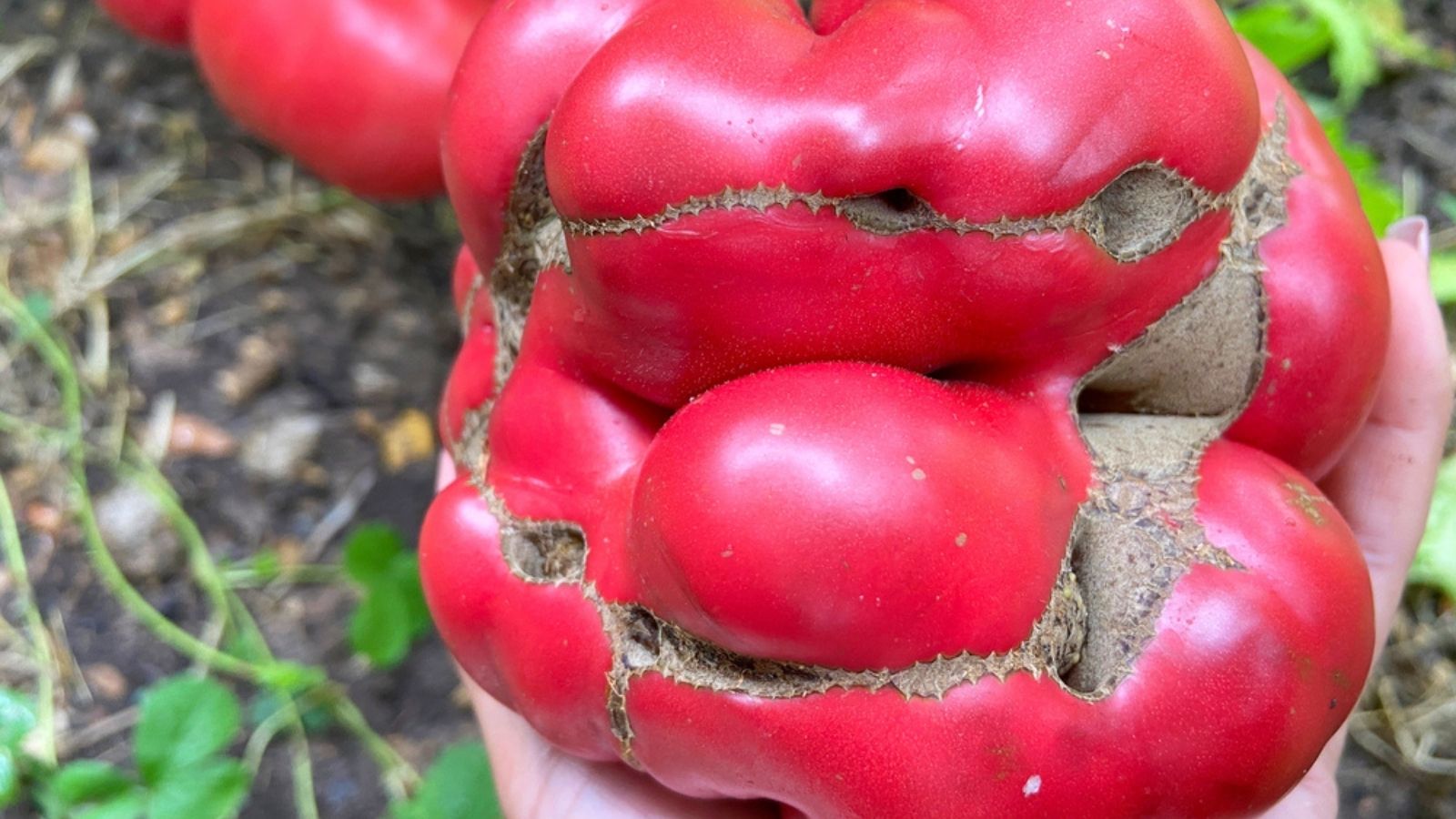
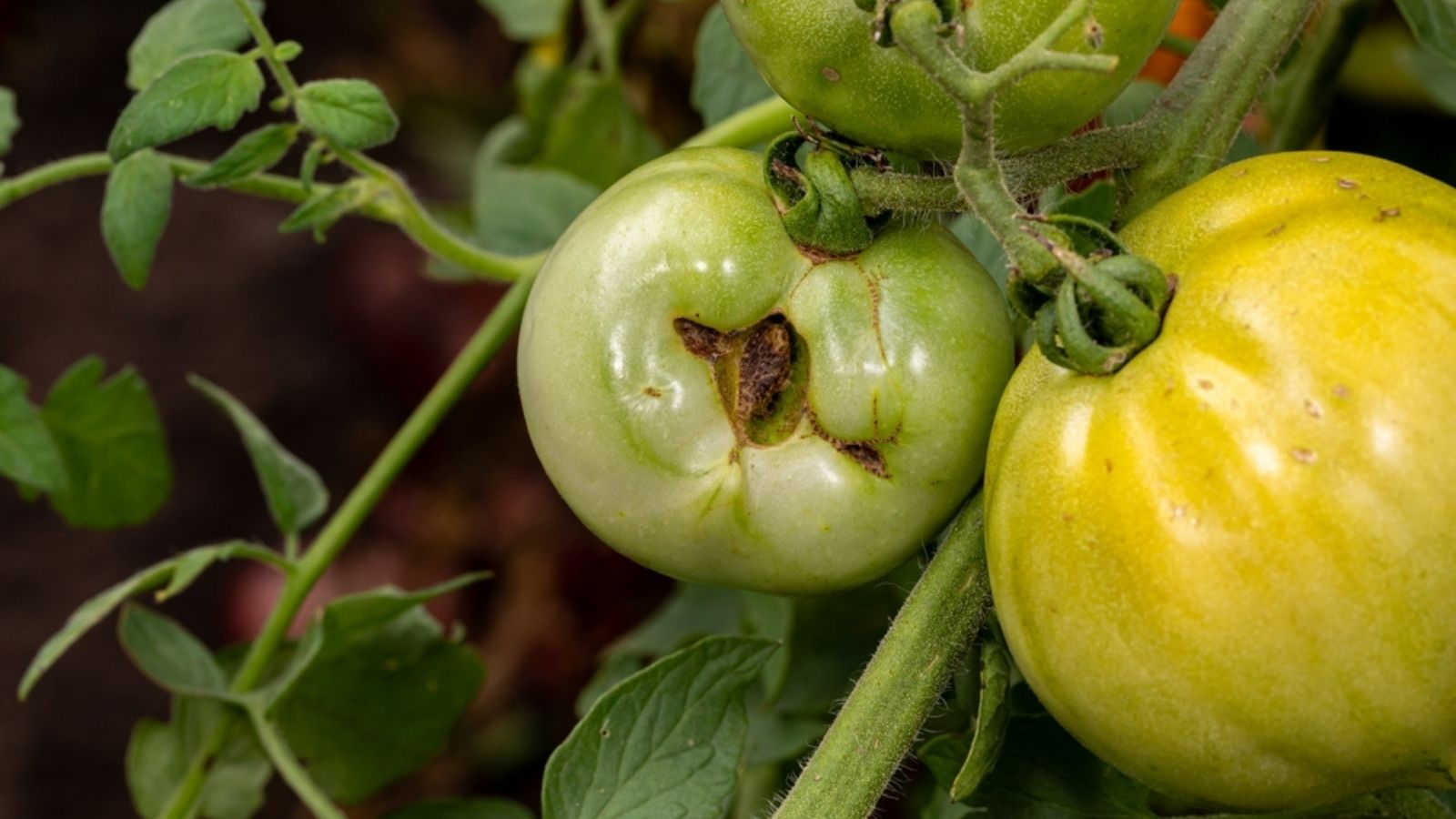
Cat-facing shows up as lobes, deep crevices, or cork-like brown scarring clustered at the blossom end of the fruit, the end opposite the stem. Cat-facing is a physiological disorder caused by damage to the tomato flower before the fruit forms, and it results in fruit that develops with irregular folds, cavities, or hardened scar tissue instead of a smooth surface. Sometimes it’s severe enough that the tomato looks like several fruits fused together. Other times it’s just a thin ring of brown scar tissue on an otherwise normal-looking tomato that you only spot when you turn it over.
Don’t confuse this with the natural deep ribbing you see on some heirloom varieties like Brandywine or Cherokee Purple. Ribbing is a consistent, symmetrical shape the variety is bred to have. Cat-facing is asymmetrical, scarred, and different on every fruit it touches, even on the same truss.
How Cat-Facing Differs From Blossom End Rot, Cracking, and Megablooms
Cat-facing is not the same problem as blossom end rot, tomato cracking, or a megabloom, even though all three show up around the same part of the fruit and get lumped together by frustrated gardeners. Here’s how to tell them apart.
Blossom end rot causes a flat, sunken, black or brown patch at the blossom end, and it comes from a calcium delivery problem usually tied to inconsistent watering rather than temperature. Cracking or splitting shows up as radial or concentric splits in the skin, usually after a heavy rain following a dry spell, and it’s a hydration issue, not a flowering issue. A megabloom is a different animal again. A megabloom, or fasciation, is a fused flower bud that develops multiple growing points instead of one, and when it grows into fruit you get a tomato that looks like two or three tomatoes mashed together, with a vertical fusion line rather than the puckered scarring typical of cat-facing. Megablooms often produce the most extreme cat-facing symptoms, since the fruit is trying to grow around more than one damaged point at once.
If your tomato has a flat black spot on the bottom, it’s blossom end rot. If it has splits radiating out from the top, it’s cracking. If it’s puckered, scarred, and lumpy at the blossom end, that’s cat-facing.
RELATED POST: Why Eggshells Won’t Fix Blossom End Rot on Tomatoes
The Causes of Cat-Facing
Cat-facing starts with damage to the flower, not the fruit, so by the time you see the deformity, the cause is already three or four weeks in the past. None of the causes below are diseases and none of them will spread from plant to plant, so you’re not dealing with anything you need to treat like an infection.
Cold Nights During Flower Development
Cold nights are the single biggest cause of cat-facing, and the threshold most often cited is nighttime temperatures dropping below 52 to 54°F (11 to 12°C) while the flower buds are forming. Daytime temperatures don’t matter here. You can have a warm, sunny 80°F (27°C) afternoon and still get cat-faced fruit if the previous few nights dipped into the low 50s. This is why the very first cluster of fruit on a plant is usually the worst affected. Those flowers formed while it was still early spring and nights were still unreliable, and by the time your second and third clusters set fruit, the nights have warmed up and the deformities mostly disappear on their own.
Temperature Swings Between Day and Night
A big daily swing between hot days and cool nights stresses the developing flower even when the nighttime low isn’t dangerously cold on its own. I see this most in early summer, when we’ll get an 85°F (29°C) afternoon followed by a 50°F (10°C) night. That kind of whiplash seems to be almost as disruptive to flower development as sustained cold.
RELATED POST: How Cold is Too Cold for Tomato Plants?
Nitrogen-Heavy Soil
Too much nitrogen is suspected of pushing a tomato plant toward lush leafy growth at the expense of stable flower development, and gardeners who load up on high-nitrogen amendments early in the season often report more cat-facing, though the exact mechanism isn’t well understood. Test your soil before adding anything. If you do need to boost nitrogen, feed with compost or well-rotted manure rather than a concentrated source, and once the plant sets its first flowers, switch to something that supports blooming instead, like a diluted comfrey tea or a light dusting of wood ash for the potassium.
Heavy Pruning
Removing too much foliage at once is thought to disrupt the plant’s supply of auxins, the natural growth hormones that regulate healthy cell division at the growing tip. Auxins are plant hormones that direct growth and cell division, and a sudden drop in supply from aggressive pruning may be enough to disrupt a forming flower. I take no more than a quarter of the plant at a time on indeterminate varieties, and I never prune the week before or during a heavy bloom flush.
Thrips Damage
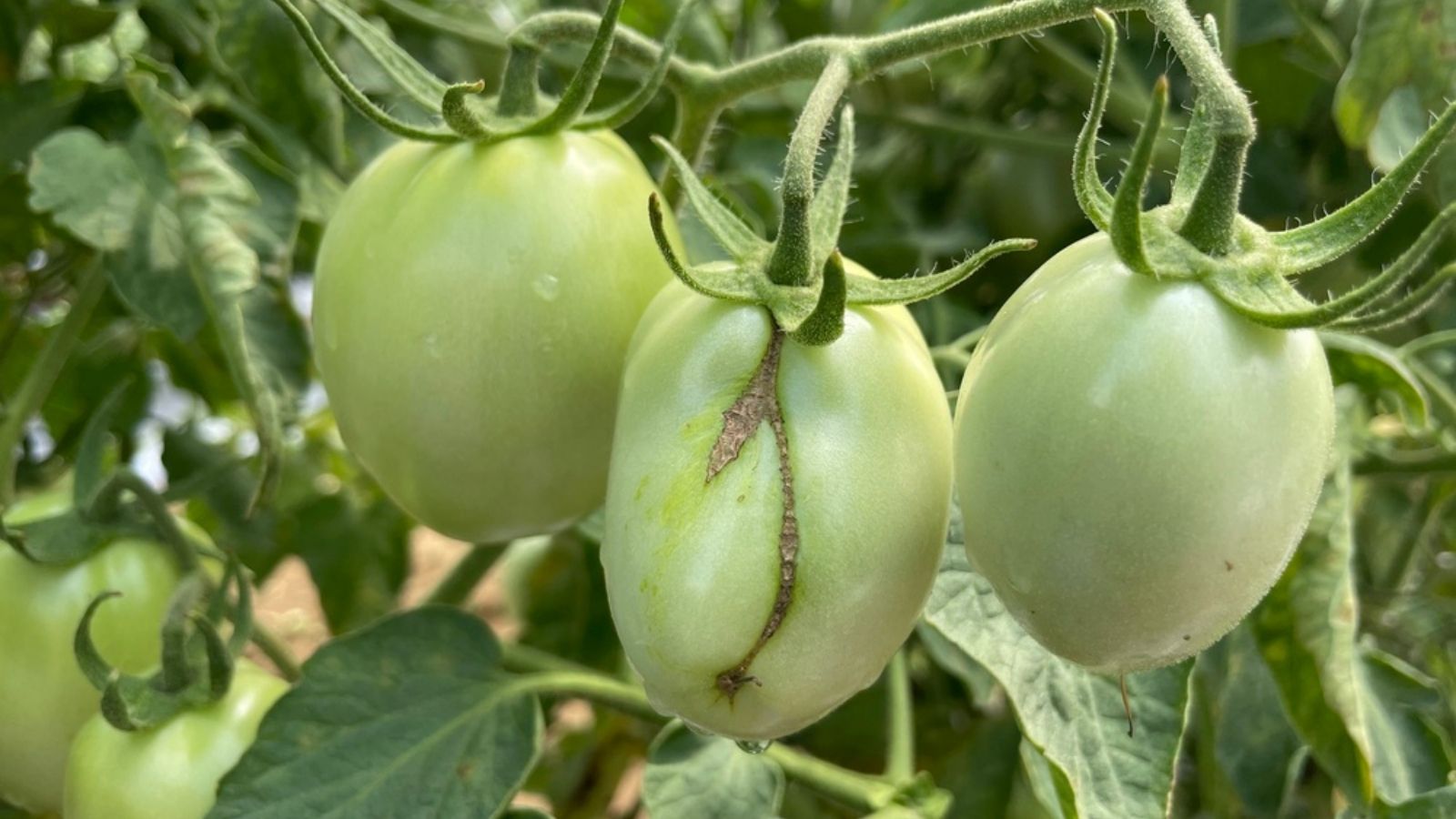
Thrips feed directly on the pistil of a developing flower, and the damage they cause while the flower is still closed can trigger the same kind of malformed growth as cold stress. Thrips are minute, fringe-winged insects that rasp and feed on plant tissue, and they’re small enough that you’ll usually need a hand lens or a shake test over white paper to spot them. Plant companion flowers like alyssum, yarrow, and dill nearby to draw in the lacewings and minute pirate bugs that prey on thrips, and if you catch an infestation early, a targeted spray of insecticidal soap or neem oil in the evening will knock them back without hurting the bees working your blossoms during the day.
Herbicide Drift
Exposure to hormone-mimicking herbicides, particularly the phenoxy-type weed killers used on lawns, can cause the same kind of flower damage that leads to cat-facing, even at very low concentrations carried in on the wind. This is worth flagging if you’re growing organically, because you don’t have to spray anything yourself to be affected. If a neighbor treats their lawn on a breezy day, drift can settle on your tomato blossoms from several yards away. If you know spraying is happening nearby, cover your plants with row fabric for the day, or at minimum hose down the foliage that evening to rinse off any residue.
Heirloom and Large-Fruited Varieties
Big, old-style heirlooms like Brandywine, Mortgage Lifter, and Cherokee Purple are far more prone to cat-facing than modern hybrids or small-fruited types, because their flowers are larger and more easily damaged in the first place. If cat-facing drives you up the wall every year, growing a few cherry, grape, or plum varieties alongside your heirlooms will give you a reliable, unblemished harvest while your heirlooms do their thing.
Cat-Faced Tomatoes Are Still Safe to Eat
Yes, cat-faced tomatoes are safe to eat, and the deformity has no effect on flavor. I’ve had some of the ugliest, most lumpy Cherokee Purples of the season turn out to be the best-tasting tomato on the vine. The only time I’d hold back is if the puckering has split the skin badly enough to leave an open wound. That break invites mold and bacteria, so check for a soft spot, a fuzzy patch, or discoloration around any crack before you cut in. If it’s just cracked and crusted over but still firm, trim away the damaged bit and eat the rest. If it’s soft or moldy, compost it.
How to Prevent Cat-Facing Next Season
You can’t eliminate cat-facing completely, since some of it comes down to weather you can’t control, but these steps will noticeably cut down on how much you see.
- Hold off on transplanting. Wait until nighttime temperatures are reliably staying above 55°F (13°C) before you put tomato seedlings in the ground, even if that means waiting a week or two past your last frost date.
- Choose smaller-fruited varieties for your earliest planting. Cherry, grape, and plum types are far less prone to cat-facing than large heirlooms, so plant a few of these first if you want an early, unblemished harvest.
- Test your soil before feeding. Only add nitrogen if a soil test shows you actually need it, and lean on compost or aged manure rather than a concentrated source.
- Prune lightly. Take no more than a quarter of the plant at a time, and avoid heavy pruning right before or during a bloom flush.
- Watch for thrips early. Shake a few blossoms over white paper every week or two during flowering, and plant alyssum, yarrow, or dill nearby to bring in their natural predators.
- Protect blooms from herbicide drift. Keep an eye on when neighbors treat their lawns, and cover your plants with row fabric or rinse the foliage if you suspect exposure.
FAQs About Cat-Facing
Will cat-facing keep happening as the season goes on?
No, cat-facing usually clears up once nighttime temperatures settle into a consistently warm range. It’s most common on the first one or two flower clusters of the season, when nights are still cool, and later fruit typically grows smooth and uniform once summer heat is established. If cool nights return in early fall, you may see it resurface on your last few clusters.
Should I remove cat-faced tomatoes from the vine?
You don’t need to remove cat-faced tomatoes unless they’ve split open badly, since they’ll still ripen and taste fine. If a fruit has a large open wound, pull it off and compost it, because a damaged tomato left on the vine is more likely to develop rot that can spread moisture and mold to fruit touching it nearby.
Can container-grown tomatoes get cat-faced too?
Yes, container-grown tomatoes can develop cat-facing, and they may actually be more prone to it because pots heat up and cool down faster than garden soil, exaggerating the day-to-night temperature swings that trigger the problem. Move containers somewhere sheltered on nights when temperatures are forecast to dip, or wrap the pot with burlap or straw to buffer the root zone.
Does cat-facing spread to other tomatoes on the plant?
No, cat-facing is a physiological response to a specific flower being stressed or damaged, not a disease, so it can’t spread from one fruit or plant to another. Each cat-faced tomato is the result of something that happened to that individual flower weeks earlier, and a plant that produces cat-faced fruit early in the season will usually produce completely normal fruit later on.
Can I save seeds from a cat-faced tomato?
Yes, seeds from a cat-faced tomato are perfectly viable, since the deformity is a response to environmental stress rather than a genetic defect in that individual fruit. The seeds will grow true to the variety, though if you’re growing a variety that’s naturally prone to cat-facing, like a large heirloom, expect the same tendency to show up again regardless of which fruit you saved seed from.
Cat-facing looks alarming the first time you find it, but it’s one of the more forgiving problems you’ll run into with tomatoes. Cool nights during flowering are almost always the culprit, the fruit is still good to eat, and a few adjustments to timing, feeding, and pruning will get you a cleaner-looking harvest as the season warms up.
You might also like…
One Caterpillar Can Strip Your Tomato Plant Bare Overnight