Affiliate disclosure: This post may contain affiliate links. Please see full disclosure.

Disclosure: This post contains affiliate links. Click here to read my affiliate policy.
Making a dust bath for chickens is easy, and it’s essential to the health and happiness of your flock. All you need are a few ingredients, most of which you probably already have, and what you don’t have to hand, you can pick up for just a few bucks. There isn’t an exact single recipe for your chicken’s dust bath, but my recipe goes beyond meeting their basic instincts – it aids in cleaning, helps get rid of parasites, and deters further pest problems.
Why Do Chickens Dust Bathe?
Chickens dust bathe because it’s good for them. Rolling and flapping in the dirt bath helps to shed dead skin and loose feathers, and it stimulates the skin, too, easing itching and encouraging healthy skin. It also helps to remove sheaths from emerging feathers. And, of course, it soaks up the excess oil in the feathers and on the skin, preventing your flock’s feathers getting matted and greasy.

There’s another key reason chickens bathe, aside from just freshening up: Dust bathing suffocates parasites like chicken lice and chicken mites. It’s a natural form of parasite control. Left unchecked, chicken parasites can cause serious harm and, in severe cases, death to your chickens. Dust baths can help you keep on top of any potential parasite incursion before it becomes a significant problem.
But if you do suspect lice of mites, check out how to identify chicken mites and how to identify chicken lice.
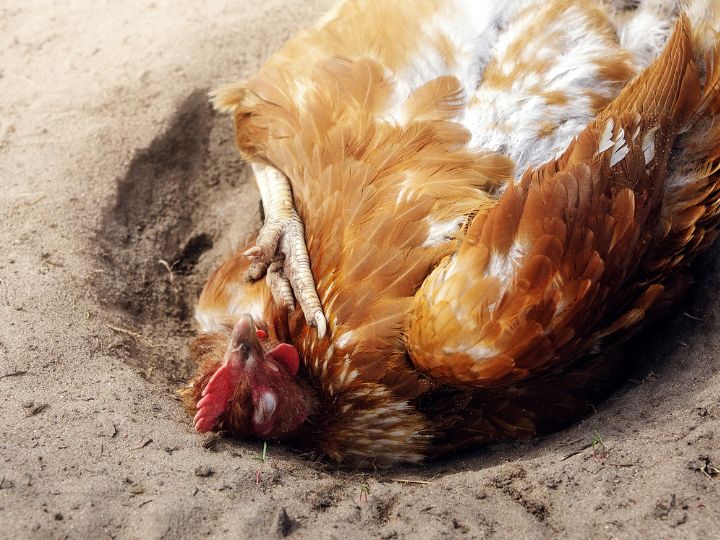
Remember, a dust bathing chicken is a happy, healthy, active chicken. Who will probably need a good nap when they’re done!
Chicken Dust Bath Ingredients
You don’t need many ingredients for your chicken’s dust bath. Backyard chicken keepers can fulfil their chicken’s need to bathe with the following ingredients:
- Topsoil (soft and well-draining is best)
- Fine sand (kids’ play sand is perfect)
- Food grade diatomaceous earth (we use this one)
- Wood ash (make sure it’s only wood ash and not a mix of random potentially toxic stuff)
- Dried herbs
These few free and cheap ingredients give your chickens the perfect dust bathing area, helping them stay clean, free of parasites, and unmolested by pests like mosquitoes.
How Big Should a Chicken Dust Bath Be?
How big a chicken dust bath should be depends on the size of your chickens and how many you’ve got. For standard chickens, make sure the bath is at least 8 inches deep and, for bantams, at least 6 inches. If you see your girls digging their own dust bath, you’ll notice that they actually dig pretty deep, so it won’t hurt if you go well over 8 inches. At a depth of 8 inches or more, a standard chicken can really get in there and cover themselves in dirt.
As for the length and width, that depends. If you spend any length of time watching chickens, you’ll see that if one decides to go for a dirt bath, many, if not all, of the others will quickly follow suit. Dust bathing is a group activity. Their instincts tell them to take a dust bath together, which, aside from being a social activity, provides a way of controlling parasites amongst themselves.
So, make sure most of your flock can get in the dust bath at the same time. If you’ve got a large flock and enough space, you can always create more than one chicken dirt bath. Your chickens really won’t mind.
How to Make a DIY Chicken Dust Bath
So, let’s get to it. Here’s how to make a chicken dust bath and be a responsible but frugal chicken keeper, with a flock of happy cluckers. Whether your chickens free range across several acres or are a smaller flock of backyard chickens, making them a dust bath area improves their health, happiness, and quality of life. And it only takes a few minutes.

Choose the Right Chicken Dust Bath Container
You can use pretty much anything for a dirt bath. Remember, if you don’t make them a dust bath, your chickens will happily dig their own right in the dirt. After all, a dust bath is the chicken equivalent of a good, exfoliating loofah and body wash in the shower.
I’ve built my girls a couple of semi-permanent dirt baths, using some untreated timber to make 1-foot deep rectangles on cleared earth, to which I add my chicken dust ingredients. For inside the chicken coop itself, I’ve got another dust bath that’s just an old kiddie’s hard plastic clamshell paddling pool or ball pit. Not that it ever belonged to a kid – in its previous life, it was a paddling pool for my dogs in the hot weather until we upgraded.
What you use for the dust bathing area depends on the size of your flock and how much space you have. You can use half barrels cut length-wise, you can use sandpits or pall pools, big flat plastic totes – basically anything your chickens can climb into and throw themselves around in without hurting themselves.
Keep It Dry
Your dust bath needs to remain dry, as the chooks won’t use it if it’s wet, muddy, and gloopy. You have a few different options for this. You can fairly easily rig up a cover for outdoor bathing areas – just a tarp suspended on poles will do the trick. If you want something a little fancier, a retractable awning, a garden umbrella, or a kid’s sand pit shade will work, too.
And, if you have a greenhouse, keep your chickens happy by using the green house as a giant dust bath over winter. Not only do chickens love dust bathing, but they’re great for clearing earth and aerating it. Every chicken loves to forage and, while using your greenhouse as a big, warm dust bath, they’ll also clear the area of weeds and pesky insects.
Add Soil
The first thing you want to add to the container is a good quality topsoil. Don’t worry overly about whether there are weed seeds in the mix, as your hens will gobble them up. Go for soft, loamy soil rather than heavy clay soil. Your hens need loose soil to spread over themselves, so compact or heavy clay won’t do the trick.
About 30 percent of the bath should be filled with loose dirt.
Add Sand
Sand boosts the soil base of your dust bath. Not only does sand help to keep the dry dirt loose, it also acts as an irritant for your chickens’ skin. The drier and sharper the sand, the better for this. So, builder’s sharp sand is ideal. Plus, it’s cheaper than play sand, as a rule.
Add about 30 % sand to the bath.
Add Wood Ash
Wood ash makes up the final third of the base for your chicken dust bath. Make sure you only burn clean, untreated wood to use as ash for your hens. Don’t use ash from wood you don’t know the provenance of, and don’t use wood pellets, as all sorts get ground up on those mixes, including adhesives, chemicals and more. Never use ash from pressure treated, stained, or sealed wood, as you don’t want to risk making your chickens ill.
Add roughly 30 percent of wood ash to the sand and soil, and that finishes off your base.
Mix in Diatomaceous Earth
Now you have your chicken bath base, it’s time to turbo-charge it! Food grade diatomaceous earth is pretty potent and, for chickens, it helps to smother any pests or parasites they’ve picked up, including ticks.
Now, it’s true that DE is a respiratory irritant, so make sure you’re wearing a mask when adding it to the dust bath. And only sprinkle a little extra layer over the top of your bathing area. A little goes a long way.
Add Herbs to Deter Pests
Next up when you make a dust bath is adding dried (or fresh) herbs to the mix. Herbs provide a little extra nutrition, but in this context, we’re more interested in their ability to deter insects, mites, lice, ticks, and other parasites.
I grow a ridiculous amount of herbs as I use them for herbal remedies as well as in the kitchen, so I’ve always got plenty of fresh and dried herbs at my fingertips. My favorite for adding to dust baths include:
- Lavender
- Rosemary
- Thyme
- Sage
- Bee balm
- Basil
- Lemon balm
- Valerian
- Oregano
Fresh or dried, just sprinkle a generous layer over top of the dust bath to add a little herbal power to help maintain chicken health.
FAQs
No, I wouldn’t use coal ash. Coal ash often contains heavy metals like mercury and other toxic substances, such as sulphur. In fact, I’d go so far as to say don’t use any ash that you don’t know the source of. Only use ash from untreated wood.
No. Using straw is a bad idea. Because it’s hollow, it provides the perfect place for parasites and insects to lurk. Then, when an unsuspecting chicken has its bath, the lurking parasite can infect the birds.
No. Using cat littler is a terrible plan. Cat litter is dry, yes, but it has large particles and often contains many additives and artificial fragrances. Plus, if its the clumping kind and your chicken gets wet after a bath, the cat littler will clump and cake to the feathers, where it dries rock hard and is incredibly difficult to remove.