
Affiliate disclosure: This post may contain affiliate links. Please see full disclosure.
The 1974 Pyrex Pueblo casserole has an extra piece I’d be delighted to find in a thrift store: a black plastic cradle that hugs the bottom of the dish. It’s not a candle warmer or a modern add-on. The original gift set came with a charcoal-gray 2½-quart casserole, a white lid covered in orange-and-black geometric decoration, and that unusual black holder. All three belong together.
I’m an avid thrifter and vintage collector, and it’s these little details that make old kitchenware interesting to me. A gray casserole on its own might not earn a second glance. Put the patterned lid and molded cradle back with it, and you’ve got a wonderfully specific bit of 1970s design.
The eye-catching pattern is on the lid, not the dish
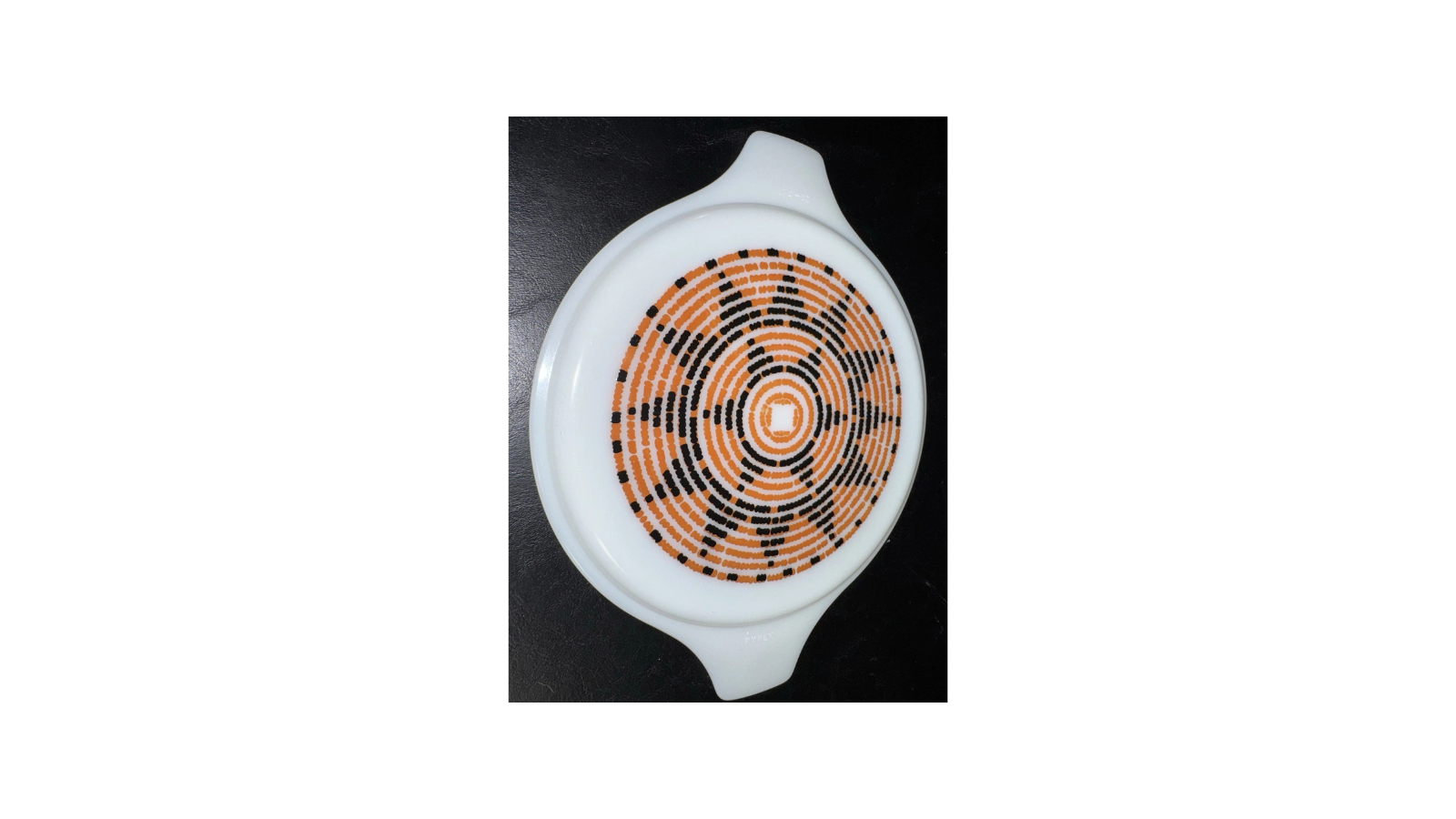
Corning introduced Pueblo in 1974 as a promotional Pyrex set. The bowl has a solid, deep-gray exterior and white opal-glass interior. The white lid is where the decoration lives: tight concentric rings of orange and black marks, forming a star-like pattern resembling the weave of a basket.
Look straight down and you’ll see broken lines circling outward from the center. I like the contrast between the serious gray casserole and that almost hypnotic lid. It’s also a handy identification clue, because the rest of the dish is completely plain.
The 1974 catalog picture and original packaging call it Pueblo, not Old Pueblo. You may also encounter Aztec or Basketweave as descriptive names, but I’d rely on the colors, pattern, and shape rather than the name on a thrift-store tag.
The black holder is a hugger cradle, not a warmer
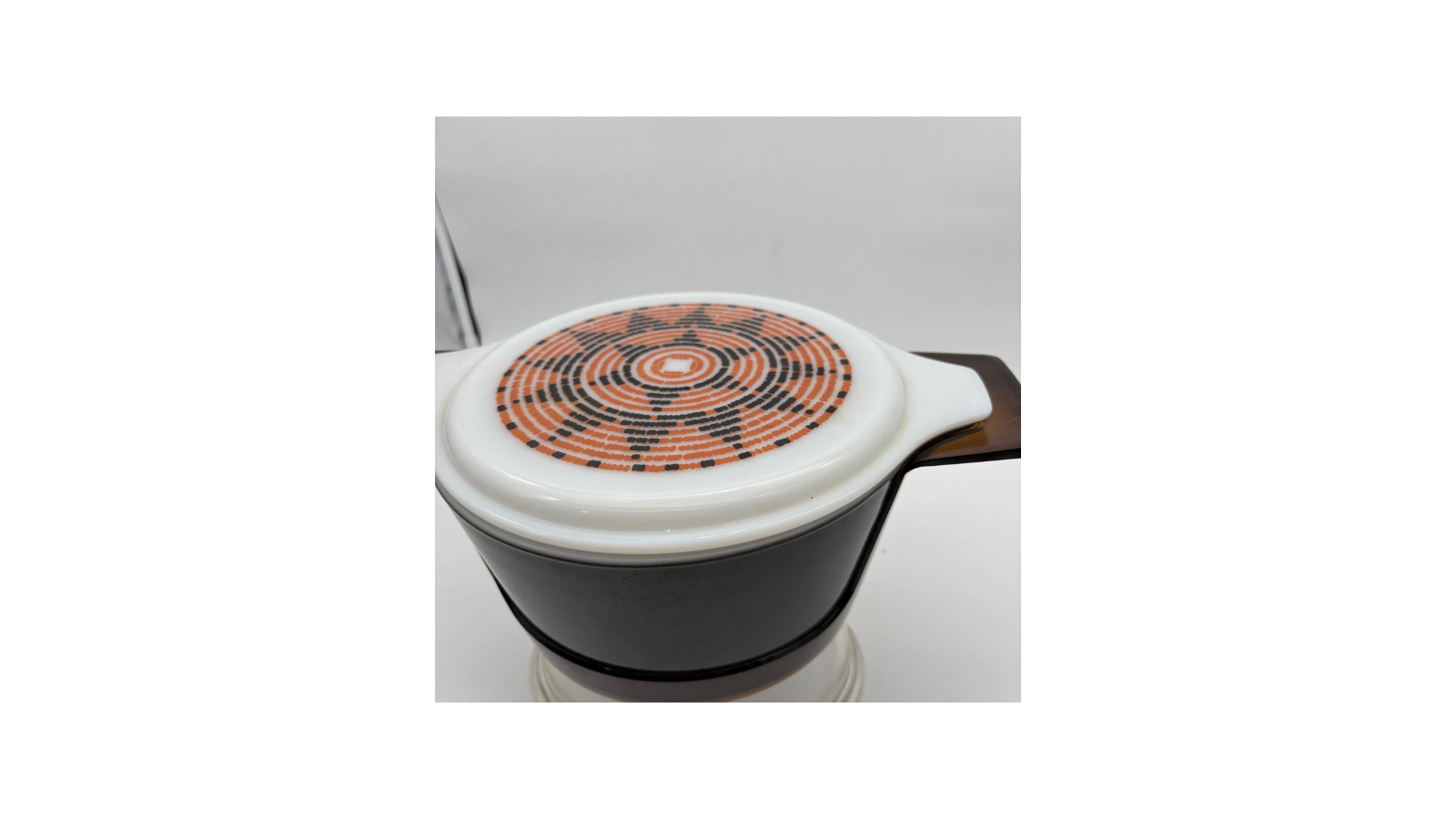
The black cradle fits closely around the casserole’s lower half, leaving the glass handles accessible. It’s molded plastic, not the brass-colored wire used for many earlier Pyrex serving sets. It supports the casserole, but there’s no candle cup underneath and nowhere to put a flame.
This was part of a broader shift at Corning. Earlier promotional casseroles often came with metal cradles and candle warmers, sometimes with wooden handles. In the early 1970s, Pyrex promotions increasingly featured plastic huggers, trivets, and underplates instead. Pueblo was one of the early examples of the newer arrangement, although not the first.
Please don’t add a tea light or try to turn the plastic hugger into a warming stand. It wasn’t designed for that. What interests me is the change in thinking: an elaborate table warmer gave way to a simpler holder that still made an everyday casserole feel like a gift.
Look for three original pieces, not just matching glass
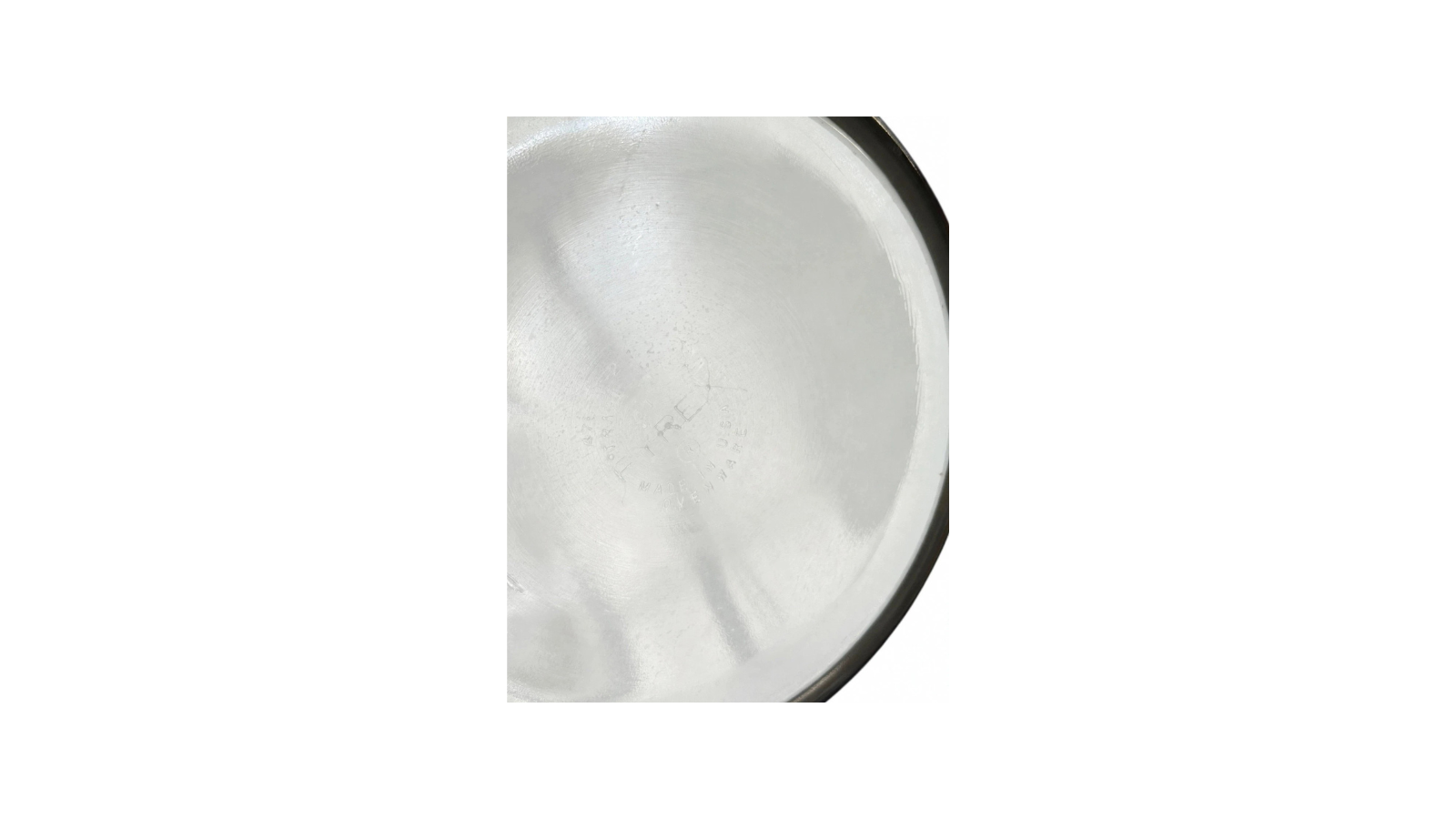
The dish is a 2½-quart round Cinderella casserole, model #475. Turn it over and look for the molded Pyrex marking and model number, sometimes followed by -B. The same basic shape appeared in other colors and patterns, so finding #475 doesn’t by itself identify Pueblo.
The decorated white opal-glass lid matters just as much. On this casserole shape, opal lids may carry the marking 25C. Check the marks if present, but don’t expect the name Pueblo to be molded into the glass. The concentric orange-and-black decoration is what makes the lid recognizable.
The complete original set contains the gray casserole, its patterned white lid, and the black plastic hugger. The original box was numbered 9573, but that’s a packaging number, not something to hunt for on the underside of the dish. I’d be very happy finding all three pieces loose, without a box.
There’s another trap for collectors. Several Pyrex shapes fit accessories from different promotions, and a lid from another set can fit a #475. A good fit matters, but you should still compare the colors and cradle with the documented original arrangement. A random black stand isn’t automatically Pueblo’s missing third piece.
Check the decoration and plastic before buying
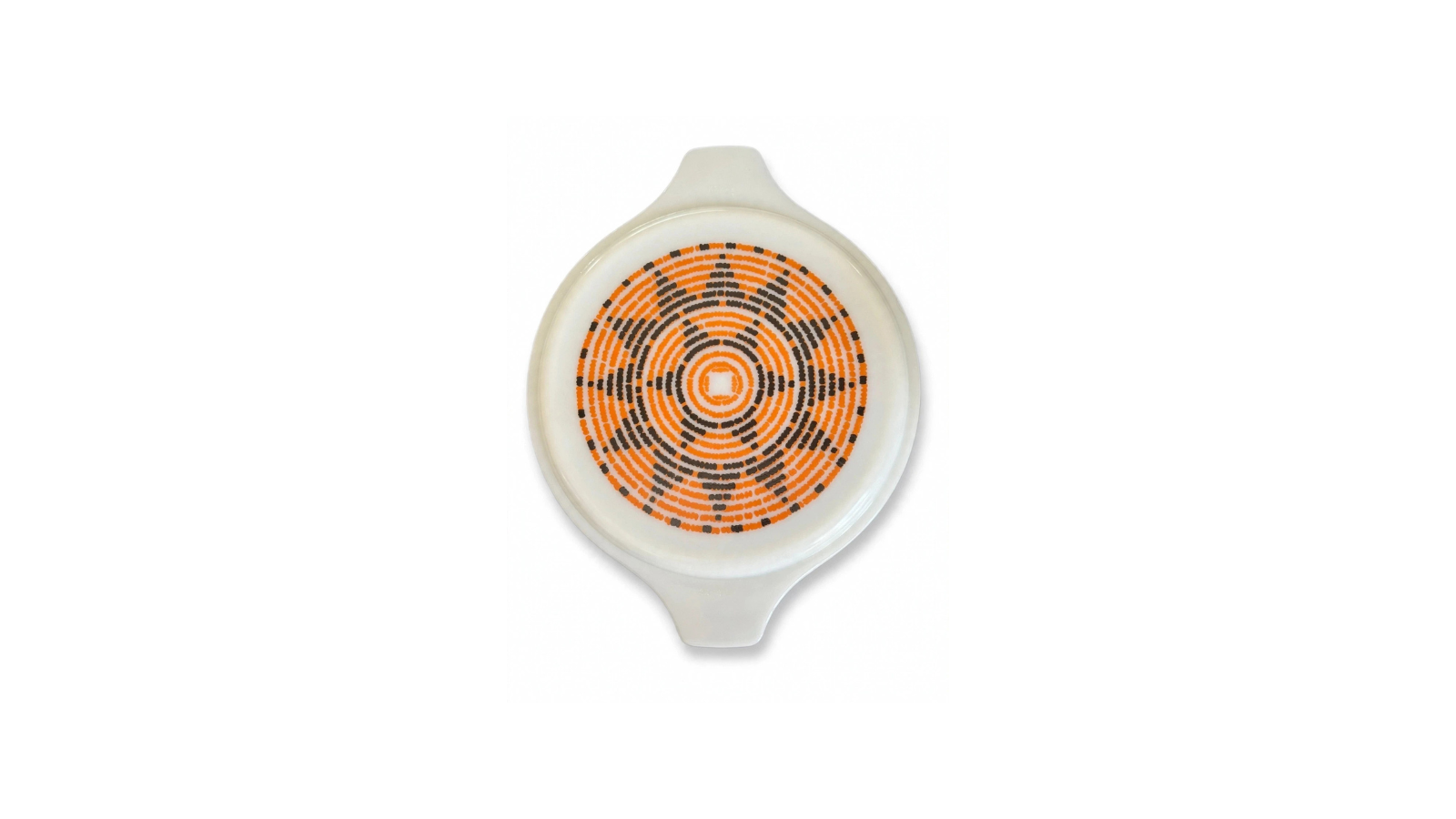
I’d inspect the white lid first. Angle it toward a strong light and look for worn orange lines, missing black marks, fine scratches, and chips around the edge. The decorative pattern should read clearly. A patchy, faded design is often wear, not an unusual variation worth celebrating.
Then inspect the charcoal finish and the glass itself. Look for dull patches, scraped paint, and chips around the rim and the handles. Check the underside for scratches and hold the dish toward the light to look for hairline cracks. A crack through the glass would put me off, particularly if anyone might be tempted to bake with it.
The cradle needs its own careful check. Watch for cracks at the molded corners, warped sides, and whitish lines where old plastic has been stressed. Try sitting the casserole in it gently if the store allows. I wouldn’t force a brittle cradle around heavy glass, or lift the casserole using an unfamiliar plastic holder.
If the cradle is missing, I wouldn’t automatically reject an otherwise beautiful Pueblo. I’d simply treat it as an incomplete set and keep an eye out for the correct holder. That seems a much better approach than pairing it with an unrelated vintage stand and hoping nobody notices.
Enjoy the original set without wearing it out
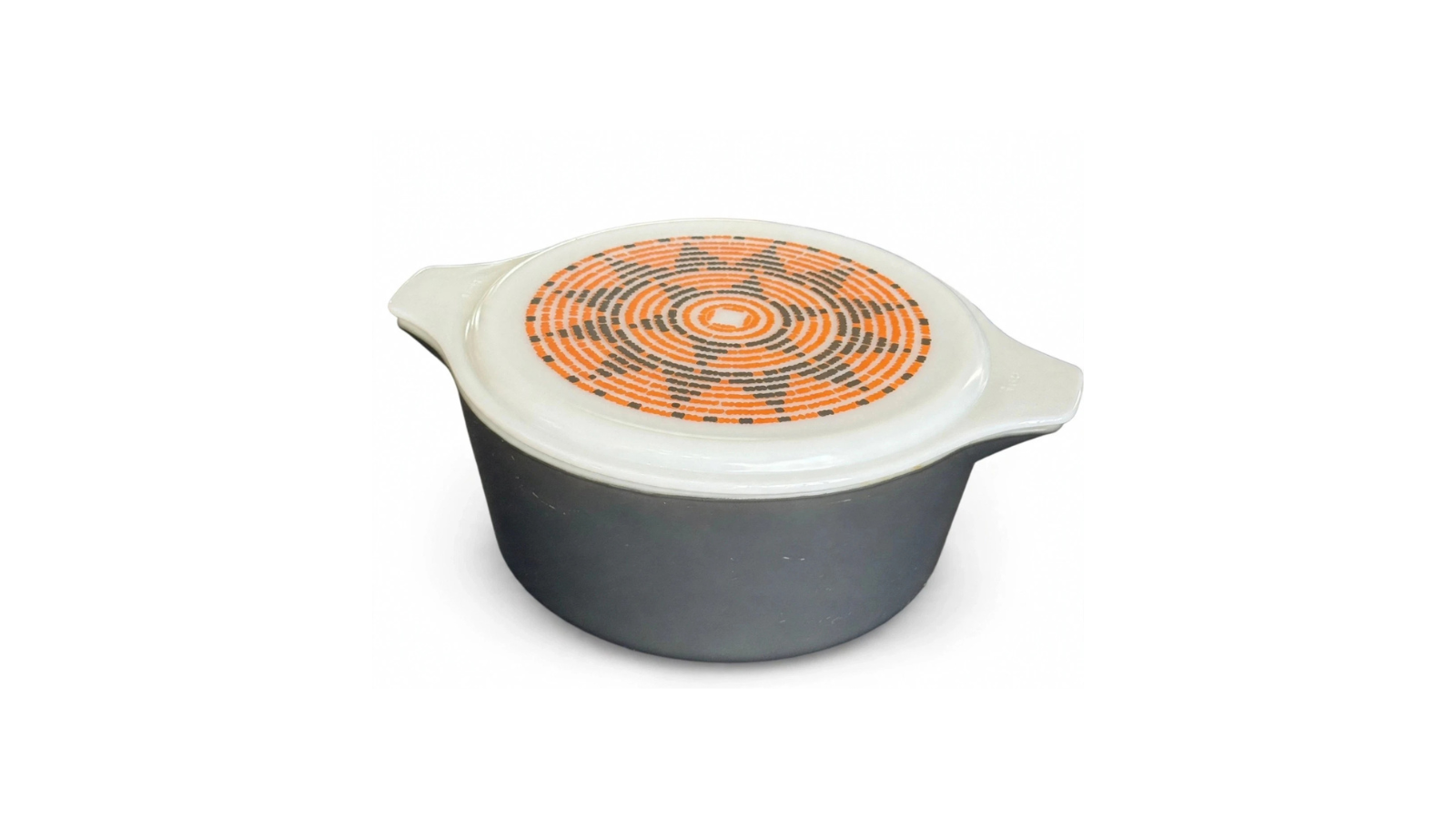
Vintage Pyrex is sturdy, but abrupt temperature changes and harsh cleaning can damage it. I’d hand-wash the glass with mild dish soap and a soft cloth, dry it carefully, and keep the hugger away from the oven, stovetop, and dishwasher. Don’t scrub that printed lid with abrasives just to shift a stubborn mark.
If I had any doubts about the condition of a fifty-year-old casserole, I’d display it rather than bake with it. The lid and cradle are too interesting to hide in separate cupboards anyway. With all three together, you can see exactly why Pueblo makes such a satisfying thrift-store find: an ordinary Pyrex casserole transformed by one extraordinary lid and a little black holder.
You might also like…
The CorningWare Pattern Collectors Dream Of Finding At A Thrift Store
The Blue-And-White Pyrex Pattern Collectors Dream Of Finding At A Thrift Store
The Pink Pyrex Pattern Collectors Dream of Finding at a Thrift Store

